AML Laws and Regulations for Pawnbrokers in Singapore
In a Nutshell
A pawnbroker in Singapore lends money against a pledge, which the pawner may redeem within the applicable redemption period or forfeit. Pawnbrokers are supervised by the Registrar of Pawnbrokers under the Ministry of Law. Their AML CFT CPF obligations are principally set out in Part 5 and the Third Schedule of the Pawnbrokers Act 2015.
The binding AML CFT CPF requirements are principally contained in Part 5 and the Third Schedule of the Pawnbrokers Act 2015. The Registrar of Pawnbrokers provides guidance to help licensed pawnbrokers apply these requirements, including the Information Guide 2020, red flag indicators and additional guidance issued in 2025. The statutory framework covers risk assessment and controls, customer due diligence, enhanced measures, targeted financial sanctions, record keeping, suspicious transaction reporting and cash transaction reporting.
Singapore’s 2024 Money Laundering National Risk Assessment assesses pawnbroking as being in the lower money laundering risk band. It identifies a moderate money laundering threat and identifies the key threats as repayment of debts using illicit money and the pawning of fraudulently obtained or stolen goods. The sector is assessed as less vulnerable to money laundering.
Around this core sit the criminal and sanctions statutes that bind every business, the national risk assessments, the pawnbroking and corporate laws the trade works within, and the FATF standards. Each instrument below is taken in turn, in plain words, with the exact source it draws on.
AML Laws and Regulations for Pawnbrokers in Singapore
A pawnbroker advances cash against a pledge and takes cash to redeem it, and both the cash and the goods can carry the taint of crime. This guide sets out the laws and regulations that apply to a pawnbroker in Singapore, from the criminal statutes that make money laundering an offence to the specific rulebook the Registrar of Pawnbrokers enforces on the pawnbroking trade.
The framework is best read in layers. The criminal and sanctions laws sit at the base. Above them is the instrument a pawnbroker works with every day, the anti money laundering part of the Pawnbrokers Act 2015 and its Third Schedule, together with the Registrar’s Information Guide. Alongside these run Singapore’s national risk assessments, the pawnbroking and corporate laws the trade answers to, and the FATF standards behind the whole regime. Each instrument below is explained through the lens of a pawnbroker, not in the abstract.
Because a pawnbroker takes in goods and pays out cash, its exposure is the placement of value: a stolen watch turned into a clean loan, or a debt cleared with the proceeds of crime. That shapes much of what follows, from how a pawnbroker identifies a pawner to how it satisfies itself that the pledge on the counter honestly came by
Singapore's Pawnbroking Sector at a Glance
There were 240 pawnbrokers in Singapore as at the end of 2023, issuing loans worth approximately S$7.1 billion. More than half were run or owned by four companies listed on the Singapore Exchange (Money Laundering National Risk Assessment 2024, chapter 8.8).
Loans are domestic and typically small, with an average loan amount of about S$1,900. Pawners must be physically present, and most pawnbroking loans are both disbursed and repaid in cash (ML NRA 2024, paragraph 8.8.5).
Risk rating: pawnbroking is assessed as lower ML risk, with moderate ML threat and lower vulnerability. Key threats are repayment of debts using illicit money and pawning of fraudulently obtained or stolen goods (ML NRA 2024, paragraphs 8.8.3, 8.8.5 and 8.8.12).
Core AML Laws and Regulations for Pawnbrokers in Singapore
These statutes and sanctions regulations establish relevant offences, prohibitions and reporting requirements. The Pawnbrokers Act 2015 separately imposes sector specific AML CFT CPF obligations on pawnbrokers.
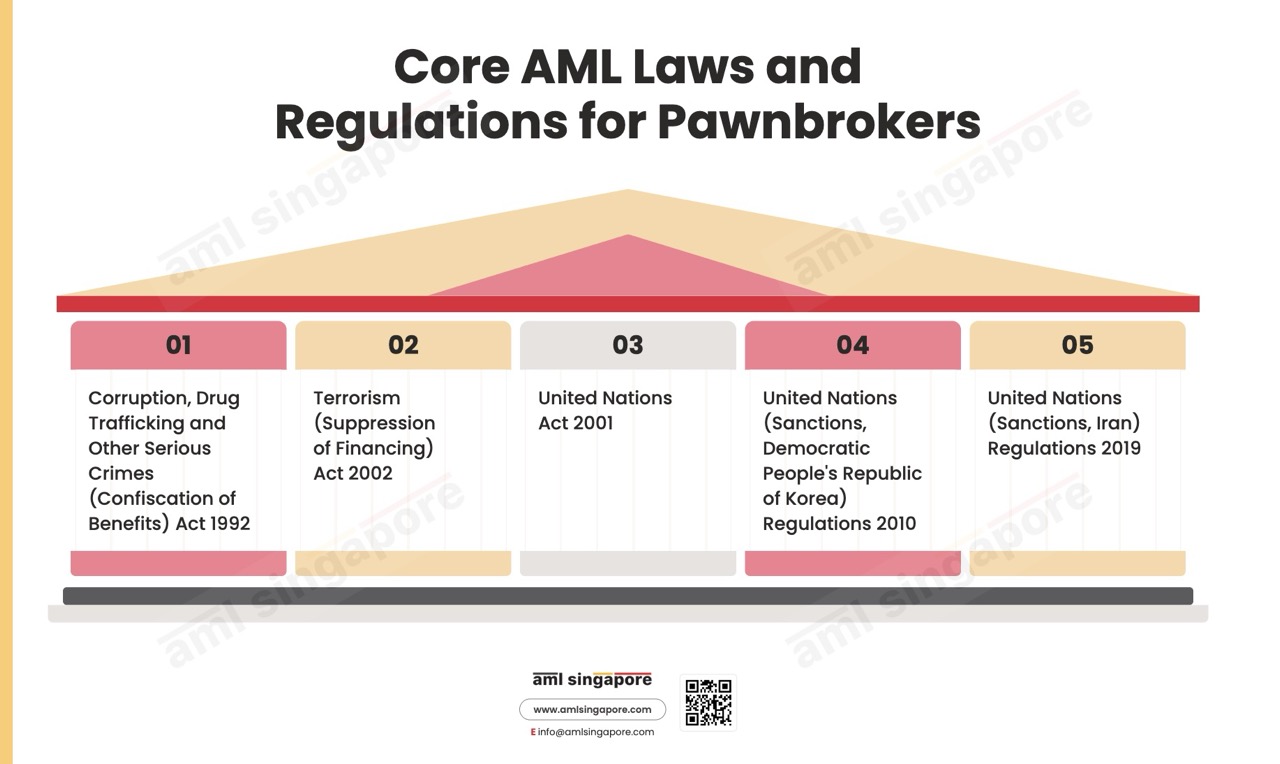
The Corruption, Drug Trafficking and Other Serious Crimes (Confiscation of Benefits) Act 1992
The CDSA establishes money laundering offences and the suspicious transaction reporting framework. Under section 45 of the CDSA, a person who knows or has reasonable grounds to suspect that any property represents or may represent the proceeds of or was used or is intended to be used in connection with, criminal conduct is subject to the statutory disclosure requirement. The Pawnbrokers Act also requires a pawnbroker to consider whether to disclose under section 45 of the CDSA in specified circumstances.
The Terrorism (Suppression of Financing) Act 2002
The Terrorism Suppression of Financing Act 2002 contains prohibitions and reporting obligations relating to terrorist property and terrorism financing. The Pawnbrokers Act separately requires a pawnbroker, before making a relevant loan or entering a relevant transaction, to take reasonable measures to assess whether relevant persons are terrorists or terrorist entities. Where the pawnbroker has reason to suspect that a relevant person is a terrorist or terrorist entity, it must decline or terminate the transaction and make a report to the Police.
The United Nations Act 2001
The United Nations Act 2001 provides the statutory basis for Singapore’s implementation of specified United Nations sanctions. The relevant sanctions regulations impose prohibitions and requirements where their statutory conditions apply.
The United Nations (Sanctions, Democratic People's Republic of Korea) Regulations 2010
The United Nations Sanctions Democratic People’s Republic of Korea Regulations 2010 give effect to specified United Nations sanctions concerning the DPRK. The regulations contain prohibitions concerning designated persons and funds and require the applicable measures to be taken where the statutory conditions are met.
The United Nations (Sanctions, Iran) Regulations 2019
The United Nations Sanctions Iran Regulations 2019 give effect to specified United Nations sanctions concerning Iran and contain prohibitions relating to designated persons, funds and specified activities. The regulations have been amended, including by the United Nations Miscellaneous Amendments Regulations 2023.
Overarching AML Laws and Regulations Applicable to Pawnbrokers in Singapore
These instruments cut across the whole regime and give a pawnbroker the practical means to discharge its reporting duties and to recognise terrorism financing when it surfaces at the counter.
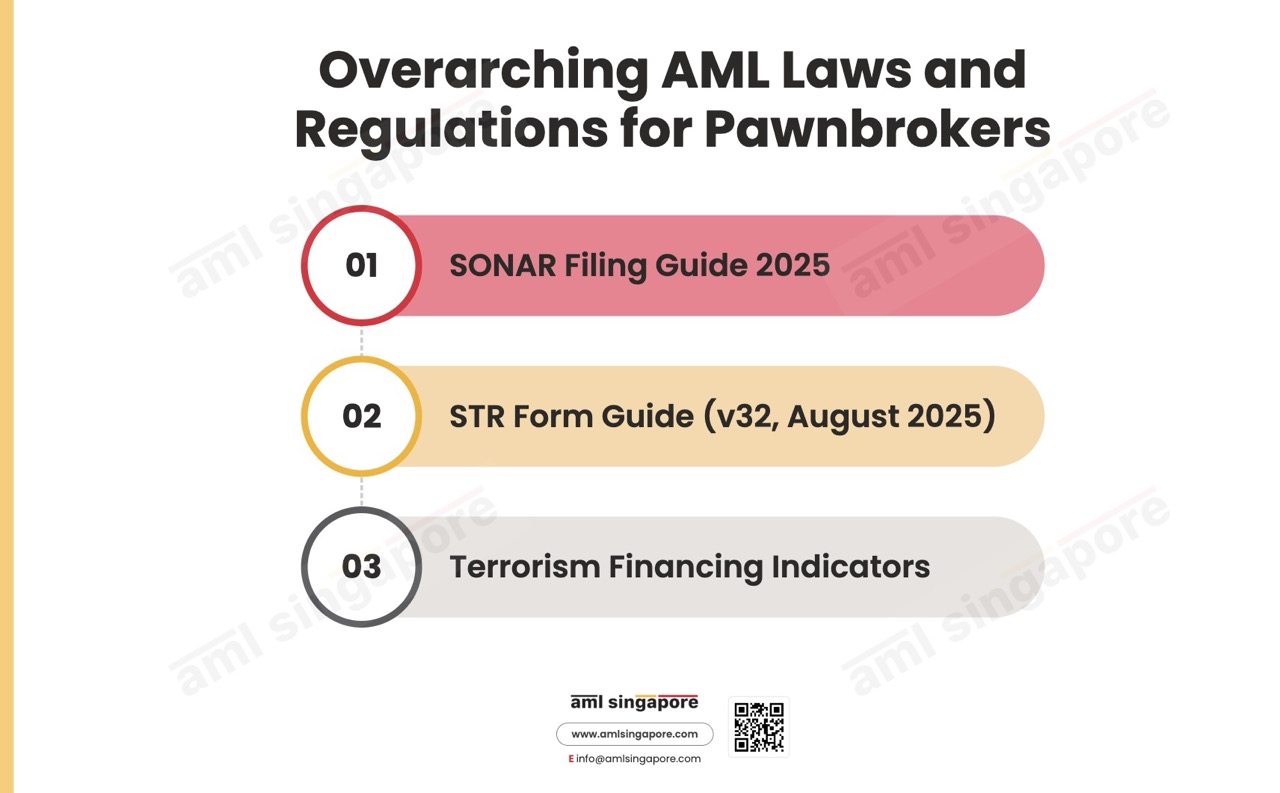
Getting Started with SONAR, for STR Filers (2025)
SONAR is the STRO Online Notices and Reporting platform used for electronic filing of suspicious transaction reports and applicable cash transaction reports. Pawnbrokers can use SONAR to submit the reports required under the applicable legislation and reporting procedures.
Form Guide for the STR Form (Version 12 August 2025)
The STR Form Guide explains how to complete and submit a suspicious transaction report through the applicable reporting process. Persons responsible for preparing and filing STRs should use it, rather than treating it as a document specifically intended for counter staff.
Terrorism Financing Indicators
Terrorism financing indicators provide examples of conduct and transaction characteristics that may assist businesses in identifying potential terrorism financing concerns. Pawnbrokers should consider relevant indicators together with their statutory obligations and the specific guidance issued by the Registry of Pawnbrokers.
National Risk Assessments Applicable to Pawnbrokers in Singapore
Singapore publishes formal assessments of where its money laundering, terrorism financing and proliferation financing risks lie, and a pawnbroker is expected to weigh these findings in its own risk assessment. For this trade, the message is reassuring but specific: pawnbrokers are rated lower risk, with the concern lying in cash and in the goods pledged.
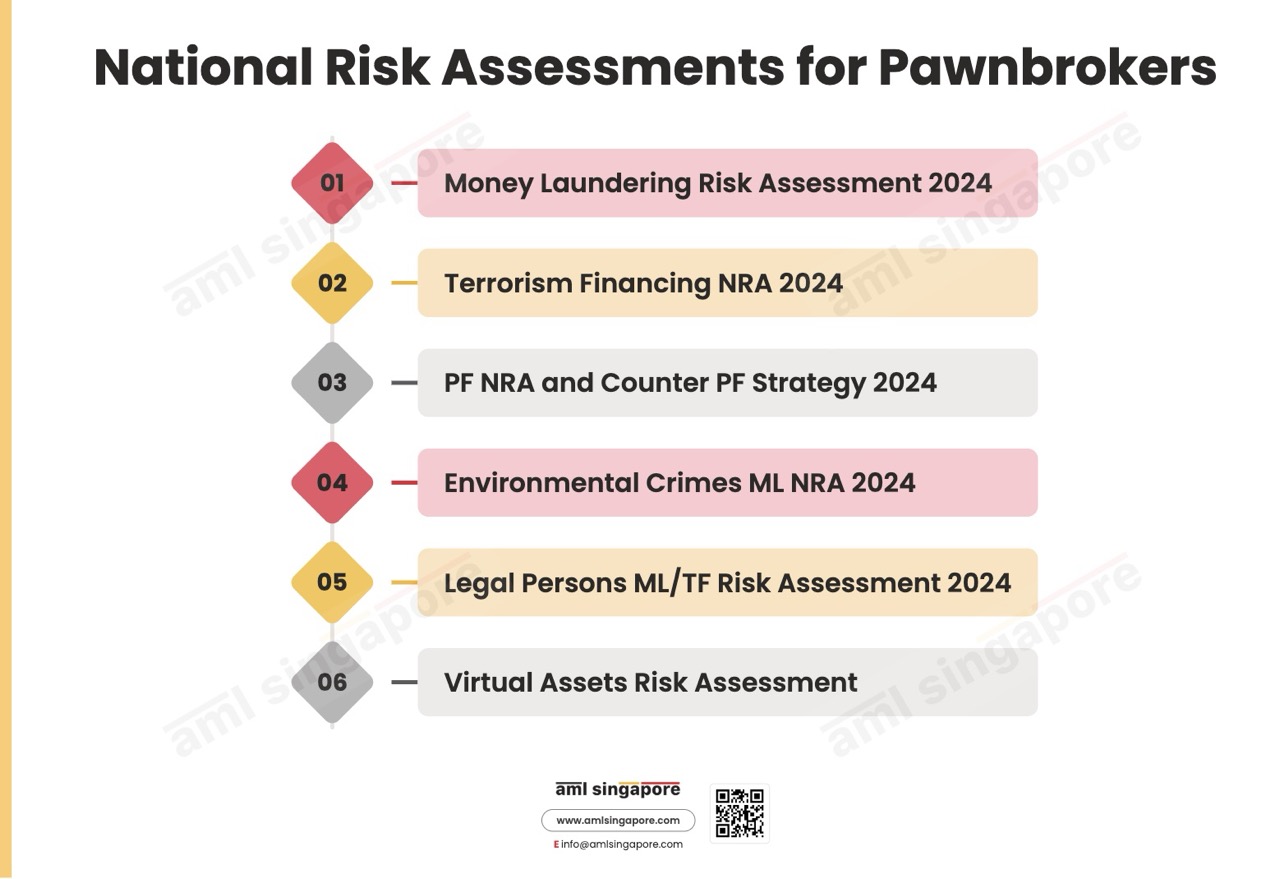
Money Laundering National Risk Assessment 2024
The national money laundering assessment assesses pawnbroking as lower ML risk. It records that loans are domestic and typically small, with pawners physically present, and identifies the key threats as repayment of debts using illicit monies and pawning fraudulently obtained or stolen goods. The sector is assessed as less vulnerable to ML. A pawnbroker should read these findings into its sector risk assessment.
Terrorism Financing National Risk Assessment 2024
The 2024 Terrorism Financing National Risk Assessment provides a national assessment of terrorism financing risks and should not be presented as establishing a specific low terrorism financing risk rating for pawnbrokers unless the assessment expressly makes that finding. Pawnbrokers should apply the relevant statutory requirements and sector specific guidance when assessing terrorism financing risks.
Proliferation Financing National Risk Assessment and Counter PF Strategy 2024
The Proliferation Financing National Risk Assessment and Counter PF Strategy 2024 identifies national proliferation financing risks and mitigation measures. The Pawnbrokers Act requires pawnbrokers to assess and manage relevant money laundering, terrorism financing and proliferation financing risks. The pawnbroker’s CPF obligations should therefore not be reduced to sanctions screening alone.
Environmental Crimes Money Laundering National Risk Assessment (May 2024)
A national study of the routes by which money made from environmental offences, from the illegal wildlife trade to unlawful logging, is laundered. It puts banks and remittance agents at the top of the risk scale, and it barely touches a pawnbroker, surfacing only where the cash a pawner brings to redeem a pledge might trace to such crime.
Money Laundering and Terrorism Financing Risk Assessment of Legal Persons (2024)
This assessment puts companies in a higher residual money laundering risk band. For a pawnbroker, it is largely peripheral, since pawners are overwhelmingly individuals, but it becomes relevant in the rare instance of a corporate pawner, when the pawnbroker must see through to the natural person behind it.
Virtual Assets (Digital Payment Tokens) Risk Assessment (2024)
This assessment weighs Singapore’s exposure to activity in digital payment tokens. Because a pawnbroker does not itself touch tokens, the connection is thin, yet it still colours how closely a pawnbroker looks at a pawner whose cash appears to have come from trading in them.
Pawnbroker Sector ML/TF Risk Snapshot
Money laundering: lower risk band, with a moderate threat but a sector assessed as less vulnerable than most, given small, domestic and face to face loans (ML NRA 2024, chapter 8.8).
Main features to watch: a pawner repaying a loan with illicit cash, and a pawner pledging goods that are stolen or fraudulently obtained (ML NRA 2024, chapter 8.8).
Terrorism and proliferation financing: low and remote, addressed through screening the pawner against the sanctions and terrorism designations (TF NRA 2024; PF NRA 2024).
Controls: the Registrar vets shareholders and directors for fitness, supervises on a risk basis, and a pawnbroker may seize a suspected stolen pledge and detain the person for the Police (ML NRA 2024, chapter 8.8).
Sector Specific Guidance Applicable to Pawnbrokers in Singapore
This is the core of a pawnbroker’s obligations. Because the trade is supervised by the Registrar of Pawnbrokers rather than MAS, its rulebook is not a MAS notice but the anti money laundering part of the Pawnbrokers Act and its Third Schedule, supported by the Registrar’s Information Guide. The two crux instruments are covered in full below.
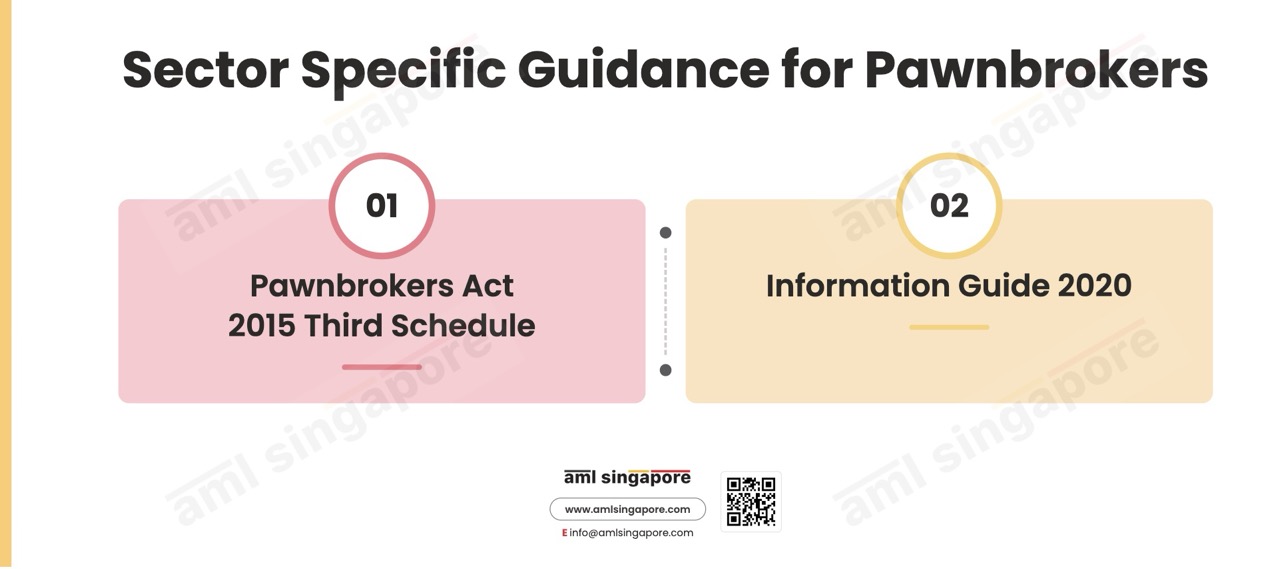
The Pawnbrokers Act 2015 (Prevention of Money Laundering, Terrorism Financing and Proliferation Financing)
Unlike most sectors, the pawnbroker’s binding AML rulebook sits inside its constituting statute. The Pawnbrokers Act 2015 contains a dedicated part on the prevention of money laundering, terrorism financing and the financing of proliferation, strengthened by the amendments that took effect in 2024, and a Third Schedule that carries the detailed customer due diligence measures. Read together they are the equivalent, for pawnbroking, of the notices and rules that govern other sectors, and they are enforced by the Registrar of Pawnbrokers within the Ministry of Law.
The part opens with programmes and measures. A pawnbroker must implement adequate programmes to prevent money laundering, terrorism financing and proliferation financing, and in particular must identify, assess, document and keep current the risks across its pawners, the countries they come from, its own operations and its products and channels. On that foundation it must develop internal policies, procedures and controls approved by senior management, appoint a compliance officer at management level, screen its employees on hiring, train them, run an independent audit function, and, where it is part of a group, apply a group level programme with information sharing and confidentiality safeguards. The extent of these measures is scaled to the pawnbroker’s risks and the size of its business.
The Third Schedule carries the customer due diligence itself. A pawnbroker must perform customer due diligence before making a relevant loan exceeding S$20,000 or entering into a relevant transaction, where it has reason to suspect money laundering, terrorism financing or proliferation financing, or where it doubts the veracity or adequacy of information obtained from earlier due diligence. It must identify and verify the pawner, any person on whose behalf the pawner acts and the beneficial owner, and it must screen them against the sanctions and terrorism designations. Simplified measures are available only where the risk is demonstrably low, and enhanced due diligence is required for higher risk pawners and loans, including a politically exposed person and a complex or unusually large transaction, calling for senior approval and steps to establish the source of wealth and funds.
The reporting duties are distinctive because there are two. A pawnbroker must file a suspicious transaction report with the Suspicious Transaction Reporting Office whenever it has reasonable grounds to suspect money laundering or terrorism financing, and it must not tip off the pawner. A pawnbroker must submit a cash transaction report for a relevant transaction involving the sale of precious stones, precious metals or precious products where cash or a cash equivalent exceeding S$20,000 is received, including two or more qualifying sales in a single day that in aggregate exceed S$20,000. The report must be submitted to the Suspicious Transaction Reporting Officer, and a copy must be submitted to the Registrar. This is separate from suspicious transaction reporting. It must also conduct ongoing monitoring of its business relationships, with enhanced monitoring for higher risk cases, and keep the records that let a transaction and its due diligence be reconstructed.
The Act ties these duties to the pawnbroker’s records. Because the Pawnbrokers Rules already require a detailed record of every pawn ticket, including the pawner’s identification information and a description of the pledged article, the due diligence and the reporting build on a record that a pawnbroker keeps in the ordinary course of business.
The Pawnbrokers Act requires pawnbrokers to keep the records and information required under section 76 and the Third Schedule for the prescribed period. The Registrar’s Information Guide states that AML CFT records and information are to be retained for five years after the latest relevant date specified in the Guide. In this way, the identification captured at the counter, the source of funds enquiry on a large or unusual redemption, and the two reports all rest on the same documentary spine, and a pawnbroker that keeps its pawn records well is already part of the way to meeting its money laundering duties. The Registrar can call for those records on inspection, so the quality of the pawn book is, in practice, the first thing a supervisor sees.
The Act also gives a pawnbroker a power no notice could confer, aimed squarely at the trade’s own risk. A pawnbroker commits an offence if it takes goods in pawn without taking reasonable steps to satisfy itself that the goods were not stolen or obtained through fraudulent or dishonest means. If the pawnbroker discovers that goods in its possession or offered to be pawned have been reported to the Police as lost, stolen or fraudulently or dishonestly obtained, it must immediately detain the goods and inform a Police officer as soon as practicable. It may also detain the person offering the goods until a Police officer arrives.
This turns the pawnbroker into an active guard against the monetisation of stolen goods, a control that sits alongside its money laundering duties rather than apart from them and marks the sector out from other cash businesses.
Information Guide 2020 on the Prevention of Money Laundering and Countering the Financing of Terrorism for Pawnbrokers
The Information Guide issued by the Registrar of Pawnbrokers in 2020 is the primary guidance a pawnbroker works with alongside the Act, and it is given the fullest treatment here. It translates the statutory duties into plain, practical terms for what is often a small, counter based business, and although it is guidance rather than a binding instrument, it is how the Registrar expects a pawnbroker to read and apply the Act, so in practice it is the working manual for the trade.
The Guide begins with the sector’s risk picture. It explains that pawnbroking is cash intensive but low in overall money laundering risk, that loans are small, domestic and taken face to face, and that the two real concerns are a pawner using illicit cash to redeem a pledge and a pawner pledging goods that are stolen or fraudulently obtained. It draws on Singapore’s national risk assessment so that a pawnbroker can see where the trade’s exposure sits, and it stresses that even a lower risk business must have controls that are genuine and used, not merely written down.
On the risk based approach, the Guide walks a pawnbroker through assessing its own risk across its pawners, its loans and its channels, and through building policies and controls that match that risk. It then works through customer due diligence in practical terms: how to identify and verify a pawner from identity documents at the counter, when the twenty thousand dollar threshold brings due diligence into play, how to treat a person acting for another or a beneficial owner, and when simplified or enhanced measures apply. It explains how to establish source of funds where a redemption in cash does not sit easily with what the pawnbroker knows of the pawner.
The Guide is at its most useful on the everyday signals and the two reports. It sets out the behaviour that should put a pawnbroker on notice, from a pawner redeeming with unusually large cash to one pledging a volume of goods that does not fit their circumstances, and it explains how to turn a suspicion into a suspicious transaction report to the Suspicious Transaction Reporting Office without tipping off the pawner, as well as when a cash transaction report is required. It covers the reasonable steps a pawnbroker should take to check that a pledge was honestly obtained, the record keeping the Act requires, and the training a pawnbroker’s counter staff need to recognise the signs.
The Guide does not stand alone, and part of its value is the way it sits at the centre of a small package of Registrar materials. It is read with additional guidance on assessing a pawner’s risk, spotting material red flags, establishing source of wealth and monitoring pawners and their transactions, with a dedicated set of red flag indicators written for the counter, and with frequently asked questions on internal policies, procedures, controls and audit reports. For a pawnbroker with a handful of shops and no compliance department, this package is designed to be lifted almost directly into a working manual, so that the risk assessment, the due diligence steps, the red flags and the audit expectations come pre shaped rather than having to be built from the statute alone. That practical framing is deliberate, because the trade is made up largely of small operators for whom a usable manual matters more than an abstract statement of the law, and the Registrar plainly intends the guidance to raise the baseline of compliance across every shop, not just the largest chains.
The Guide is candid about the consequences. It draws out the offences a pawnbroker and its officers can commit, from failing to carry out due diligence or to report a suspicion through to tipping off a pawner, and the penalties that follow, so that a small firm understands the regime is enforced. It is reinforced by the Registrar’s additional guidance on assessing customer risk, identifying material red flags, establishing source of wealth and monitoring pawners and their transactions, by a set of red flag indicators for the trade, and by frequently asked questions on internal policies, procedures, controls and audit reports. Read with the Act, the Guide turns a set of statutory duties into a workable routine for a pawnbroker at the counter.
The Reporting and Due Diligence Triggers a Pawnbroker Applies
The pawnbroker regime turns on clear triggers. The table below sets out each one and the action it requires under the Act.
Trigger | What the pawnbroker must do under the Pawnbrokers Act 2015 |
A loan or transaction exceeding S$20,000 | Perform customer due diligence: identify and verify the pawner, any person acted for and the beneficial owner (section 75 and the Third Schedule) |
Any suspicion of ML, TF or PF | Perform due diligence regardless of amount, and consider filing a suspicious transaction report |
Doubt about information already held | Repeat or complete due diligence to resolve the doubt before proceeding |
A higher risk pawner or loan | Apply enhanced due diligence, including establishing source of wealth and funds and obtaining senior approval |
A cash transaction meeting the threshold | File a cash transaction report as required under section 74A |
Reasonable suspicion of ML or TF | File a suspicious transaction report to STRO and do not tip off the pawner |
The Money Laundering Risks Specific to Pawnbroking
The national assessment locates the trade’s risk in a few features. The table below maps them to the controls a pawnbroker applies.
Pawnbroking specific risk | How a pawnbroker guards against it |
A pawner repays a loan with illicit cash | Monitor redemptions, question repayment in unexplained cash, and establish source of funds where the amount or pattern does not fit the pawner |
A pledge is stolen or fraudulently obtained | Take reasonable steps to satisfy that the article was not obtained illegally before accepting it as a pledge |
A suspected stolen article is presented | Use the statutory power to seize the article and detain the person, delivering both into the custody of a Police officer |
A criminal seeks to control a pawnbroker | Fit and proper vetting of substantial shareholders and directors by the Registrar keeps criminals out of ownership |
Anonymity of a walk in pawner | The pawner must be physically present, so identification is taken face to face rather than remotely |
Allied Laws Applicable to Pawnbrokers in Singapore
These statutes are not primarily AML instruments, but each supports the regime: some govern the conduct of pawnbroking, others govern the legal persons behind a corporate pawner, and others give investigators their powers or create the offences a pawnbroker screens against.
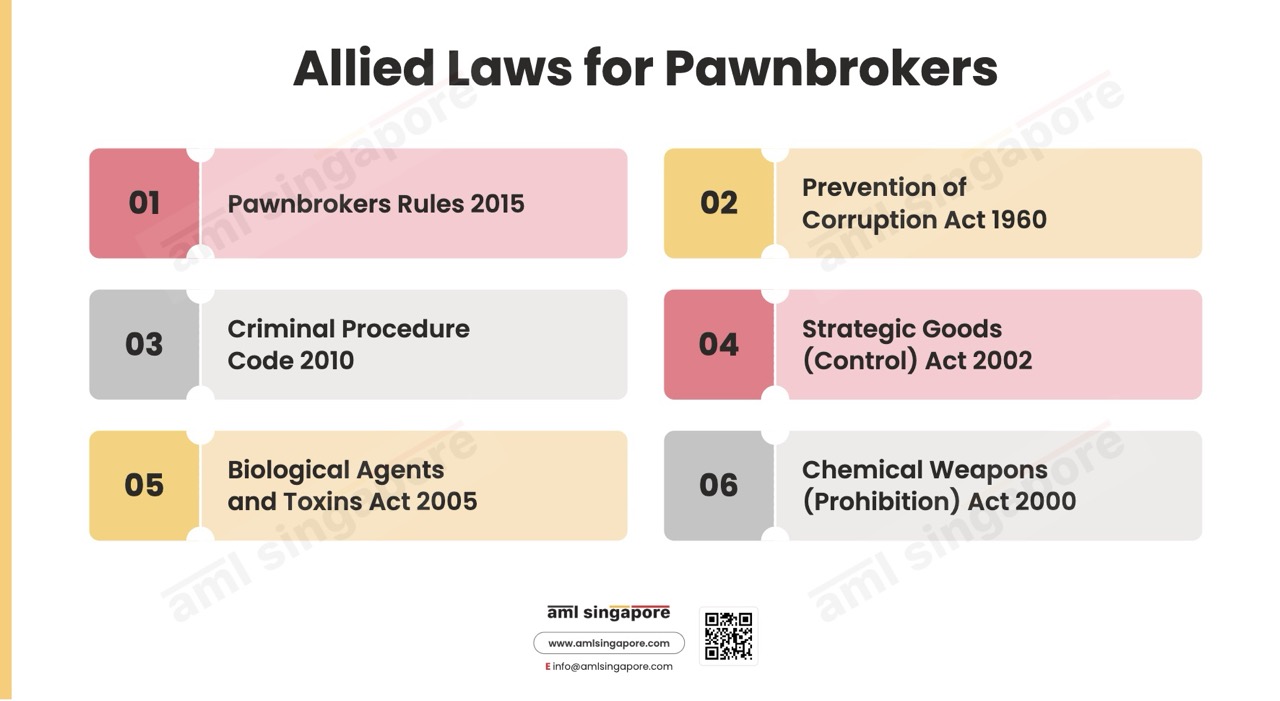
The Pawnbrokers Rules 2015
The Pawnbrokers Rules 2015 prescribe various operational requirements for licensees, including requirements concerning records, identification information, pawn tickets and monthly statements. They were recently revised and published on 3rd July 2026.
The Prevention of Corruption Act 1960
The Prevention of Corruption Act 1960 establishes offences relating to corruption and provides investigative powers. Corruption offences may also constitute predicate offences for the CDSA. The Act should not be described as creating a general AML screening requirement for pawnbrokers.
The Criminal Procedure Code 2010
The Criminal Procedure Code 2010 establishes criminal procedure and provides investigative powers, including powers relating to searches, seizures and production of information and documents. The exercise of these powers in a particular investigation depends on the applicable statutory requirements and orders.
The Strategic Goods (Control) Act 2002
The Strategic Goods Control Act 2002 regulates the transfer and brokering of strategic goods and strategic goods technology and provides related licensing, registration and enforcement requirements. Its relevance to a pawnbroker is indirect and should not be presented as creating a specific proliferation financing due diligence requirement for pawnbrokers.
The Biological Agents and Toxins Act 2005
The Biological Agents and Toxins Act 2005 regulates specified biological agents and toxins and related activities. Its relevance to a pawnbroker is indirect. The article should not state that the Act itself requires pawnbrokers to conduct proliferation financing screening.
The Chemical Weapons (Prohibition) Act 2000
The Chemical Weapons Prohibition Act 2000 gives effect to Singapore’s obligations under the Chemical Weapons Convention and establishes offences and regulatory requirements concerning chemical weapons and specified chemicals. Its relevance to pawnbrokers is indirect, and it should not be described as imposing a specific proliferation financing screening obligation on them.
Miscellaneous Laws and Regulations Applicable to Pawnbrokers in Singapore
These national strategies, committee reports and typologies set the direction of Singapore’s regime and the public private partnership a pawnbroker operates within. They carry no binding force, but they steer how supervisors act and supply typologies a pawnbroker builds into its checks.
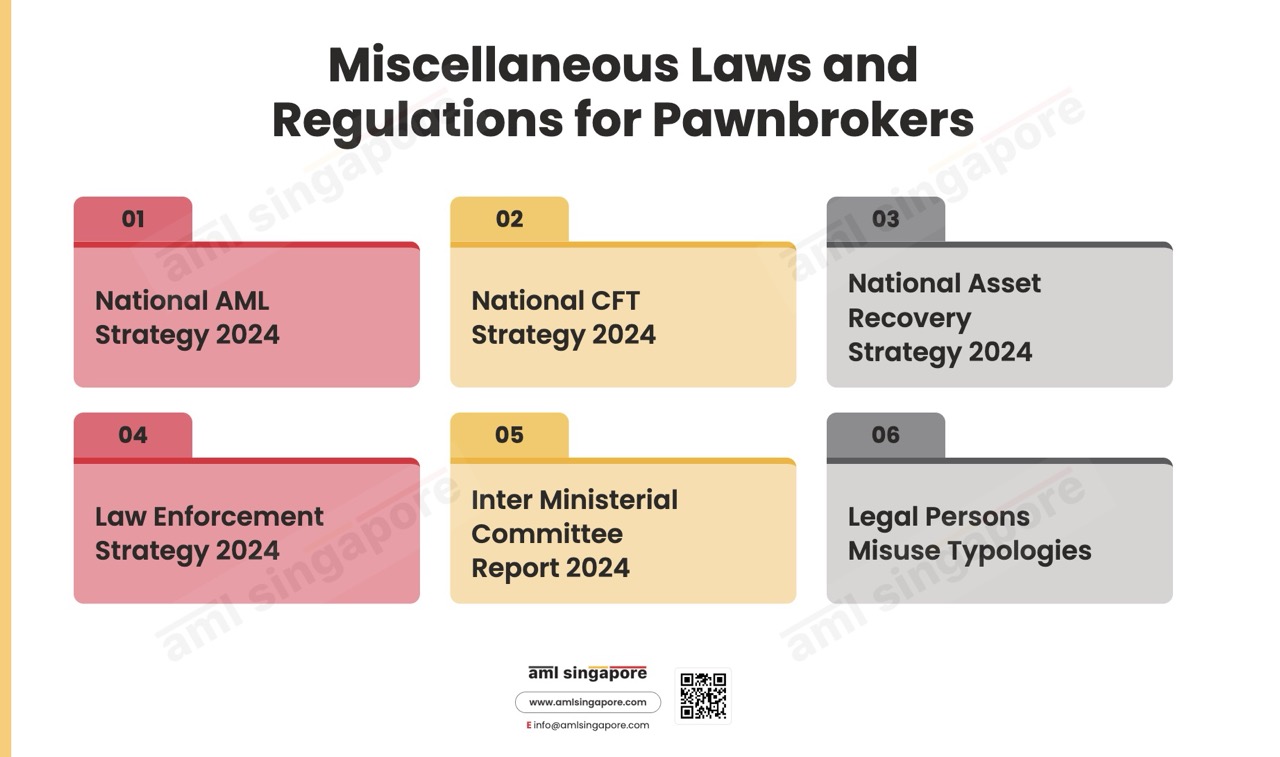
National Anti Money Laundering Strategy 2024
Singapore’s National Anti Money Laundering Strategy sets out national priorities under Prevent, Detect and Enforce. The strategy provides broader national context for the AML controls and reporting obligations applicable to pawnbrokers.
National Strategy for Countering the Financing of Terrorism 2024
Renewed in 2024 alongside the terrorism financing risk assessment, this strategy moves on five fronts at once, coordinating risk identification, strengthening the legal and sanctions architecture, keeping oversight firm, driving enforcement and broadening cooperation. It signals where a pawnbroker should steer its terrorism financing controls.
National Asset Recovery Strategy 2024
Singapore’s plan for tracing, seizing and recovering proceeds of crime. Pawnbrokers may contribute through statutory reporting and cooperation with lawful investigative processes. The Pawnbrokers Act also contains specific requirements concerning goods reported as lost, stolen or fraudulently or dishonestly obtained.
Singapore Law Enforcement Strategy to Combat Money Laundering (October 2024)
A joint strategy of Singapore’s money laundering investigation agencies that names focus areas and key actions and relies on two way information flows with the private sector. It frames the enforcement backdrop a pawnbroker supports through its reporting on suspicious loans, redemptions and pledges.
Inter Ministerial Committee on Anti Money Laundering Report (October 2024)
Commissioned after a major laundering case, this review advanced recommendations on curbing the abuse of structures, tightening the responsibilities of gatekeepers and improving information sharing between agencies and firms. Its themes extend to a cash based dealer such as a pawnbroker and signal the sterner supervisory posture the wider sector now works under.
Legal Persons: Misuse Typologies and Best Practices (2018)
A study of the methods used to misuse companies and partnerships. It applies to a pawnbroker only at the margin, since pawners are almost always individuals, but it helps in the uncommon case where a corporate pawner or a hidden owner comes to the counter.
International Standards Applicable to Pawnbrokers in Singapore
The FATF standards provide international AML, CFT and CPF standards that inform Singapore’s framework. They are not themselves binding Singapore law on pawnbrokers. The binding sector specific obligations arise from Singapore legislation, including the Pawnbrokers Act and its Third Schedule.
The FATF Recommendations (updated June 2026)
The FATF Recommendations provide international standards for AML, CFT and CPF. They are not Singapore legislation and do not themselves impose directly binding obligations on Singapore pawnbrokers. The binding obligations arise from Singapore legislation and applicable subsidiary legislation.
Methodology for Assessing Technical Compliance and Effectiveness (updated June 2026)
The FATF’s methodology is used to assess countries’ technical compliance with the FATF Recommendations and the effectiveness of their AML CFT CPF systems. It is an international assessment methodology and does not itself establish the Registrar’s requirements for pawnbrokers.
Mutual Evaluation Report of Singapore (May 2026)
The 2026 FATF and Asia/Pacific Group mutual evaluation assesses Singapore’s AML CFT CPF framework for effectiveness and compliance with the FATF Recommendations. It is an international assessment of Singapore and does not itself create supervisory obligations for pawnbrokers.
FATF Guidance on Politically Exposed Persons (Recommendations 12 and 22, 2013)
Sets out how to recognise a politically exposed person and step up due diligence in response, senior sign off, working out the source of wealth and funds, and closer monitoring, which a pawnbroker brings to bear where a pawner is a PEP.
Guidance on Beneficial Ownership of Legal Persons (March 2023)
Guidance under the revised Recommendation 24 on obtaining and verifying beneficial ownership information, of use to a pawnbroker in the rare case where a pledge is offered by or a loan taken through a body corporate.
Best Practices on Beneficial Ownership for Legal Persons (October 2019)
A collection of country best practices for keeping beneficial ownership information adequate, accurate and up to date, backing a pawnbroker’s checks where a corporate pawner stands behind a transaction.
Concealment of Beneficial Ownership (July 2018)
A FATF and Egmont Group typologies report on how criminals hide beneficial ownership through intermediaries and structures. Its relevance to a pawnbroker is narrow but real where a person seems to be pledging on behalf of someone kept out of sight.
Risk Based Approach: Beneficial Ownership and Transparency of Legal Arrangements (March 2024)
Guidance under Recommendation 25 on trusts and similar arrangements, of limited but occasional use to a pawnbroker where a trust or similar structure stands behind a pawner’s funds.
FATF Guidance on Counter Proliferation Financing (February 2018)
Guidance on the financial provisions of Security Council resolutions concerning proliferation financing. It provides international guidance on implementing proliferation financing measures and does not itself impose binding Singapore obligations on pawnbrokers.
Guidance on Proliferation Financing Risk Assessment and Mitigation (June 2021)
Describes how a firm should assess and reduce proliferation financing risk after the changes to Recommendations 1 and 2 brought it within the risk assessment duty, which a pawnbroker now discharges as part of its risk assessment.
Money Laundering from Environmental Crime (July 2021)
A FATF examination of the ways money from environmental crime moves through the financial system. It concerns a pawnbroker only slightly, coming into view where the cash a pawner uses might originate in such activity.
Guidance on Digital Identity (March 2020)
Helps a pawnbroker judge whether a digital identity system is reliable and independent enough for customer due diligence under a risk based approach, a question that arises as the trade digitises parts of its onboarding while keeping the face to face pledge.
Artificial Intelligence and Deepfakes: Impacts on ML/TF/PF
A forward looking FATF scan of how artificial intelligence and deepfakes threaten preventive systems, for example synthetic identities defeating identity checks, alongside the uses of such tools in screening and monitoring.
Summary of the Key Instruments
The table below distils the instruments a pawnbroker relies on most, what type each is, whom it binds, and the core obligation it places on the trade. Keep it as a rapid lookup alongside the discussion; the detailed sections above are the governing account.
Instrument | Type | Binds | Core obligation for a pawnbroker |
CDSA 1992 | Statute | Everyone | Report suspected criminal proceeds; do not tip off |
TSOFA 2002 | Statute | Everyone | Do not deal in terrorist property; screen and report |
UN Act sanctions regulations (DPRK, Iran) | Regulations | All persons | Screen for and freeze designated persons without delay |
Pawnbrokers Act 2015 (AML part + Third Schedule) | Statute (binding) | Pawnbrokers | Risk based CDD, checks on pledges, records, STR and CTR |
Information Guide 2020 for Pawnbrokers | Guidance | Pawnbrokers | Primary guidance; how to apply the Act |
Pawnbrokers Rules 2015 | Rules | Pawnbrokers | Pawn ticket records and identification of the pawner |
FATF Recommendations | Standard | Countries/DNFBPs | The global standard behind the domestic rules |
Conclusion
For a pawnbroker in Singapore, the anti money laundering framework is proportionate to a small, cash based, face to face trade, but it is real and it is enforced by a regulator of its own. The criminal statutes establish offences and suspicious transaction reporting obligations, while the Pawnbrokers Act and its Third Schedule establish sector specific requirements for risk assessment, customer due diligence, enhanced measures, targeted financial sanctions, record keeping and reporting. Pawnbrokers must also comply with the prescribed cash transaction reporting regime for relevant transactions involving precious stones, precious metals or precious products. Because the risk lives in cash and in the goods pledged, a pawnbroker’s controls are built around who its pawner is and where the pledge came from.
The instruments form different parts of the framework. A pawnbroker’s risk assessment can take account of national risk assessments; its AML CFT CPF duties arise principally from the Pawnbrokers Act and Third Schedule; operational record and identification requirements also arise under the Pawnbrokers Rules; and applicable sanctions obligations arise from Singapore legislation and regulations. FATF standards provide international context but are not themselves binding Singapore law.
Seeing how the pieces connect, and remembering that the Registrar of Pawnbrokers, not MAS, is the supervisor, is what turns a short statutory part into a framework a pawnbroker can defend.
An independent AML health check measures a pawnbroker’s controls, including its handling of cash and its checks on pledged goods, against the Pawnbrokers Act and its own risk profile, and shows where to close gaps before the Registrar does.
Frequently Asked Questions
Customer due diligence applies in the circumstances prescribed by the Pawnbrokers Act and its Third Schedule, including relevant loans exceeding S$20,000, suspicion of money laundering, terrorism financing or proliferation financing, and doubts concerning previously obtained identification information. The applicable requirements include identification and verification, beneficial ownership measures and enhanced measures where required.
Customer due diligence applies in the circumstances prescribed by the Pawnbrokers Act and its Third Schedule, including relevant loans exceeding S$20,000, suspicion of money laundering, terrorism financing or proliferation financing, and doubts concerning previously obtained identification information. The applicable requirements include identification and verification, beneficial ownership measures and enhanced measures where required.
Singapore’s 2024 assessment places pawnbroking in the lower risk band. Loans are small, domestic and taken face to face, which limits the trade’s exposure. The threat is moderate and the two real concerns are a pawner repaying with illicit cash and a pawner pledging goods that are stolen or fraudulently obtained.
A pawnbroker must take reasonable steps to satisfy itself that goods were not stolen or obtained through fraudulent or dishonest means. Where the statutory conditions concerning goods reported as lost, stolen or fraudulently or dishonestly obtained are met, the Pawnbrokers Act provides for detention of the goods and notification to a Police officer, together with circumstances in which the person offering the goods may also be detained.
Yes. A pawnbroker must consider and make the applicable suspicious transaction disclosure where the statutory conditions are met. Separately, a pawnbroker must file a cash transaction report for prescribed relevant transactions involving the sale of precious stones, precious metals or precious products where cash or a cash equivalent exceeding S$20,000 is received, including qualifying aggregated sales.
Through ongoing monitoring and the Registrar’s red flag indicators, watching for a redemption in unusually large cash, a pawner pledging a volume of goods that does not fit their circumstances, or a repayment that cannot be explained. Our guide to STR red flags explains common triggers and how they lead to a report.
About the Author

Pathik Shah
FCA, CAMS, CISA, CS, DISA (ICAI), FAFP (ICAI)
Pathik is a Chartered Accountant with more than 26 years of experience in governance, risk, and compliance. He helps companies with end-to-end AML compliance services, from conducting Enterprise- Wide Risk Assessments to implementing the robust AML Compliance framework. He has played a pivotal role as a functional expert in developing and implementing RegTech solutions for streamlined compliance.