AML Laws and Regulations for Real Estate Agencies and Salespersons in Singapore
In a Nutshell
A real estate agency and its salespersons stand at the front of a property deal, and a property transaction can place a large sum of illicit money into a high value asset in a single transaction. That is why the sector sits under a dedicated anti money laundering regime, supervised by the Council for Estate Agencies, not the Monetary Authority of Singapore.
The binding rulebook is the Estate Agents (Prevention of Money Laundering, Proliferation Financing and Terrorism Financing) Regulations 2021, as amended with effect from 1 July 2025. The Council for Estate Agencies issued its updated Guide dated 30 June 2025. The 2025 amendments also introduced PF requirements, expanded counterparty due diligence and changed certain financial penalties for AML, PF and TF breaches to a per breach basis. The Regulations also cover enhanced due diligence, ongoing monitoring, risk assessment, internal controls, record keeping and targeted financial sanctions.
Singapore’s 2024 Money Laundering National Risk Assessment assesses the money laundering threat to the real estate sector as moderately high and the sector as more vulnerable than most. It highlights the high value of real estate transactions, the store of value characteristics of property, exposure to foreign customers from higher risk jurisdictions, and the misuse of corporate vehicles and other structures to obscure beneficial ownership. The assessment also notes that public housing is subject to restrictions and controls that reduce its exposure compared with private property.
Around this core sit the criminal and sanctions statutes that bind every business, the national risk assessments, the property and corporate laws the trade works within, and the FATF standards. Each instrument below is taken in turn, in plain words, with the exact source it draws on.
AML Laws and Regulations for Real Estate Agencies and Salespersons in Singapore
A property transaction can move a very large sum in one step, and the salesperson who arranges it is the first person placed to see whether the money makes sense. This guide sets out the laws and regulations that apply to a real estate agency and a registered salesperson in Singapore, from the criminal statutes that make money laundering an offence to the specific rulebook the Council for Estate Agencies enforces on estate agency work.
The framework is best read in layers. The criminal and sanctions laws sit at the base. Above them is the instrument a salesperson works with on every deal, the Estate Agents (Prevention of Money Laundering, Proliferation Financing and Terrorism Financing) Regulations 2021, together with the Council’s Guide. Alongside these run Singapore’s national risk assessments, the Estate Agents Act that licenses the trade, the property and corporate laws it operates within, and the FATF standards behind the whole regime. Each instrument below is explained through the lens of a real estate agency and its salespersons, not in the abstract.
Real estate can be used to place illicit funds into high value assets, including placement through companies or arrangements that obscure beneficial ownership. That shapes much of what follows, from how a salesperson looks through a corporate buyer to the beneficial owner to the checks it must run on the counterparty on the other side of the deal.
Singapore's Real Estate Agency Sector at a Glance
As of 1 January 2023, there were 1,118 licensed real estate agencies and 34,427 registered salespersons in Singapore. The sector covers residential and commercial property transactions (Money Laundering National Risk Assessment 2024, chapter 8.3).
Public housing constituted approximately 72 percent of Singapore’s housing stock in 2023 and is subject to tight government controls. Private properties are generally more freely transacted and higher in value, making the private residential housing segment more susceptible to money laundering.
Risk rating: the real estate sector is assessed as having a medium high ML risk and as more vulnerable to ML than most sectors. Key vulnerabilities include high value transactions, the store of value and investment characteristics of property, the use of corporate vehicles or legal arrangements that can disguise beneficial ownership, and exposure to foreign customers, including customers from higher ML risk jurisdictions (ML NRA 2024, chapter 8.3).
Core AML Laws and Regulations for Real Estate Agencies and Salespersons in Singapore
These statutes and sanctions regulations establish offences, reporting or disclosure duties and targeted financial sanctions that may be relevant to real estate agencies and salespersons. The Estate Agents PMLPFTF Regulations impose additional sector specific AML, counter proliferation financing and counter terrorism financing obligations on licensed estate agents and registered salespersons.
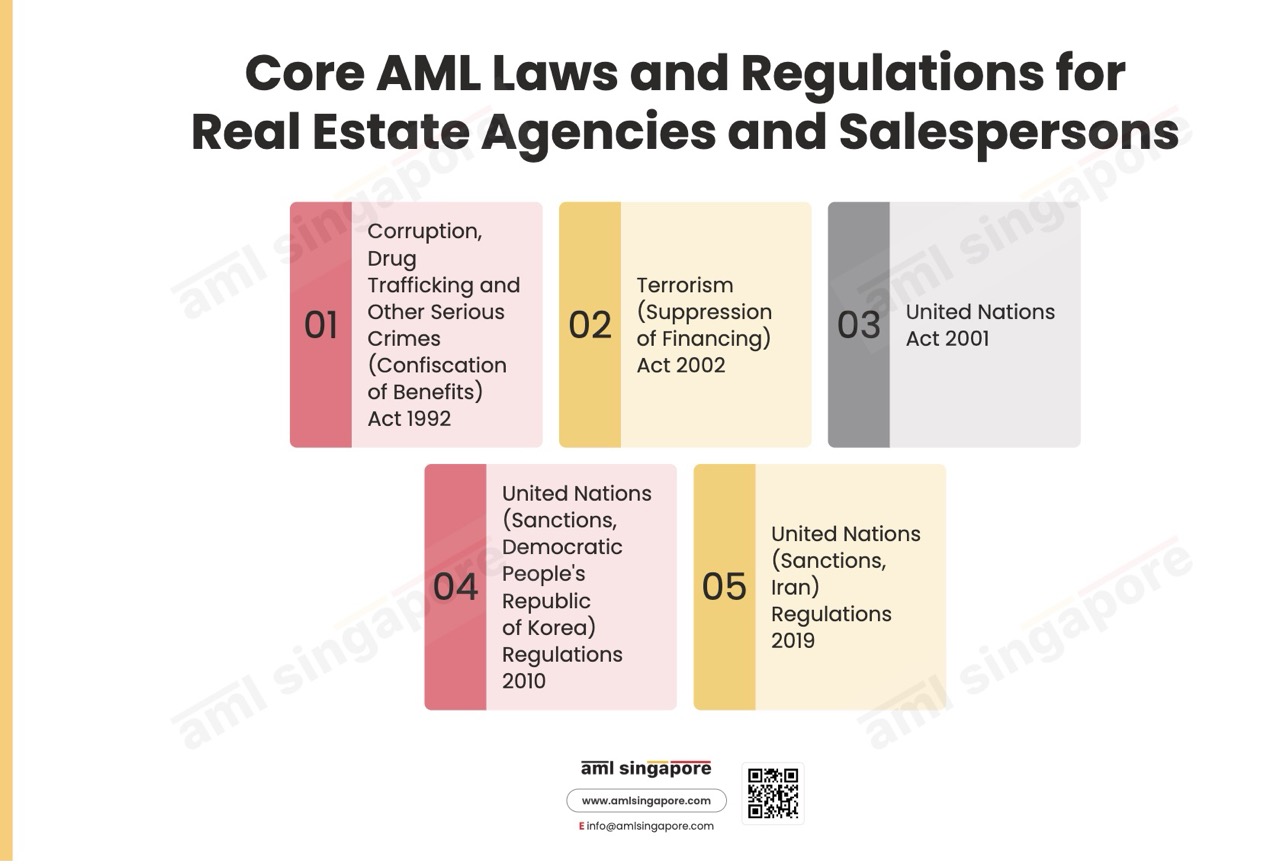
The Corruption, Drug Trafficking and Other Serious Crimes (Confiscation of Benefits) Act 1992
The CDSA contains Singapore’s principal money laundering offences and provides for confiscation of criminal benefits. Section 45 requires a person who knows or has reasonable grounds to suspect that property may relate to criminal activity to disclose the information to the STRO. Suspicious transaction reports are filed electronically through SONAR with the Suspicious Transaction Reporting Office.
The Terrorism (Suppression of Financing) Act 2002
The TSOFA contains offences relating to the financing of terrorism and imposes disclosure obligations concerning property and financial transactions belonging to terrorists and acts of terrorism financing. The PMLPFTF Regulations require applicable targeted financial sanctions measures, including screening and prescribed action where relevant persons are designated.
The United Nations Act 2001
The United Nations Act provides the legislative basis for regulations implementing applicable United Nations Security Council sanctions in Singapore. Estate agents and salespersons must comply with applicable targeted financial sanctions requirements under the PMLPFTF Regulations.
The United Nations (Sanctions, Democratic People's Republic of Korea) Regulations 2010
The United Nations (Sanctions, Democratic People’s Republic of Korea) Regulations 2010 implement applicable United Nations sanctions concerning the DPRK in Singapore. Estate agents and salespersons must comply with applicable targeted financial sanctions requirements and take the prescribed action where a relevant designated person or entity is identified.
The United Nations (Sanctions, Iran) Regulations 2019
The applicable UN sanctions regulations form part of Singapore’s targeted financial sanctions framework. Estate agents and salespersons must comply with applicable sanctions requirements under the PMLPFTF Regulations.
Overarching AML Laws and Regulations Applicable to Real Estate Agencies and Salespersons in Singapore
These instruments cut across the whole regime and give a salesperson the practical means to discharge their reporting duty and to recognise terrorism financing when it surfaces in a deal.
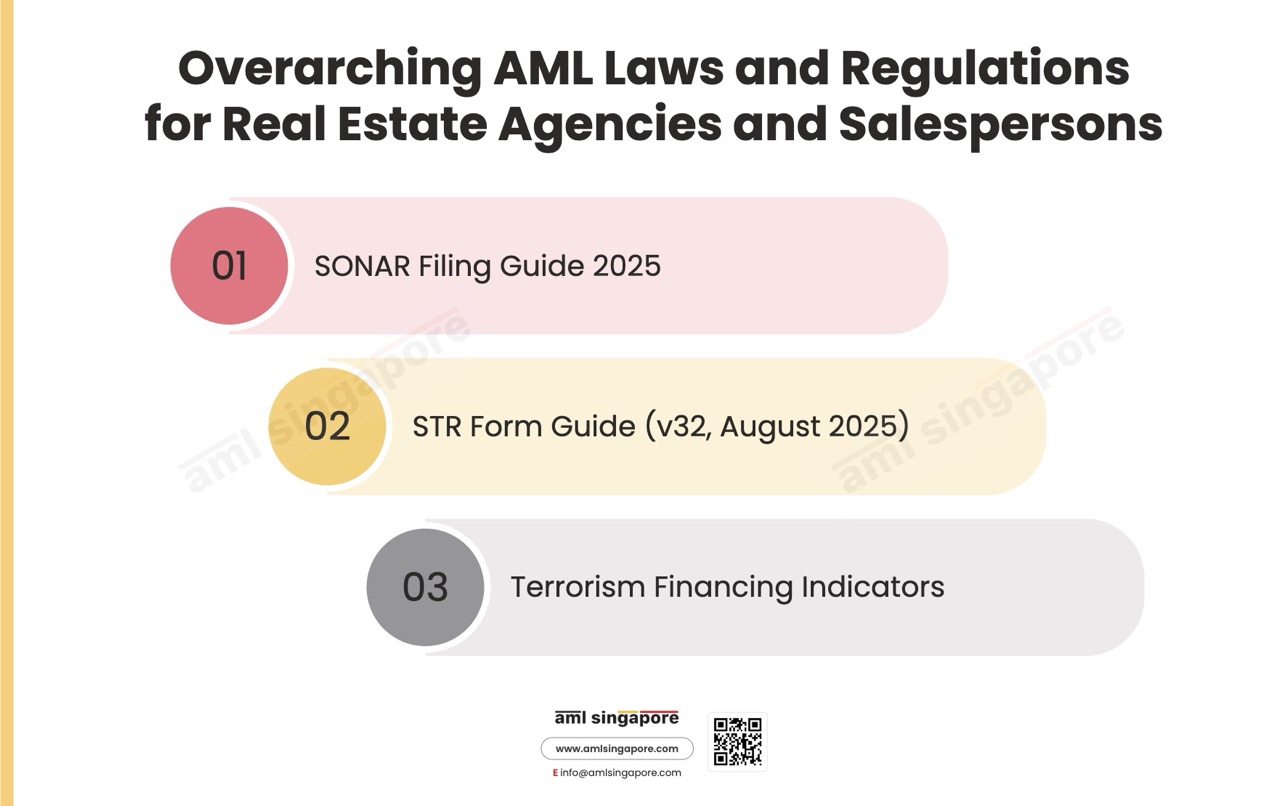
Getting Started with SONAR, for STR Filers (2025)
SONAR is the STRO Online Notices and Reporting platform used to file Suspicious Transaction Reports electronically with the Suspicious Transaction Reporting Office. Businesses and their employees can use SONAR to submit STRs, subject to the applicable registration and access requirements.
Form Guide for the STR Form (Version 12 August 2025)
A part by part walkthrough of the current suspicious transaction report form, showing what each field requires, from the reporting agency’s particulars to the grounds for suspicion, and requiring a distinct internal reference for every filing. A salesperson reaches for it when reporting a client, a counterparty or a deal whose facts will not reconcile.
Terrorism Financing Indicators
A STRO reference grouping terrorism financing indicators under due diligence anomalies, fund flows that break the usual pattern, and dealings with no real economic rationale. It helps a salesperson notice terrorism financing sitting behind a property deal and backs the decision to file a terrorism financing report.
National Risk Assessments Applicable to Real Estate Agencies and Salespersons in Singapore
Singapore publishes formal assessments of where its money laundering, terrorism financing and proliferation financing risks lie. The national risk assessments provide relevant risk information that licensed estate agents should consider when assessing and managing their ML, PF and TF risks. For this sector, the message is pointed: real estate is a favoured channel for placing large sums, which places the trade among the more vulnerable.
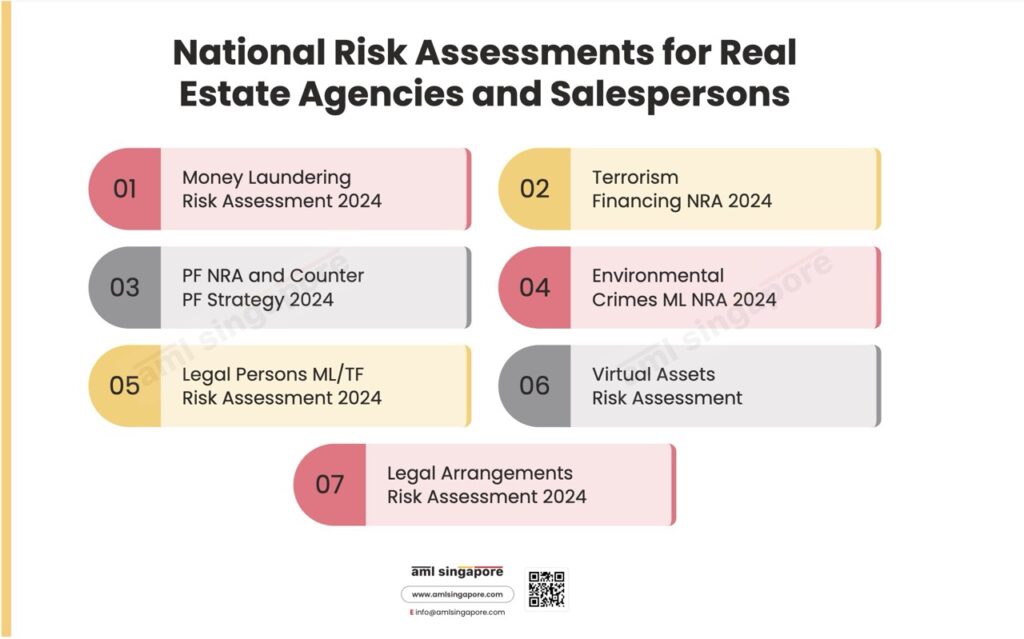
Money Laundering National Risk Assessment 2024
The 2024 NRA assesses the real estate sector as having a medium high ML risk and as more vulnerable to ML. Key risks include high value transactions, property as a store of value, the use of corporate vehicles or legal arrangements to disguise beneficial ownership, and exposure to foreign customers. Public housing is considered less vulnerable due to tight controls. An agent or salesperson should read these findings into the agency’s sector risk assessment.
Terrorism Financing National Risk Assessment 2024
The 2024 Terrorism Financing National Risk Assessment identifies money remittance services, banks and digital payment token service providers among the key vulnerable sectors. It also identifies emerging TF risks and typologies and informs the national CFT strategy. Estate agents and salespersons should consider relevant TF risks as part of their risk based AML, CPF and CFT controls.
Proliferation Financing National Risk Assessment and Counter PF Strategy 2024
The 2024 Proliferation Financing National Risk Assessment identifies Singapore’s exposure to proliferation financing risks arising from its position as an international financial centre and trading and transhipment hub. It supports targeted PF risk mitigation by authorities and private sector entities, including relevant DNFBPs. Estate agents and salespersons should consider applicable PF risks and targeted financial sanctions as part of their CPF controls.
Environmental Crimes Money Laundering National Risk Assessment (May 2024)
A study of how the proceeds of environmental crime are laundered. It rates banks and remittance agents as the high risk sectors, and its relevance to a salesperson arises where a property purchase may be funded by such proceeds, adding a strand to the source of funds enquiry on a higher risk buyer.
Money Laundering and Terrorism Financing Risk Assessment of Legal Persons (2024)
Singapore’s Money Laundering and Terrorism Financing Risk Assessment of Legal Persons examines the ML and TF threats and vulnerabilities associated with different types of legal persons and the measures used to mitigate those risks. It highlights the potential misuse of legal persons to obscure illicit money trails and beneficial ownership. Estate agents and salespersons should consider relevant findings when conducting due diligence on entity clients and beneficial owners.
Money Laundering and Terrorism Financing Risk Assessment of Legal Arrangements (2024)
This companion assessment examines the ML and TF risks associated with legal arrangements, including express trusts. Its findings are relevant where a property transaction involves a trust or other legal arrangement. It explains how a trust can obscure ultimate ownership. Where a client is a legal arrangement, the responsible person must perform the applicable CDD and beneficial ownership measures required by the Regulations.
Virtual Assets (Digital Payment Tokens) Risk Assessment (2024)
Singapore’s Virtual Asset Risk Assessment examines the money laundering and terrorism financing risks associated with virtual assets and digital payment tokens. For estate agents and salespersons, relevant risks may arise where a property transaction involves funds connected with virtual asset activity and relevant virtual asset risks should be considered where applicable under the risk based framework.
Real Estate Sector ML/TF Risk Snapshot
Money laundering: moderately high threat and a sector assessed as more vulnerable than most, because a property purchase places a large sum in one step and holds value (ML NRA 2024, chapter 8.3).
Main features to watch: purchase through a company or trust that hides the owner, foreign and higher risk buyers, and funds whose source cannot be explained (ML NRA 2024, chapter 8.3).
Lower risk segment: public housing is tightly controlled, while private residential property is more susceptible to money laundering (ML NRA 2024, chapter 8.3).
Controls: the Council for Estate Agencies licenses agencies, vets them for fitness, and requires customer, beneficial ownership and counterparty due diligence and reporting (ML NRA 2024, chapter 8.3).
Sector Specific Guidance Applicable to Real Estate Agencies and Salespersons in Singapore
This is the core of the trade’s obligations. Because the sector is supervised by the Council for Estate Agencies rather than MAS, its rulebook is not a MAS notice but the Estate Agents Regulations, supported by the Council’s Guide. The two core instruments, the Regulations and the Guide, are discussed below.
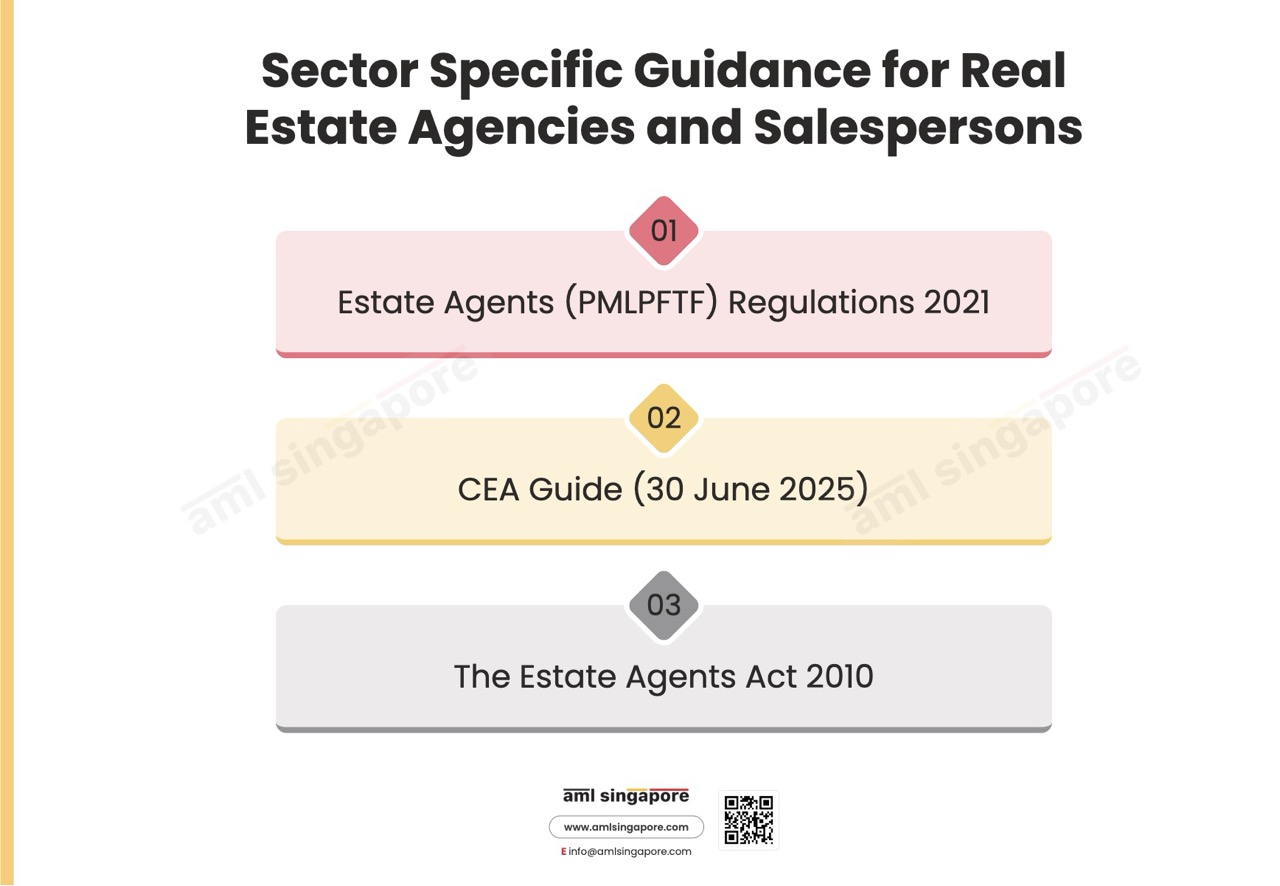
The Estate Agents (Prevention of Money Laundering, Proliferation Financing and Terrorism Financing) Regulations 2021
The Estate Agents (Prevention of Money Laundering, Proliferation Financing and Terrorism Financing) Regulations 2021 are the binding AML/CFT rulebook for the trade. Made under the Estate Agents Act and administered by the Council for Estate Agencies, they apply to a responsible person in relation to estate agency work. Where a registered salesperson has been authorised by the licensed estate agent to carry out the work, the registered salesperson is the responsible person. In other cases, the licensed estate agent is the responsible person. The Regulations allocate obligations according to the responsible person carrying out the estate agency work.
The Regulations open with general customer due diligence. The prescribed customer due diligence includes identifying and verifying the client using reliable and independent sources. Where the client is an entity or a legal arrangement, it must go further and identify the beneficial owner, the natural person who ultimately owns or controls the entity, obtaining the prescribed information and taking reasonable measures to verify it. This look through is central, because a property is so often bought through a company, and the salesperson must know who really stands behind the buyer or the seller.
Enhanced due diligence applies where the higher risk conditions in Regulation 6 are met, including specified higher risk transactions, foreign politically exposed persons and relevant higher risk jurisdictions, with source of wealth and funds. In April 2026, CEA issued further industry guidance on implementing the AML, CPF and CFT amendments that took effect on 1 July 2025.
For an acquisition or disposition involving an unrepresented counterparty, the responsible person must perform the applicable counterparty due diligence, subject to the Regulations and exceptions. Enhanced counterparty due diligence applies where the relevant transaction or person presents a higher risk. The CEA states that unrepresented counterparty due diligence applies to rental, sale and purchase transactions, except HDB residential rental transactions.
The Regulations complete the framework with monitoring, controls and reporting. A responsible person must conduct ongoing monitoring of its business relationships, and an agency must carry out a risk assessment and maintain internal controls and compliance management proportionate to its size.
It must keep records of its due diligence and its transactions for the prescribed period. And where the applicable statutory reporting obligation is triggered, the relevant disclosure must be made to the Suspicious Transaction Reporting Office. The Regulations also contain requirements concerning tipping off and situations where the responsible person cannot complete the required due diligence.
The Regulations also fix where the duties land inside an agency. The Regulations allocate duties to the responsible person and impose separate compliance management obligations on licensed estate agents, including risk assessment and internal controls.
The Regulations allocate duties according to the responsible person and require licensed estate agents to maintain appropriate risk assessment, internal controls and compliance management arrangements. Registered salespersons authorised to carry out estate agency work may themselves be the responsible person for that work.
This is why an agency’s risk assessment and its supervision of its salespeople matter as much as any single file, and why the Council for Estate Agencies looks at both the agency’s system and the salesperson’s conduct when it inspects. A gap in either, a policy that is never applied, or a salesperson who skips the checks, is enough to put the agency in breach, so the two responsibilities must work together in practice rather than on paper.
Reliance and responsibility run through the Regulations. A responsible person may rely on a third party where regulation 8 permits it, subject to the conditions and responsibilities under the Regulations. Because a property deal typically involves an agency on each side, a law practice and often a bank, the Regulations make clear that the salesperson cannot assume another party has done the checks; its own due diligence, on its client and, where required, the counterparty, is its own to perform and to evidence to the Council for Estate Agencies.
CEA Guide on the Estate Agents (PMLPFTF) Regulations 2021 (30 June 2025)
The Council for Estate Agencies Guide on the Estate Agents PMLPFTF Regulations 2021, dated 30 June 2025, provides practical guidance to estate agents and salespersons on implementing their obligations under the Regulations. The Guide should be read together with the FAQs, binding legislation and regulations, and the Consumer’s Guide to Due Diligence and includes practical forms and unrepresented counterparty due diligence.
The Guide begins with the sector’s risk picture and the risk based approach. It explains why real estate attracts money laundering, that a purchase can place a large sum in one step, that property holds value, and that corporate vehicles and foreign buyers add risk, and it walks an agency through assessing its own risk across its clients, its transactions and its channels. It stresses that the depth of due diligence should follow the risk, so that a high value private property deal, a corporate buyer or a foreign client draws closer attention than a routine, lower risk transaction.
On customer due diligence, counterparty due diligence, the Guide explains how estate agents and salespersons should identify and verify clients, beneficial owners and unrepresented counterparties. The Guide includes specific forms for unrepresented counterparties and provides for enhanced measures where the relevant higher risk conditions apply. It gives particular attention to establishing source of wealth and funds on a high value purchase, and to the handling of a client or counterparty that is a politically exposed person or connected to a higher risk jurisdiction, the situations where a property deal is most exposed.
The Guide is at its most useful on the everyday signals and the report. It is accompanied by red flag indicators for developers, agencies and salespersons, and it explains the warning signs a salesperson should watch for, from a buyer indifferent to the property to a price that does not match the market or funds arriving from an unexpected third party, and how a suspicion becomes a suspicious transaction report to the Suspicious Transaction Reporting Office without tipping off the client or the counterparty. It is supported by frequently asked questions for agents and salespersons and by a consumer guide, so that both the trade and the public understand the checks a property transaction now involves.
The Guide provides practical guidance on applying the requirements of the Regulations. It recognises that a salesperson meets a client early, often before a price is agreed, and it helps time the due diligence so that identification and verification happen before the agency work is carried out rather than at the eleventh hour of a completion. It addresses common real world situations: a co broking deal where two agencies are involved, a buyer purchasing through a newly formed company, an overseas buyer who cannot attend in person, and a rental rather than a sale. In each, it points the salesperson to the measures the Regulations require, so that the guidance maps onto the transactions an agency handle rather than an abstract model of them.
The Guide provides practical examples and materials that agencies can use when implementing the Regulations. That is especially useful for a smaller agency without a dedicated compliance team, which can adopt the Guide’s approach directly rather than designing its own from first principles, and then provide evidence to the Council that its salespersons follow it.
The Guide is candid about roles, records and consequences. It explains how the duties fall on the agency and on the individual salesperson, what the key executive officer must oversee, and how records of due diligence and transactions must be kept and produced to the Council on inspection. It explains the compliance duties and potential consequences of failing to comply with the applicable requirements, and it reflects the Council’s expectation that an agency keeps its controls current as risks, and the Regulations, evolve. Read with the Regulations, the Guide turns a set of legal duties into a routine an agency can run across every listing and every deal.
The Council for Estate Agencies Guide on the Estate Agents PMLPFTF Regulations 2021, dated 30 June 2025, provides practical guidance to estate agents and salespersons on implementing their obligations under the Regulations. The Guide should be read together with the FAQs, binding legislation and regulations, and the Consumer’s Guide to Due Diligence and includes practical forms and unrepresented counterparty due diligence.
The Guide begins with the sector’s risk picture and the risk based approach. It explains why real estate attracts money laundering, that a purchase can place a large sum in one step, that property holds value, and that corporate vehicles and foreign buyers add risk, and it walks an agency through assessing its own risk across its clients, its transactions and its channels. It stresses that the depth of due diligence should follow the risk, so that a high value private property deal, a corporate buyer or a foreign client draws closer attention than a routine, lower risk transaction.
On customer due diligence, counterparty due diligence, the Guide explains how estate agents and salespersons should identify and verify clients, beneficial owners and unrepresented counterparties. The Guide includes specific forms for unrepresented counterparties and provides for enhanced measures where the relevant higher risk conditions apply. It gives particular attention to establishing source of wealth and funds on a high value purchase, and to the handling of a client or counterparty that is a politically exposed person or connected to a higher risk jurisdiction, the situations where a property deal is most exposed.
The Guide is at its most useful on the everyday signals and the report. It is accompanied by red flag indicators for developers, agencies and salespersons, and it explains the warning signs a salesperson should watch for, from a buyer indifferent to the property to a price that does not match the market or funds arriving from an unexpected third party, and how a suspicion becomes a suspicious transaction report to the Suspicious Transaction Reporting Office without tipping off the client or the counterparty. It is supported by frequently asked questions for agents and salespersons and by a consumer guide, so that both the trade and the public understand the checks a property transaction now involves.
The Guide provides practical guidance on applying the requirements of the Regulations. It recognises that a salesperson meets a client early, often before a price is agreed, and it helps time the due diligence so that identification and verification happen before the agency work is carried out rather than at the eleventh hour of a completion. It addresses common real world situations: a co broking deal where two agencies are involved, a buyer purchasing through a newly formed company, an overseas buyer who cannot attend in person, and a rental rather than a sale. In each, it points the salesperson to the measures the Regulations require, so that the guidance maps onto the transactions an agency handle rather than an abstract model of them.
The Guide provides practical examples and materials that agencies can use when implementing the Regulations. That is especially useful for a smaller agency without a dedicated compliance team, which can adopt the Guide’s approach directly rather than designing its own from first principles, and then provide evidence to the Council that its salespersons follow it.
The Guide is candid about roles, records and consequences. It explains how the duties fall on the agency and on the individual salesperson, what the key executive officer must oversee, and how records of due diligence and transactions must be kept and produced to the Council on inspection. It explains the compliance duties and potential consequences of failing to comply with the applicable requirements, and it reflects the Council’s expectation that an agency keeps its controls current as risks, and the Regulations, evolve. Read with the Regulations, the Guide turns a set of legal duties into a routine an agency can run across every listing and every deal.
The Estate Agents Act 2010
The statute that constitutes the trade and houses its anti money laundering regime. It establishes the Council for Estate Agencies, requires estate agencies to be licensed and salespersons to be registered, and empowers the AML Regulations. Holding a licence and registration is what brings a firm and its salespersons within the Regulations and the Council’s supervision.
The Due Diligence Measures a Salesperson Applies
The Regulations set out the measures by situation. The table below sets out each one and the action it requires of a responsible person.
Situation | What the responsible person must do under the Regulations 2021 |
Before any estate agency work for a client | Perform general customer due diligence: identify and verify the client from reliable and independent sources (regulation 4) |
A client that is an entity or a legal arrangement | Identify and verify the beneficial owner, the natural person who ultimately owns or controls the entity or arrangement (regulation 5) |
A rental, not only a sale or purchase | Apply the due diligence the Regulations require to rental transactions as well (regulation 7) |
A higher risk client or transaction | Perform enhanced due diligence, including establishing source of wealth and funds (regulation 6) |
Acting for one side of a higher risk deal | Carry out enhanced counterparty due diligence on the other side of the transaction, not only on the firm’s own client (regulation 12D) |
Any reasonable suspicion of ML, TF or PF | File a suspicious transaction report to STRO, and do not tip off the client or the counterparty |
Why Real Estate Attracts Laundering
The national assessment explains the sector’s vulnerability through the nature of property and its buyers. The table below maps it to a salesperson’s controls.
Why real estate attracts laundering | What it means for a salesperson’s controls |
A large sum in a single transaction | A property purchase can place a substantial amount at once, so a high value deal deserves close due diligence on the buyer and the funds |
A store of value that can appreciate | Real estate holds and grows value, which is why criminals favour it and why the source of the purchase money matters |
Purchase through a company or trust | A corporate vehicle or arrangement can disguise the real owner, so the salesperson must look through to the beneficial owner |
Foreign and higher risk buyers | The market draws foreign buyers, some from higher risk jurisdictions, calling for enhanced measures and source of funds checks |
Public housing is different | HDB flats are tightly controlled, closed to foreigners and not observed to be misused, so the private segment carries the higher risk |
Allied Laws Applicable to Real Estate Agencies and Salespersons in Singapore
These statutes are not primarily AML instruments, but each supports the regime: some license and govern the trade, others govern the legal persons behind a corporate buyer, and others give investigators their powers or create the offences a salesperson screens against.
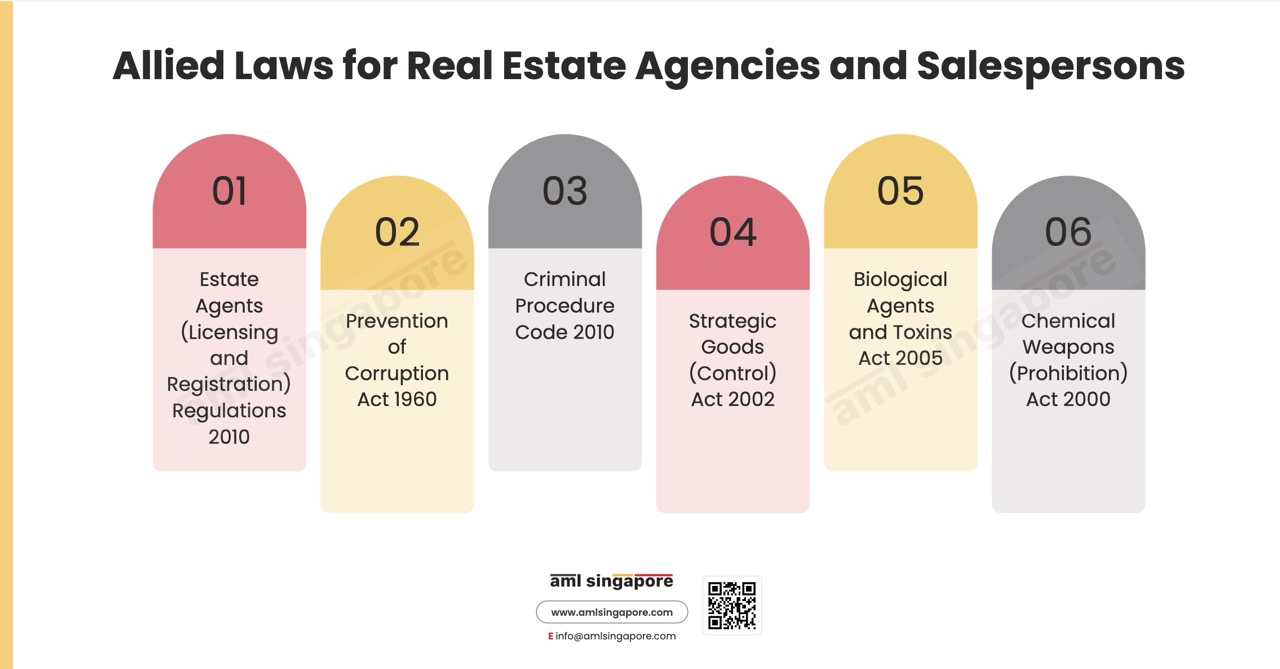
The Estate Agents (Licensing and Registration) Regulations 2010
The rules that govern the licensing of agencies and the registration of salespersons, including fit and proper requirements. They set the professional gate a firm and a salesperson must pass and keep, and they form the regulatory frame within which the AML Regulations and the Council’s inspections operate. From 1 January 2026, RESs and KEOs are subject to an enhanced requirement of 16 CPD hours each year. From 1 January 2027, CEA will move to a three year licensing and registration cycle and introduce a new Currency Requirement for RES registration renewal.
The Prevention of Corruption Act 1960
Singapore’s principal anti corruption law. Because corruption is a predicate offence for money laundering, its proceeds are among the funds a salesperson watches for when a buyer’s means do not fit the purchase, and its presumption on unexplained assets reinforces scrutiny where the source of the money cannot be explained.
The Criminal Procedure Code 2010
The statute setting out how criminal matters are investigated and tried in Singapore, including the powers to demand production and to search and seize. The Criminal Procedure Code 2010 provides the procedural framework for criminal investigations and proceedings, including statutory powers available to law enforcement authorities. Where an estate agency receives a lawful request or order for documents or information, it must comply with the applicable legal requirements. Any confidentiality or disclosure restriction should be stated only where the relevant statutory provision applies.
The Strategic Goods (Control) Act 2002
Governs the transfer and brokering of strategic and dual use goods, the proliferation financing nexus a salesperson meets at a distance, where a buyer’s funds derive from a business that touches such trade, adding a strand to the source of funds enquiry on a higher risk purchaser.
The Biological Agents and Toxins Act 2005
The Biological Agents and Toxins Act 2005 regulates specified biological agents and toxins and related activities. Its relevance to real estate agencies and salespersons is indirect.
The Chemical Weapons (Prohibition) Act 2000
The Chemical Weapons Prohibition Act 2000 gives effect to Singapore’s obligations under the Chemical Weapons Convention and establishes offences and regulatory requirements concerning chemical weapons and specified chemicals. Its relevance to real estate agents and salespersons is indirect, and it should not be described as imposing a specific proliferation financing screening obligation on them.
Miscellaneous Laws and Regulations Applicable to Real Estate Agencies and Salespersons in Singapore
These national strategies, committee reports, and typology resources provide policy direction, risk information and practical context for Singapore’s AML, CFT and CPF framework. They are not substitutes for the binding legislation and regulations applicable to estate agents and salespersons, but their findings may inform risk assessment and the development of appropriate controls.
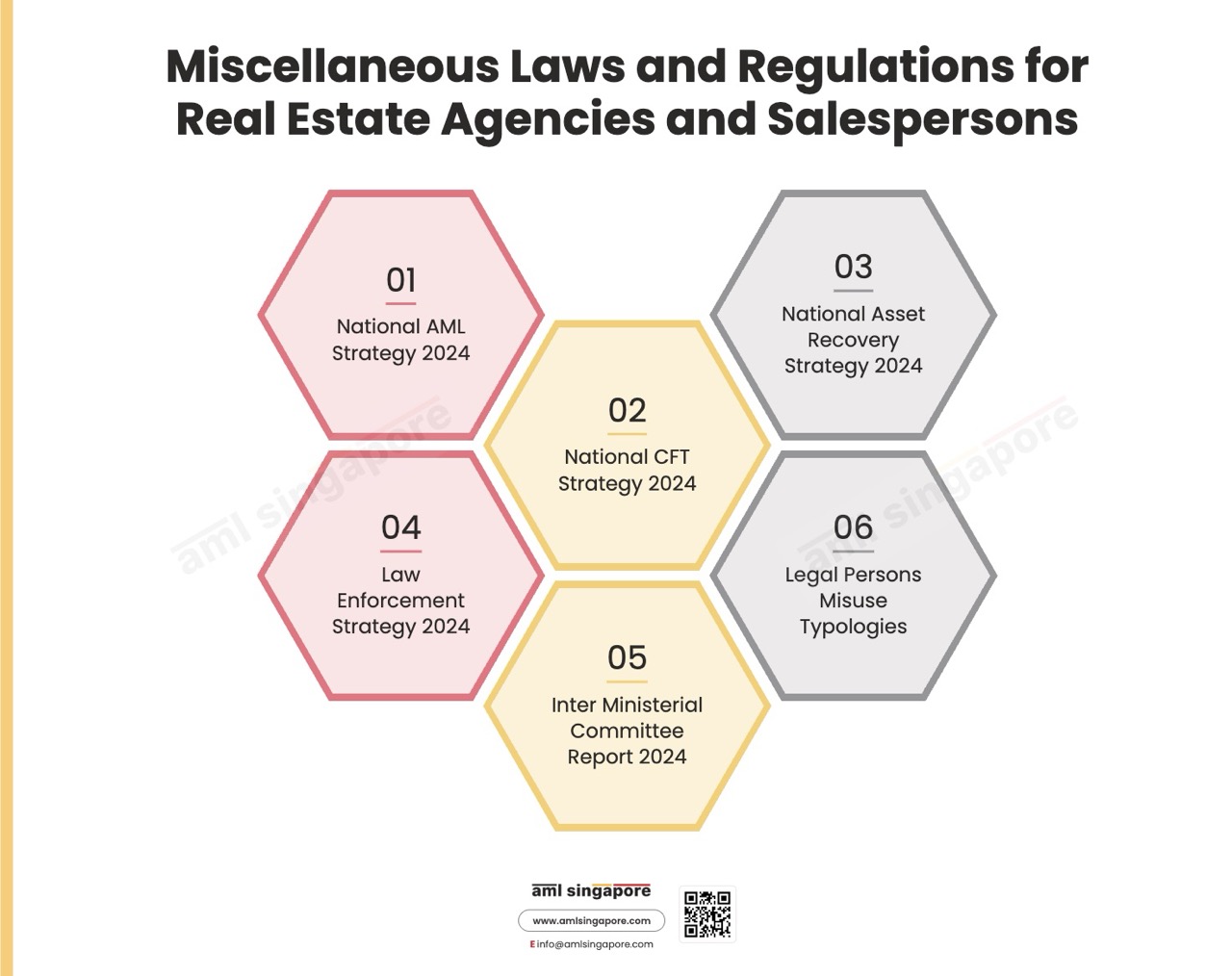
National Anti Money Laundering Strategy 2024
Singapore’s National Anti Money Laundering Strategy 2024 sets out the national approach to addressing money laundering risks and is structured around three pillars: Prevent, Detect and Enforce. It provides the broader national policy framework within which real estate agencies and salespersons carry out their AML obligations.
National Strategy for Countering the Financing of Terrorism 2024
Singapore refreshed its National Strategy for Countering the Financing of Terrorism in July 2024 alongside the updated Terrorism Financing National Risk Assessment. The strategy retains five prongs: coordinated and comprehensive risk identification, strong legal and sanctions frameworks, robust regulatory regimes, decisive enforcement actions, and international partnerships and cooperation. Its objectives are to prevent, detect and disrupt terrorism financing.
National Asset Recovery Strategy 2024
Singapore’s National Asset Recovery Strategy sets out the country’s comprehensive approach to recovering illicit funds and assets from criminals and forfeiting those assets or returning them to victims. It forms part of Singapore’s efforts to strengthen its AML and CFT regime. Its relevance to estate agents and salespersons is through the wider national framework for detecting and recovering illicit assets.
Singapore Law Enforcement Strategy to Combat Money Laundering (October 2024)
Singapore’s Law Enforcement Strategy to Combat Money Laundering was published in October 2024 by the Singapore Police Force, Central Narcotics Bureau and Corrupt Practices Investigation Bureau. It identifies key focus areas for prioritising money laundering threats and guiding investigations, based on the risks identified in the 2024 Money Laundering National Risk Assessment. It forms part of the wider national AML framework rather than creating sector specific obligations for estate agents and salespersons.
Inter Ministerial Committee on Anti Money Laundering Report (October 2024)
The Inter Ministerial Committee on Anti Money Laundering published its report on 4 October 2024 following its review of Singapore’s AML framework. The review covered the misuse of corporate structures, financial institutions, gatekeepers including real estate salespersons and estate agencies, government monitoring and sense making capabilities, and enforcement capabilities. Its recommendations formed part of the measures to strengthen Singapore’s AML framework.
Legal Persons: Misuse Typologies and Best Practices (2018)
Legal Persons Misuse Typologies and Best Practices is a typology resource concerning the misuse of legal persons and the concealment of beneficial ownership. It provides examples and indicators that can assist relevant stakeholders in understanding risks associated with legal persons. It is a typology resource and not a binding legal requirement for estate agents or salespersons.
International Standards Applicable to Real Estate Agencies and Salespersons in Singapore
FATF standards inform Singapore’s AML/CFT/CPF framework but are not Singapore legislation. Estate agent obligations arise from Singapore legislation and regulations.
The FATF Recommendations (updated June 2026)
The 40 Recommendations are the global AML/CFT and counter proliferation standard, and FATF Recommendations 22 and 23 address AML/CFT obligations for designated non financial businesses and professions, including real estate agents. They inform Singapore’s domestic framework but are not directly binding legislation.
Methodology for Assessing Technical Compliance and Effectiveness (updated June 2026)
The FATF’s yardstick for two things at once: whether a country’s rules technically meet the Recommendations and whether its defences work on the ground. It is the benchmark against which Singapore, and the real estate sector within it, is assessed, and it shapes the Council’s expectations.
Mutual Evaluation Report of Singapore (May 2026)
The 2026 review by the FATF and the Asia/Pacific Group judges how effectively Singapore’s regime works in practice, including the supervision of real estate agents as a designated sector. It frames the expectations the Council for Estate Agencies carries into its oversight.
FATF Guidance on Politically Exposed Persons (Recommendations 12 and 22, 2013)
Sets out how to recognise a politically exposed person and lift due diligence in response, senior sign off, working out the source of wealth and funds, and closer monitoring, which a salesperson brings to bear when a PEP is on either side of a property deal, above all a high value one.
Guidance on Beneficial Ownership of Legal Persons (March 2023)
Guidance under the revised Recommendation 24 on obtaining and verifying beneficial ownership information, shaping how a salesperson identifies the natural person behind a company that is buying a property.
Best Practices on Beneficial Ownership for Legal Persons (October 2019)
A collection of country best practices for keeping beneficial ownership information adequate, accurate and up to date, backing a salesperson’s checks where a company stands behind a purchase.
Concealment of Beneficial Ownership (July 2018)
A FATF and Egmont Group typologies report on how criminals hide beneficial ownership through nominees and layered structures, giving a salesperson the red flags where a buyer seems to be acting for someone kept out of sight.
Risk Based Approach: Beneficial Ownership and Transparency of Legal Arrangements (March 2024)
Guidance under Recommendation 25 on trusts and similar arrangements, relevant to a salesperson where a trust or similar structure is used to hold or buy a property.
FATF Guidance on Counter Proliferation Financing (February 2018)
Guidance on carrying out the financial provisions of Security Council resolutions against weapons of mass destruction proliferation, under which a salesperson must screen and act without delay in line with Recommendation 7 where a buyer’s structure could disguise procurement.
Guidance on Proliferation Financing Risk Assessment and Mitigation (June 2021)
Describes how a firm should assess and reduce proliferation financing risk after the changes to Recommendations 1 and 2 brought it within the risk assessment duty, which an agency now discharges as part of its risk assessment.
Money Laundering from Environmental Crime (July 2021)
A FATF report on the channels through which the proceeds of environmental crime pass into and through the financial system. It becomes relevant to a salesperson where a property purchase might be funded from such proceeds, adding one more consideration to the checks it makes.
Guidance on Digital Identity (March 2020)
Helps an agency judge whether a digital identity system is reliable and independent enough for customer due diligence under a risk based approach, a live question as clients are onboarded remotely for a viewing or a deal
Artificial Intelligence and Deepfakes: Impacts on ML/TF/PF
A forward looking FATF survey of the threat artificial intelligence and deepfakes pose to preventive systems, such as a synthetic identity slipping past the verification of a buyer met only online, set against the ways the same tools can strengthen screening and monitoring.
Summary of the Key Instruments
The table below distils the instruments a real estate agency and its salespersons rely on most, what type each is, whom it binds, and the core obligation it places on the trade. Treat it as a fast lookup next to the discussion; the detailed sections above stay the governing account.
Instrument | Type | Binds | Core obligation for a real estate agency |
CDSA 1992 | Statute | Everyone | Report suspected criminal proceeds; do not tip off |
TSOFA 2002 | Statute | Everyone | Do not deal in terrorist property; screen and report |
UN Act sanctions regulations (DPRK, Iran) | Regulations | All persons | Screen for and freeze designated persons without delay |
Estate Agents (PMLPFTF) Regulations 2021 | Regulations (binding) | Agencies, salespersons | Customer, beneficial ownership and counterparty CDD; STR |
CEA Guide (30 June 2025) | Guidance | Agencies, salespersons | Primary guidance; how to apply the Regulations |
Estate Agents Act 2010 | Statute | The trade | Licence agencies, register salespersons, empower the Regulations |
FATF Recommendations | Standard | Countries/DNFBPs | Designate real estate agents; global CDD standard |
Conclusion
For real estate agencies and salespersons in Singapore, the AML, CPF and CFT framework combines general criminal and sanctions laws with sector specific requirements under the Estate Agents PMLPFTF Regulations 2021. The Regulations require customer due diligence, beneficial ownership measures, risk assessment, enhanced due diligence where applicable, ongoing monitoring, targeted financial sanctions measures, record keeping and counterparty due diligence.
The CEA provides guidance and supervises estate agents and salespersons for compliance with the applicable framework. Because the risk lives in high value transactions and hidden ownership, a salesperson’s controls are built around who its client and the counterparty really are and where the money comes from.
The instruments interlock. An agency’s risk assessment draws on the national risk assessments; its due diligence flows from the Estate Agents Regulations and the Council’s Guide; its licence and its salespersons’ registration come from the Estate Agents Act; and its beneficial ownership work is governed by the Estate Agents PMLPFTF Regulations, with corporate information and other reliable sources used as part of the verification process. Seeing how the pieces connect, and remembering that the Council for Estate Agencies, not MAS, is the supervisor, is what turns a property gatekeeper into a framework an agency can defend.
Property developers selling units in their own new projects follow a parallel regime under the Controller of Housing, which our companion guide to real estate developers explains.
The risk assessment is the foundation the Estate Agents Regulations build on. We help real estate agencies scope, document and defend that assessment against Singapore’s national risk assessments.
Frequently Asked Questions
Real estate agencies and their salespersons are supervised for anti money laundering purposes by the Council for Estate Agencies, under the Estate Agents Act, not by the Monetary Authority of Singapore. Their rulebook is the Estate Agents (Prevention of Money Laundering, Proliferation Financing and Terrorism Financing) Regulations 2021, read with the Council’s Guide.
Before carrying out the relevant estate agency work, the salesperson must complete the applicable customer due diligence. Where the counterparty is unrepresented, the applicable counterparty due diligence requirements also apply, subject to the relevant requirements and exceptions. Enhanced measures apply where the higher risk conditions under the Regulations are met.
Counterparty due diligence applies to an unrepresented counterparty in a property transaction where an estate agent or salesperson is acting for a client, subject to the requirements and exceptions in the Regulations. The current CEA guidance states that unrepresented counterparty due diligence applies to rental, sale and purchase transactions, except HDB residential rental transactions. Enhanced counterparty due diligence applies where the higher risk conditions under the Regulations are met.
Singapore’s 2024 assessment rates the threat as moderately high and the sector as more vulnerable than most. A property purchase can place a large sum in a single transaction and holds value, corporate vehicles can disguise the real owner, and the market draws foreign buyers. Public housing is tightly controlled and less exposed, so the private segment carries the higher risk.
Where the client is an entity or a legal arrangement, the salesperson must identify and verify the beneficial owner, the natural person who ultimately owns or controls it, from reliable and independent sources. This look through is central to a salesperson’s due diligence where a property is bought through a company or a trust.
Where the applicable statutory reporting obligation is triggered, a suspicious transaction report must be filed with the Suspicious Transaction Reporting Office through SONAR. The CDSA requires disclosure where a person knows or has reasonable grounds to suspect that property represents the proceeds of or is connected to criminal conduct. Separate disclosure obligations apply under the TSOFA and applicable United Nations sanctions regulations. Our guide to STR red flags explains common triggers, such as a purchase funded from an unexplained source or a buyer indifferent to the property.
About the Author

Pathik Shah
FCA, CAMS, CISA, CS, DISA (ICAI), FAFP (ICAI)
Pathik is a Chartered Accountant with more than 26 years of experience in governance, risk, and compliance. He helps companies with end-to-end AML compliance services, from conducting Enterprise- Wide Risk Assessments to implementing the robust AML Compliance framework. He has played a pivotal role as a functional expert in developing and implementing RegTech solutions for streamlined compliance.