AML Laws and Regulations for Money Lenders in Singapore
In a Nutshell
A licensed moneylender in Singapore lends small, mostly unsecured sums to individuals and businesses under a licence from the Registry of Moneylenders. Its regulator is the Ministry of Law, so its anti money laundering rulebook is different from the one banks and other institutions follow.
That rulebook is the Moneylenders (Prevention of Money Laundering, Terrorism Financing and Proliferation Financing) Rules 2009, made under the Moneylenders Act 2008, supported by an Information Guide and additional guidance from the Registry. Together they set the risk based approach, customer due diligence on the borrower, enhanced measures for politically exposed persons, suspicious transaction reporting and record keeping.
Singapore’s 2024 Money Laundering National Risk Assessment assesses the licensed moneylending sector as medium low money laundering risk. It identifies the cash intensive nature of the sector as its key vulnerability and notes that loans are domestic in nature, typically small and straightforward. The assessment also states that IPTO will continue to require licensed moneylenders to approve loans only after face to face contact with their customers.
Around this core sit the criminal and sanctions statutes that bind every business, the national risk assessments, the Moneylenders Act that licenses the sector, and the FATF standards.
AML Laws and Regulations for Money Lenders in Singapore
A licensed moneylender deals in small loans and, often, in cash, and that combination is what draws money laundering attention to an otherwise modest corner of finance. This guide sets out the laws and regulations that apply to a licensed money lender in Singapore, from the criminal statutes that make money laundering an offence to the detailed rulebook the Registry of Moneylenders enforces on money lending business.
The framework is best read in layers. The criminal and sanctions laws sit at the base. Above them is the instrument a moneylender works with every day, the Moneylenders (Prevention of Money Laundering, Terrorism Financing and Proliferation Financing) Rules 2009, together with the Registry’s guidance. Alongside these run Singapore’s national risk assessments, the Moneylenders Act that licenses the sector, and the FATF standards behind the whole regime. Each instrument below is explained through the lens of a moneylender, not in the abstract.
Because a moneylender advances cash and takes repayment in cash, its exposure is less to the cross border layering seen in banking than to the simple placement of illicit cash, whether a criminal lends out dirty money through a licence or repays a loan with the proceeds of crime. That shapes much of what follows, from how a moneylender screens a borrower to how it watches a repayment.
Singapore's Licensed Money Lenders at a Glance
There were 153 licensed moneylenders in Singapore issuing loans of approximately S$1.9 billion as at the end of 2023. The number of licensed moneylenders had remained stable in recent years. The sector supervisor for licensed moneylenders was IPTO, which applied a risk based approach to supervision. (ML NRA 2024, paragraphs 7.12.5 and 7.12.10)
Loans disbursed by licensed moneylenders are domestic in nature, with the majority of customers being locals, followed by foreigners working or residing in Singapore. Transactions are generally straightforward loan issuances and collection of loan repayments. Given the statutory limits on the quantum of loans that may be disbursed, moneylending loans are typically small, with an average loan value of about S$5,300. (ML NRA 2024, paragraphs 7.12.5 and 7.12.6)
Risk rating: the sector is assessed as having medium low money laundering risk. The key vulnerability identified is the intensity of cash transactions, while the sector’s ML threat is assessed as moderate. (ML NRA 2024, paragraphs 7.12.3, 7.12.7 and 7.12.13).
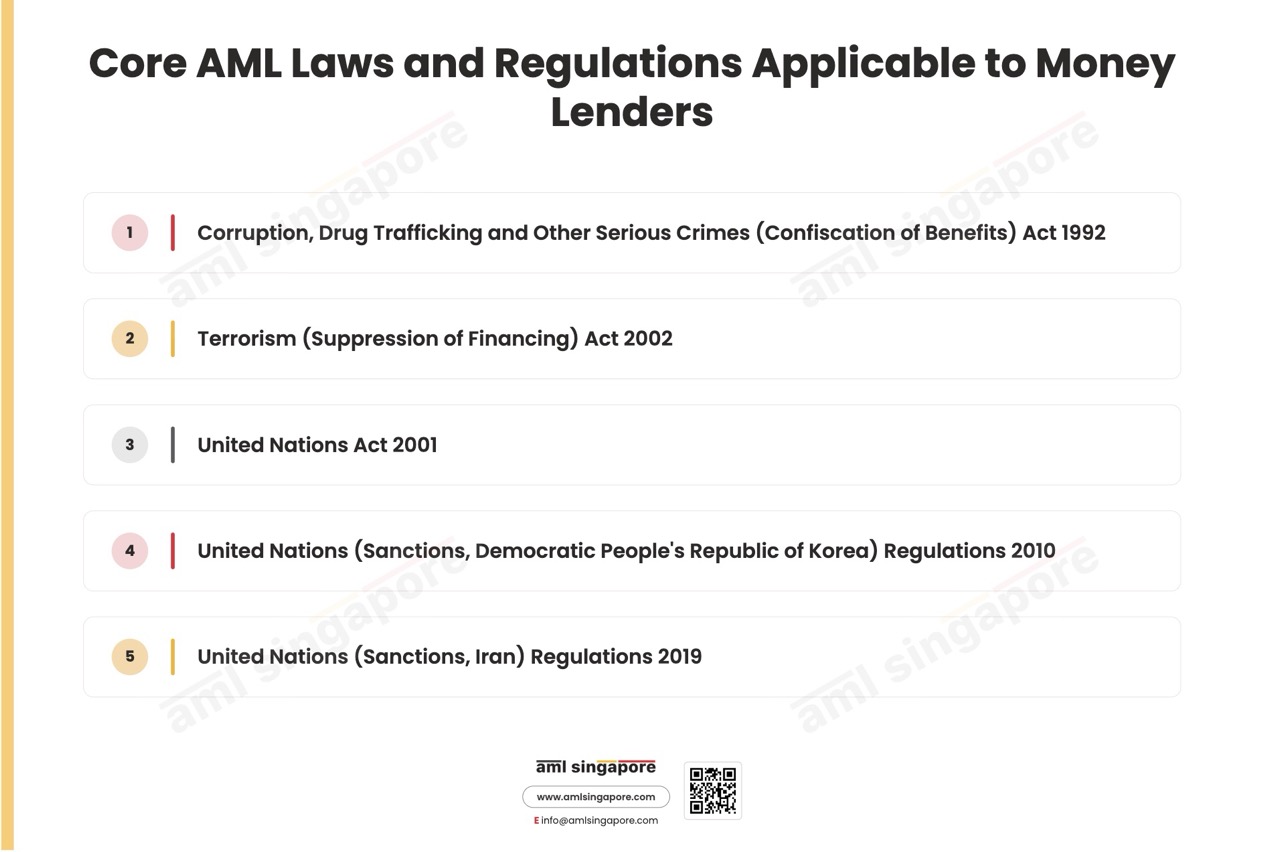
Core AML Laws and Regulations for Money Lenders in Singapore
These laws and regulations form part of the legal framework applicable to moneylenders for preventing money laundering, terrorism financing and proliferation financing. The CDSA and TSOFA contain specific disclosure and other obligations, while the United Nations Act and regulations made under it give effect to specified United Nations sanctions. The Moneylenders Rules impose sector specific customer due diligence, screening, suspicious transaction reporting and other AML, CFT and CPF obligations on moneylenders.
The Corruption, Drug Trafficking and Other Serious Crimes (Confiscation of Benefits) Act 1992
The CDSA contains Singapore’s principal money laundering offences and provisions relating to confiscation of benefits from drug dealing and criminal conduct. Section 45 requires a person who, in the course of their trade, profession, business or employment, knows or has reasonable grounds to suspect that property represents the proceeds of, was used in connection with, or is intended to be used in connection with drug dealing or criminal conduct to disclose that knowledge or suspicion to a Suspicious Transaction Reporting Officer as soon as is reasonably practicable. Section 57 contains the tipping off offence.
The Terrorism (Suppression of Financing) Act 2002
Under the TSOFA, certain dealings involving property belonging to terrorists or terrorist entities are prohibited, and section 8 imposes a disclosure obligation on every person in Singapore, and every Singapore citizen outside Singapore, who has possession, custody or control of such property or information about a transaction or proposed transaction involving such property. The Moneylenders Rules also require moneylenders to evaluate borrowers and relevant persons to determine whether they are terrorists or terrorist entities and to carry out the prescribed screening measures.
The United Nations Act 2001
The United Nations Act 2001 empowers the Minister to make regulations to give effect to Article 41 of the Charter of the United Nations. Moneylenders are expected to comply with the United Nations Act and regulations made under it. The Registry of Moneylenders also requires licensed moneylenders to screen customers against the relevant lists of designated individuals and entities published by MAS under the United Nations Act and TSOFA.
The United Nations (Sanctions, Democratic People's Republic of Korea) Regulations 2010
Made under the United Nations Act, these regulations give effect to applicable United Nations sanctions relating to the Democratic People’s Republic of Korea in Singapore. Moneylenders must comply with the applicable requirements of the United Nations Act and its regulations and must carry out customer screening as required under the Moneylenders (Prevention of ML, TF and PF) Rules 2009 and directions from the Registrar. Where a match or prohibited transaction is identified, the moneylender must comply with the applicable prohibition, disclosure and other requirements under the relevant legislation.
The United Nations (Sanctions, Iran) Regulations 2019
The Iran regulations give effect to applicable United Nations sanctions relating to Iran in Singapore. Moneylenders are expected to comply with the United Nations Act and regulations made under it and must carry out the customer screening and other measures required under the Moneylenders (Prevention of ML, TF and PF) Rules 2009. A moneylender must comply with the applicable requirements under the United Nations Act and the relevant regulations.
Overarching AML Laws and Regulations Applicable to Money Lenders in Singapore
These instruments cut across the whole regime and give a moneylender the practical means to discharge its reporting duties and to recognise terrorism financing when it surfaces in a loan.
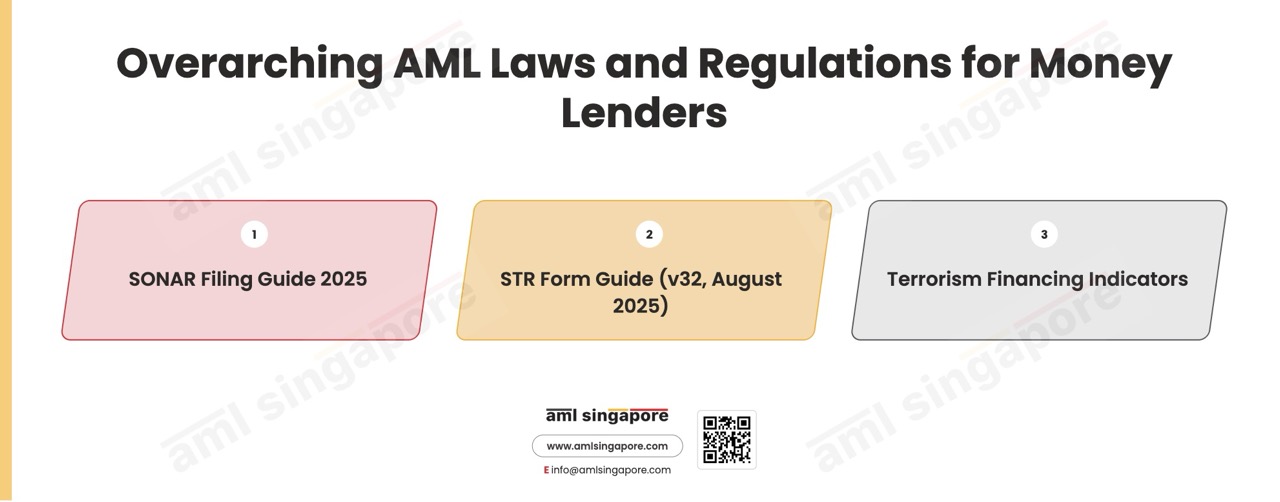
Getting Started with SONAR, for STR Filers (2025)
SONAR is the STRO Online Notices and Reporting platform through which a moneylender lodges its suspicious transaction reports electronically. It leads a filer through registration, the setting of user roles and the act of submission, and it is the channel by which the section 45 CDSA duty is discharged. A moneylender’s compliance staff rely on it to file promptly and to keep proof of each report.
Form Guide for the STR Form (Version 12 August 2025)
The Registry of Moneylenders provides guidance and resources for filing suspicious transaction reports. Moneylenders should use the current STR filing materials made available by the Registry and the applicable STRO reporting platform.
Terrorism Financing Indicators
The relevant terrorism financing indicators help moneylenders identify activity that may require further assessment and appropriate action under the applicable AML and CFT requirements. Where the statutory conditions for disclosure under TSOFA are met, the applicable disclosure must be made in accordance with TSOFA.
National Risk Assessments Applicable to Money Lenders in Singapore
Singapore publishes national assessments of money laundering, terrorism financing and proliferation financing risks. The Moneylenders Rules require each moneylender to identify, assess and understand the risks arising from its moneylending business and to take appropriate measures to manage those risks. Singapore’s 2024 Money Laundering National Risk Assessment assesses the licensed moneylending sector as medium low ML risk and identifies the intensity of cash transactions as the sector’s key vulnerability.
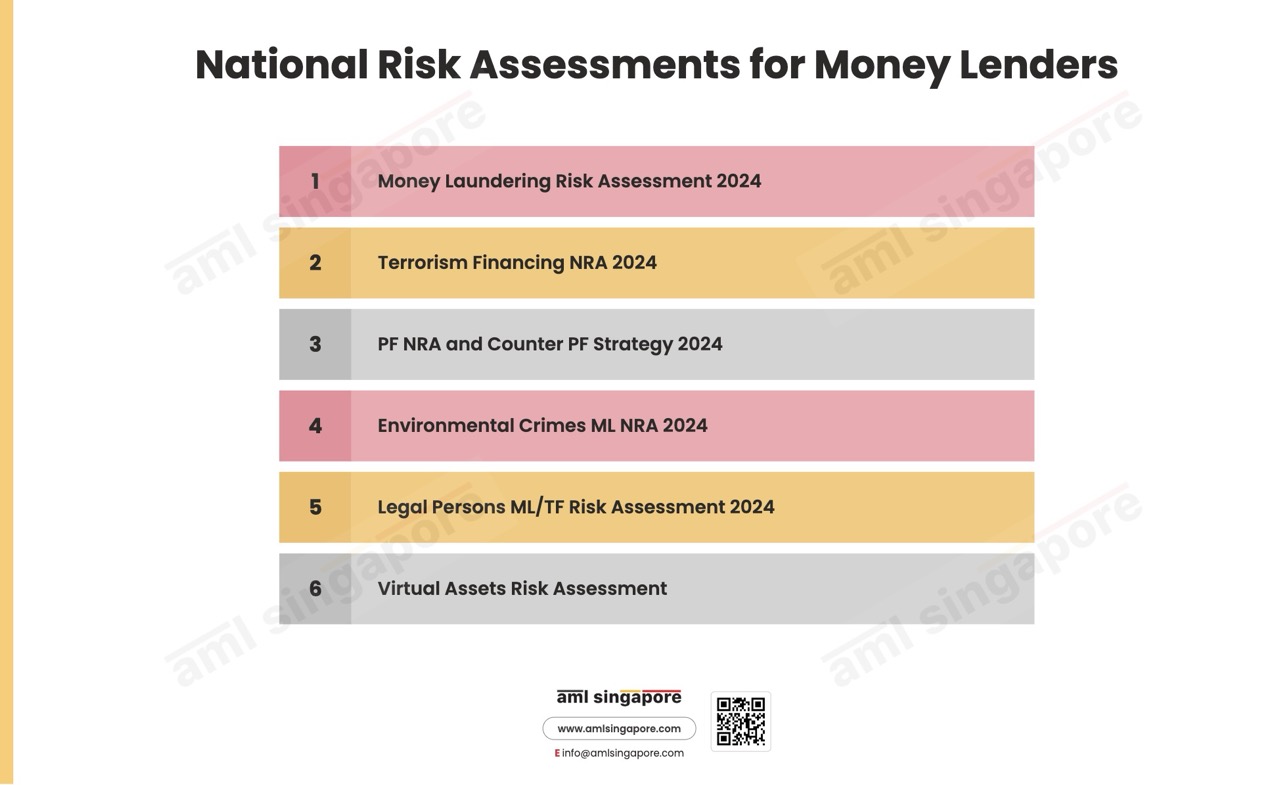
Money Laundering National Risk Assessment Singapore 2024
The national money laundering assessment devotes a section to licensed moneylenders and assesses the sector as having medium low ML risk. It states that there are no observed indications that criminals are targeting the licensed moneylending sector for ML purposes, although the cash intensive nature of the industry raises potential ML concerns because of the anonymity of cash. The assessment also notes that loans are domestic in nature and typically small. A moneylender should read these findings into its sector risk assessment.
Terrorism Financing National Risk Assessment 2024
The 2024 Terrorism Financing National Risk Assessment provides an updated assessment of Singapore’s terrorism financing threats and vulnerabilities and is intended to support a targeted and risk focused approach to countering terrorism financing. Moneylenders should consider relevant findings from the TF NRA when assessing and mitigating applicable terrorism financing risks, alongside their obligations under the Moneylenders (Prevention of Money Laundering, Terrorism Financing and Proliferation Financing) Rules 2009 and applicable terrorism financing legislation.
Proliferation Financing National Risk Assessment and Counter PF Strategy 2024
The Proliferation Financing National Risk Assessment and Counter PF Strategy 2024 identifies Singapore’s key proliferation financing threats and higher risk sectors and sets out relevant counter PF measures. Although moneylenders are not identified among the higher PF risk sectors in the assessment, all financial and non financial sectors are expected to remain alert to PF risks and take the PF NRA findings into account when reviewing and enhancing their counter PF controls, including relevant targeted financial sanctions measures. Moneylenders should also comply with the applicable requirements under the Moneylenders (Prevention of Money Laundering, Terrorism Financing and Proliferation Financing) Rules 2009 and applicable sanctions legislation.
Environmental Crimes Money Laundering National Risk Assessment (May 2024)
The Environmental Crime Money Laundering National Risk Assessment 2024 provides a targeted assessment of Singapore’s exposure to money laundering arising from environmental crimes, including illegal wildlife trafficking, illegal logging and waste trafficking. It identifies banks and cross border payment service providers as the sectors most vulnerable to misuse for laundering proceeds from environmental crimes. Moneylenders should consider relevant environmental crime ML risks when assessing their customers and transactions, particularly where information indicates that funds may be connected to environmental crime.
Money Laundering and Terrorism Financing Risk Assessment of Legal Persons (2024)
The Legal Persons Risk Assessment 2024 assesses companies and unregistered foreign companies as high ML risk and identifies instances in which companies have been misused for illicit purposes, including through shell companies. For a moneylender dealing with a corporate borrower, the assessment is relevant to understanding the ML and TF risks associated with legal persons and the importance of identifying and verifying beneficial ownership in accordance with the applicable AML/CFT requirements.
Virtual Assets (Digital Payment Tokens) Risk Assessment (2024)
The Virtual Assets Risk Assessment 2024 provides a targeted assessment of the money laundering, terrorism financing and proliferation financing risks associated with virtual assets in Singapore and identifies relevant threats, vulnerabilities and mitigation measures. For moneylenders, the assessment may be relevant where a customer, transaction or source of funds or repayment has a connection to virtual asset activity. Moneylenders should consider such connections when assessing the relevant customer and transaction risks under their risk based AML/CFT/CPF framework.
Money Lender Sector ML/TF Risk Snapshot
Money laundering: medium low risk band, with criminals not observed targeting the licensed sector and loans that are small and domestic (ML NRA 2024, chapter 7.12).
Main feature to watch: cash, since a criminal may lend out illicit funds through a licence or repay a loan with the proceeds of crime; the Registry encourages a move toward electronic payments (ML NRA 2024, chapter 7.12).
Terrorism financing: given little lending to foreigners and the absence of overseas transactions, risk is little (TF NRA 2024).
Controls: a loan is approved only after face to face contact with the borrower, and the Registry conducts risk based inspections (ML NRA 2024, chapter 7.12).
Sector Specific Guidance Applicable to Money Lenders in Singapore
This is the core of a moneylender’s obligations. Because the sector is supervised by the Ministry of Law rather than MAS, its rulebook is not a MAS notice but the Moneylenders Rules, supported by the Registry’s Information Guide and additional guidance. The two crux instruments, the Rules and the Information Guide, are covered in full below.
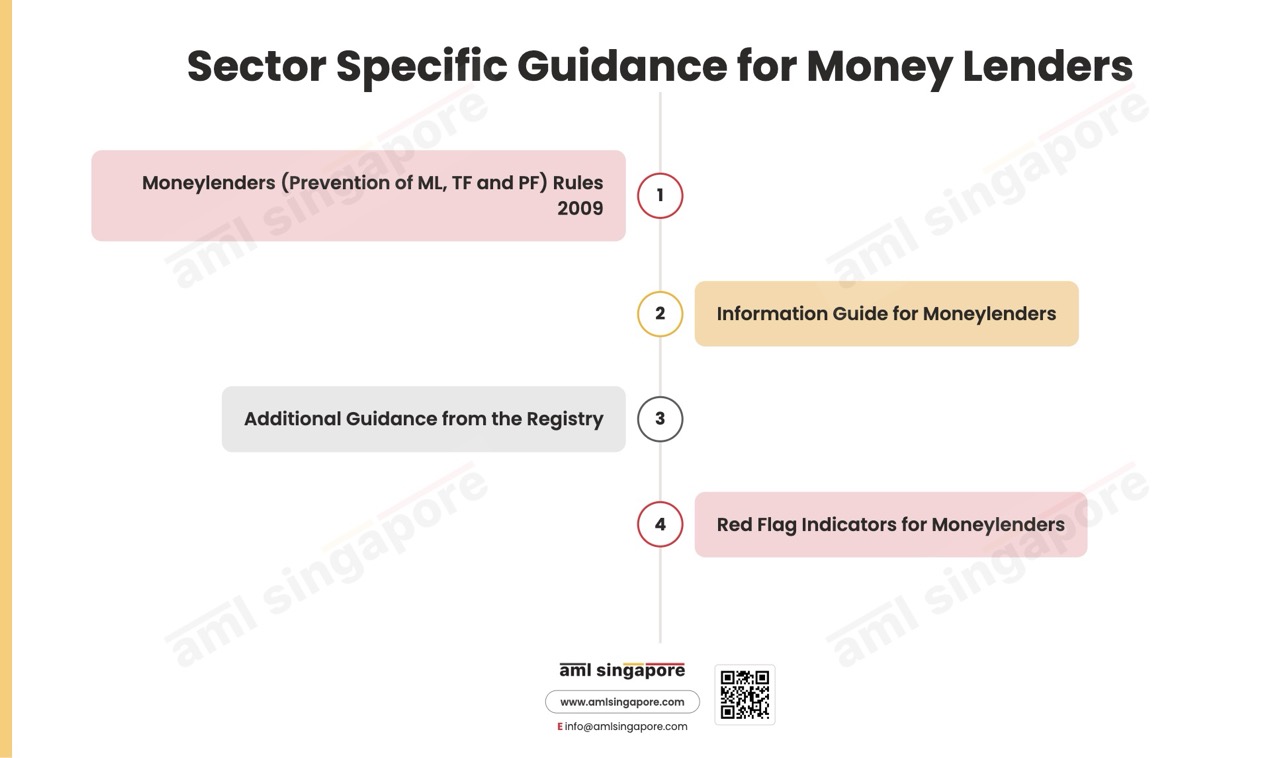
The Moneylenders (Prevention of Money Laundering, Terrorism Financing and Proliferation Financing) Rules 2009
The Moneylenders (Prevention of Money Laundering, Terrorism Financing and Proliferation Financing) Rules 2009 are the binding AML, CFT and CPF rules for moneylenders within their scope. They are made under section 93 of the Moneylenders Act 2008 and came into operation on 1 March 2009. The current version is the 2026 Revised Edition dated 3 July 2026. The Rules apply to every moneylender who grants secured or unsecured loans to the public.
The Rules require a moneylender to establish and implement internal policies, procedures and controls and to assess and manage its money laundering, terrorism financing and proliferation financing risks. Initial customer due diligence includes identifying and verifying the borrower and, where applicable, the borrower’s agent, connected parties and beneficial owner, as well as obtaining information on the purpose of the loan. Customer screening must cover every borrower and every agent, connected party and beneficial owner of a borrower against lists and information provided by the Registrar and relevant law enforcement authorities and other sources directed by the Registrar. A moneylender must also comply with the applicable requirements where it cannot complete customer due diligence or cannot verify the relevant information.
The Rules set out the customer due diligence information that a moneylender must obtain and verify. For initial due diligence, the required information depends on whether the borrower is an individual or an entity or legal arrangement and includes information concerning the borrower, its agent, connected parties and beneficial owner where applicable. Ongoing due diligence requires the moneylender to keep relevant information up to date and scrutinise transactions.
Customer screening requires a moneylender to evaluate borrowers and relevant persons to determine whether they are terrorists or terrorist entities and to screen them against lists and information provided by the Registrar and relevant law enforcement authorities, as well as other sources relating to money laundering, terrorism financing and proliferation financing as directed by the Registrar. The screening must be carried out when considering a loan, periodically during the business relationship, when relevant lists or information are updated and when relevant persons change.
The Rules apply simplified customer due diligence only where the applicable conditions are met and the risks are assessed as low. Enhanced customer due diligence is required for politically exposed persons and certain other higher risk cases. For a politically exposed persons, the measures include documenting movements of funds in the account used for disbursing or repaying a loan and assessing the likelihood of the account being used for money laundering, terrorism financing or proliferation financing, as well as establishing the source of wealth and source of funds of the borrower or beneficial owner. Enhanced measures also apply to specified complex or unusually large loans, unusual patterns of loans and other higher risk cases.
The remaining rules complete the framework. A moneylender must make the applicable disclosure where the circumstances in rule 7 arise and must comply with the tipping off requirements in rule 7A and any applicable statutory tipping off provisions. Record keeping requirements are set out in rule 7B. The Rules also contain requirements concerning audit and compliance, employees and officers, personal data, and guidelines and directions issued by the Registrar.
Information Guide on the Prevention of Money Laundering and Countering the Financing of Terrorism for Moneylenders
The Information Guide issued by the Registry provides guidance to moneylenders on the prevention of money laundering and terrorism financing and explains relevant provisions and compliance measures. It is guidance rather than legislation or subsidiary legislation. Moneylenders must comply with the binding requirements in the Moneylenders Rules and applicable legislation, while the Guide assists them in understanding and implementing those requirements.
The Guide begins with the sector’s risk picture. It explains that the cash intensive nature of money lending is the main concern, that loans are typically small and domestic, and that the terrorism financing risk is low because little is lent to foreigners and there are no overseas transactions. It draws on Singapore’s national risk assessment so that a moneylender can see where the industry’s exposure sits and tailor its controls accordingly, and it stresses that even a low risk business must have controls that are real and used, not merely written down.
On the risk based approach, the Guide walks a moneylender through assessing its own risk across its borrowers, its products and its channels, and through building policies and controls that match that risk. It then works through customer due diligence in practical terms: how to identify and verify a borrower from identity documents, how to treat an agent or a corporate borrower’s beneficial owner, and how the face to face contact the Registry requires before a loan is approved both satisfies due diligence and guards against scams and impersonation. It explains when simplified measures are acceptable and when enhanced measures, including for a politically exposed person, are required.
The Guide is at its most useful on the everyday signals. It sets out the kinds of behaviour that should put a moneylender on notice, from a borrower whose income cannot support the repayments to one who repays in unusually large cash or through a third party, and it explains how to turn a suspicion into a suspicious transaction report to the Suspicious Transaction Reporting Office without tipping off the borrower. It covers record keeping, the training a moneylender’s staff need, and the establishment of the source of a borrower’s funds where the loan or the repayment does not add up. Read with the Rules, it turns a short set of legal obligations into a workable compliance routine for a small lender.
The Guide is candid about the consequences. It draws out the key offences a moneylender and its officers can commit, from failing to carry out due diligence or to report a suspicion through to tipping off a borrower, and the penalties that follow, so that a small firm understands the rules are enforced and not merely aspirational.
It reminds a moneylender that the duty to report a suspicion attaches to whoever forms it and cannot be delegated away, that staff need training to recognise the signs, and that record keeping is not a formality but the evidence a moneylender will rely on if the Registry inspects it or the police come asking. In this way the Guide bridges the gap between a short set of rules and the practical judgement a lender exercises at the counter every day.
Additional Guidance from the Registry of Moneylenders
Beyond the Information Guide, the Registry has issued additional guidance addressing areas such as customer risk assessment, source of wealth, source of funds and ongoing monitoring. This guidance supports moneylenders in applying the requirements of the Rules and should be distinguished from the binding requirements contained in legislation and subsidiary legislation.
Red Flag Indicators for Moneylenders
The Registry’s list of red flag indicators is a ready reference a moneylender can put in front of its staff. It groups the warning signs into behaviour of the borrower, signs of concern about reporting or record keeping, problems with identity documents, and unusual cash, and it is designed to be used at the counter, when a loan is applied for and when a repayment is made. The table below distils the four groups; the full list should be built into a moneylender’s own procedures.
Red flag Indicators a Moneylender Watches for
The Registry groups its red flags into four families. The table below summarises them; a moneylender should adopt the full list in its procedures.
|
Category |
Examples a licensed moneylender treats as red flags |
|
The borrower |
Admits to criminal activity, is watched by another person, over explains the loan, or has income that cannot support the repayments |
|
Reporting and records |
Tries to avoid documentation, seems unusually versed in reporting rules, or volunteers that the repayment money is clean |
|
Identity documents |
Produces vague, new or seemingly false identity documents, refuses to show originals, or gives a name spelt differently across loans |
|
Cash |
Repays a loan using unusually large amounts of cash or through a third party in circumstances that may give rise to suspicion. |
How Money Lenders differ from MAS regulated institutions
The sector’s regulator and rulebook set it apart from the rest of the financial sector. The table below draws the contrast.
|
Feature |
How money lenders differ from MAS regulated financial institutions |
|
Who supervises AML/CFT |
The Registry of Moneylenders, part of the Insolvency and Public Trustee’s Office in the Ministry of Law, not the Monetary Authority of Singapore |
|
The binding rulebook |
The Moneylenders (Prevention of ML, TF and PF) Rules 2009, made under the Moneylenders Act 2008, in place of a MAS notice |
|
The customer |
The borrower on a loan account, rather than a depositor, policyholder or investor |
|
Onboarding |
A loan is approved only after face to face contact with the borrower, a scam and impersonation safeguard specific to this sector |
|
Where suspicions go |
The same route as every institution: a suspicious transaction report to the Suspicious Transaction Reporting Office |
Allied Laws Applicable to Money Lenders in Singapore
These statutes are not primarily AML instruments, but each supports the regime: some license and govern money lenders, others give investigators their powers, and others create the predicate offences and proliferation controls a moneylender screens against.
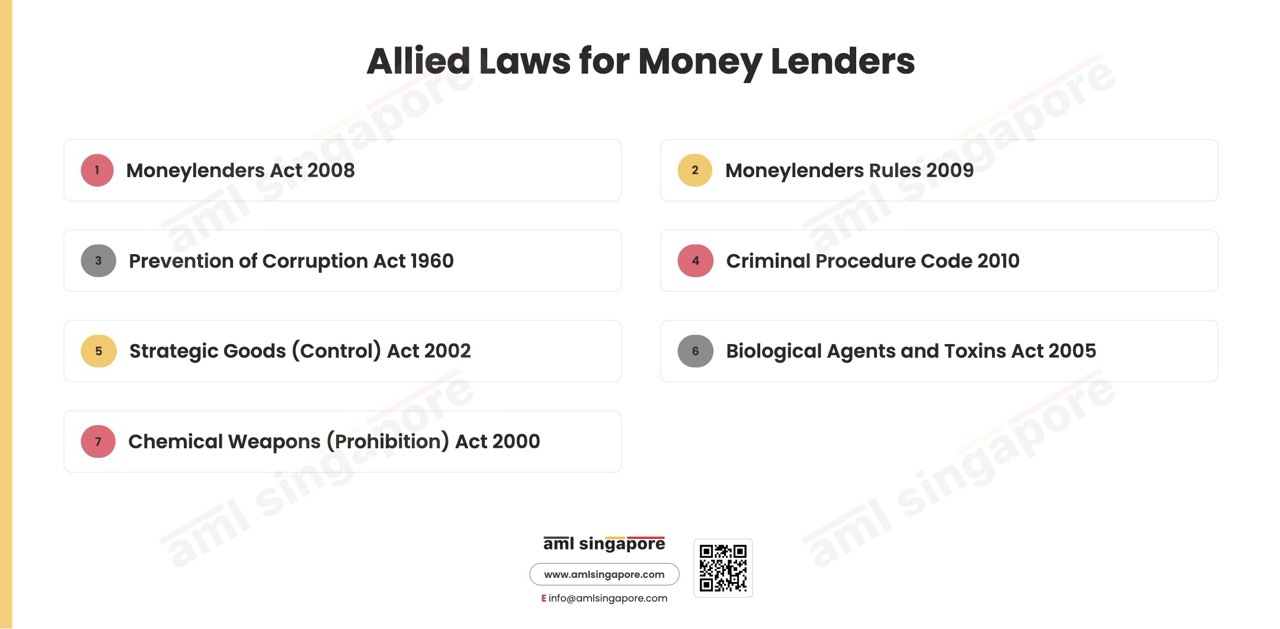
The Moneylenders Act 2008
The Moneylenders Act 2008 establishes the statutory framework for moneylending in Singapore. It provides for the licensing and regulation of moneylenders and empowers the Minister for Law to make rules for carrying out the purposes and provisions of the Act, including rules for the detection and prevention of money laundering, terrorism financing and proliferation financing. The AML rules apply according to their own scope, which includes every moneylender that grants secured or unsecured loans to the public.
The Moneylenders Rules 2009
The Moneylenders Rules 2009 are the general rules governing licensed moneylending matters under the Moneylenders Act 2008. They are separate from the Moneylenders (Prevention of Money Laundering, Terrorism Financing and Proliferation Financing) Rules 2009, which contain the sector specific AML, CFT and CPF requirements. The current Moneylenders Rules 2009 are the 2026 Revised Edition dated 3 July 2026.
The Prevention of Corruption Act 1960
Singapore’s main anti corruption law. Because corruption is a predicate offence for money laundering, the proceeds of offences under it are part of what a moneylender looks for in checks on a borrower’s source of funds, and its presumption on unexplained assets reinforces scrutiny where a borrower’s means cannot be explained.
The Criminal Procedure Code 2010
The code of criminal procedure that equips investigators with powers of production, search and seizure. Served with a production order, or an order relating to a loan or its proceeds, a moneylender must comply, preserve its records and avoid tipping off, which is how an AML investigation reaches into a loan account.
The Strategic Goods (Control) Act 2002
The Strategic Goods (Control) Act 2002 regulates the transfer and brokering of strategic goods and related activities. It is relevant to the broader proliferation financing framework, but it does not itself impose a general sanctions screening obligation on moneylenders. A moneylender’s customer screening and proliferation financing obligations arise principally under the Moneylenders Rules and applicable sanctions legislation and directions.
The Biological Agents and Toxins Act 2005
The Biological Agents and Toxins Act 2005 regulates specified biological agents and toxins and prohibits specified activities involving them. It forms part of Singapore’s broader legal framework addressing weapons of mass destruction and proliferation risks. However, the Act does not itself impose a general proliferation financing screening obligation on moneylenders.
The Chemical Weapons (Prohibition) Act 2000
The Chemical Weapons (Prohibition) Act 2000 gives domestic effect to Singapore’s obligations under the Chemical Weapons Convention and prohibits specified activities involving chemical weapons and related substances. It forms part of the broader legal framework relevant to proliferation risks, while the moneylender’s specific customer screening and proliferation financing obligations arise under the Moneylenders Rules and applicable sanctions requirements.
Miscellaneous Laws and Regulations Applicable to Money Lenders in Singapore
These national strategies, committee reports and typologies set the direction of Singapore’s regime and the public private partnership a moneylender operates within. They carry no binding force, but they direct how supervisors act and supply many of the typologies a moneylender builds into its screening.
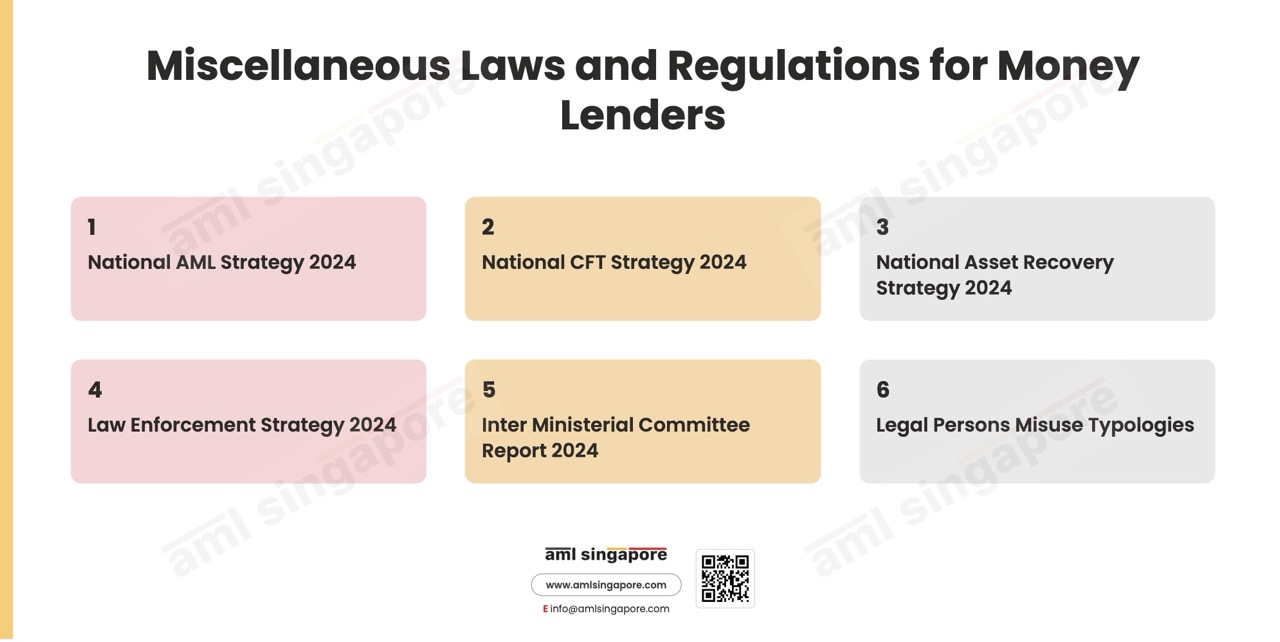
National Anti Money Laundering Strategy 2024
Singapore’s national AML blueprint, built on the pillars of Prevent, Detect and Enforce. A moneylender sits within the Prevent pillar, where the authorities commit to risk based supervision and to the beneficial ownership transparency a moneylender relies on for due diligence on a corporate borrower.
National Strategy for Countering the Financing of Terrorism 2024
Renewed in 2024 with the terrorism financing risk assessment, this strategy works on five fronts: coordinated risk identification, strong legal and sanctions frameworks, a sound regulatory regime, firm enforcement and international partnership. It signals the direction a moneylender’s terrorism financing controls should take.
National Asset Recovery Strategy 2024
Singapore’s strategy for tracing, seizing and returning the proceeds of crime, noting billions recovered in recent years. A moneylender is a partner in it mainly through its reporting and its cooperation with production orders, since loan proceeds and repayments can be the subject of restraint.
Singapore Law Enforcement Strategy to Combat Money Laundering (October 2024)
A joint strategy of Singapore’s money laundering investigation agencies that names focus areas and key actions and depends on two way information flows with the private sector. It frames the enforcement backdrop a moneylender supports through its reporting on suspicious loans and repayments.
Inter Ministerial Committee on Anti Money Laundering Report (October 2024)
The review conducted after a large money laundering case, recommending measures on the misuse of corporate structures, the duties of gatekeepers and better information sharing. Its themes reach a moneylender that lends to companies, and it marks the firmer supervisory stance the wider financial sector now sits under.
Legal Persons: Misuse Typologies and Best Practices (2018)
A typologies paper on the ways companies and partnerships get misused, giving a moneylender the red flags for beneficial ownership and corporate borrower checks. It is useful where a moneylender lends to a company, a partnership or a business with an opaque owner.
International Standards Applicable to Money Lenders in Singapore
Singapore’s regime is built to meet the FATF standards, and the Moneylenders Rules track them. These instruments are the least sector specific of all, yet they explain why the domestic rules look the way they do and hand a moneylender the typologies and methods supervisors expect it to track.
The FATF Recommendations (updated June 2026)
The FATF Recommendations are international standards for combating money laundering, terrorist financing and the financing of proliferation. Singapore’s domestic AML, CFT and CPF framework is designed in the context of these international standards, but the legal obligations of a licensed moneylender arise from Singapore legislation and applicable regulatory requirements rather than directly from the FATF Recommendations.
Methodology for Assessing Technical Compliance and Effectiveness (updated June 2026)
The FATF Methodology is used to assess a country’s technical compliance with the FATF Recommendations and the effectiveness of its AML, CFT and CPF framework. It therefore provides the assessment framework used for evaluating Singapore’s national regime, while the legal obligations of individual moneylenders arise from Singapore legislation and applicable regulatory requirements.
Mutual Evaluation Report of Singapore (May 2026)
The FATF and Asia/Pacific Group Mutual Evaluation Report of Singapore was published on 6 May 2026 and assessed Singapore’s AML, CFT and CPF measures based on an on site visit conducted in July 2025. It frames supervisory expectations across the financial system, including the proportionate expectations placed on small lenders such as money lenders.
FATF Guidance on Politically Exposed Persons (Recommendations 12 and 22, 2013)
Explains the FATF standards and guidance concerning politically exposed persons, including enhanced due diligence measures such as establishing source of wealth and source of funds and enhanced ongoing monitoring in the circumstances specified by the FATF Recommendations. The specific obligations applicable to a moneylender arise from the Moneylenders Rules.
Guidance on Beneficial Ownership of Legal Persons (March 2023)
Guidance on implementing the financial provisions of Security Council resolutions concerning the proliferation of weapons of mass destruction. For a moneylender in Singapore, the applicable legal obligations arise from Singapore legislation, including the Moneylenders Rules and relevant sanctions regulations, rather than directly from the FATF guidance or FATF Recommendations.
Best Practices on Beneficial Ownership for Legal Persons (October 2019)
A collection of country best practices for keeping beneficial ownership information adequate, accurate and up to date, backing a moneylender’s use of registries and multiple sources when it identifies the owner of a corporate borrower.
Concealment of Beneficial Ownership (July 2018)
A joint FATF and Egmont Group typologies report on how criminals hide beneficial ownership through intermediaries and structures, giving a moneylender the red flags to detect concealment behind a corporate borrower.
Risk Based Approach: Beneficial Ownership and Transparency of Legal Arrangements (March 2024)
Guidance focused on Recommendation 25 and trusts and similar arrangements, helping a moneylender assess and mitigate risk where a trust or similar structure stands behind a borrower.
FATF Guidance on Counter Proliferation Financing (February 2018)
Guidance on implementing the financial provisions of United Nations Security Council resolutions concerning proliferation financing and targeted financial sanctions. The specific obligations applicable to a moneylender in Singapore arise from Singapore legislation and applicable sanctions regulations and the Moneylenders Rules, rather than directly from the FATF guidance.
Guidance on Proliferation Financing Risk Assessment and Mitigation (June 2021)
Describes how a firm should assess and reduce proliferation financing risk once the changes to Recommendations 1 and 2 brought it within the risk assessment duty across the sector.
Money Laundering from Environmental Crime (July 2021)
A FATF study of how the proceeds of environmental crime move through the financial system. Its relevance to a moneylender is limited but real where a corporate borrower’s revenue may derive from illegal logging, mining or waste, and it adds to the red flags a lender weighs.
Guidance on Digital Identity (March 2020)
Helps a moneylender judge whether a digital identity system is reliable and independent enough for customer due diligence under a risk based approach, a question that arises as lenders digitise onboarding while keeping the required face to face step.
Artificial Intelligence and Deepfakes: Impacts on ML/TF/PF
A forward looking FATF scan of how artificial intelligence and deepfakes threaten preventive systems, for example, synthetic identities defeating identity checks, alongside AI’s uses in screening and monitoring.
Summary of the Key Instruments
The table below distils the instruments a licensed moneylender relies on most, what type each is, whom it binds, and the core obligation it places on the lender. A compact reference to sit beside the detail, not a substitute for the fuller sections above.
|
Instrument |
Type |
Binds |
Core obligation for a moneylender |
|
CDSA 1992 |
Statute |
Everyone |
Report suspected criminal proceeds; do not tip off |
|
TSOFA 2002 |
Statute |
Everyone |
Do not deal in terrorist property; screen and report |
|
FSM sanctions regulations (DPRK, Iran) |
Regulations |
All persons |
Freeze designated persons’ assets without delay |
|
Moneylenders Rules 2009 (PML/TF/PF) |
Rules (binding) |
Money lenders |
Risk based CDD on the borrower, records, STR |
|
Information Guide for Moneylenders |
Guidance |
Money lenders |
Primary guidance; how to apply the Rules |
|
Moneylenders Act 2008 |
Statute |
Money lenders |
Licence the lender; set loan and interest caps |
|
FATF Recommendations |
Standard |
Countries/FIs |
International standards that inform Singapore’s AML, CFT and CPF framework |
Conclusion
For a licensed moneylender in Singapore, the AML, CFT and CPF framework comprises the Moneylenders (Prevention of Money Laundering, Terrorism Financing and Proliferation Financing) Rules 2009 together with applicable legislation and regulatory requirements. The CDSA, TSOFA, United Nations Act and applicable sanctions regulations impose separate statutory obligations, while the Moneylenders Rules establish sector specific requirements for risk assessment, customer due diligence, screening, enhanced measures, disclosures and record keeping. The Registry of Moneylenders under the Ministry of Law supervises the sector.
The instruments interlock. A moneylender’s risk assessment is informed by Singapore’s national risk assessments and the risks identified under the Moneylenders Rules. Its customer due diligence, screening, enhanced due diligence, suspicious transaction reporting and record keeping obligations arise principally from the Moneylenders Rules and applicable legislation. Its licensing and other moneylending requirements arise under the Moneylenders Act and related rules. Its sanctions and proliferation financing obligations include requirements under the United Nations Act and regulations made under it. The Registry of Moneylenders under the Ministry of Law is the sector supervisor for moneylenders.
Frequently Asked Questions
Moneylenders are supervised by the Insolvency and Public Trustee’s Office within the Ministry of Law through the Registry of Moneylenders. The AML, CFT and CPF requirements applicable to moneylenders are set out principally in the Moneylenders (Prevention of Money Laundering, Terrorism Financing and Proliferation Financing) Rules 2009, together with applicable legislation, the Registry’s guidance and directions.
The binding rules are the Moneylenders (Prevention of ML, TF and PF) Rules 2009, which set the risk based approach, customer due diligence on the borrower, enhanced measures for politically exposed persons, suspicious transaction reporting, tipping off and record keeping. They are read together with the Registry’s Information Guide and additional guidance, which explain how to apply the Rules in a small lending business.
Singapore’s 2024 Money Laundering National Risk Assessment assesses the moneylending sector as medium low ML risk after considering its threats, vulnerabilities and controls. The assessment states that loans disbursed by licensed moneylenders are domestic in nature, that most customers are locals followed by foreigners working or residing in Singapore, and that the average loan value was approximately S$5,300 as at the end of 2023. Licensed moneylenders must also conduct face to face verification of the borrower’s identity before granting a loan.
Licensed moneylenders are required to meet borrowers in person at the approved place of business to conduct physical face to face verification of identity before granting a loan. The Registry identifies this as an important safeguard against scams and unlicensed moneylending, while the AML Rules separately set out the applicable customer due diligence requirements.
A moneylender must make the applicable disclosure when the circumstances in rule 7 arise, including circumstances requiring disclosure under section 45 of the CDSA 1992 or Part 3 of the Terrorism Act 2002. Section 45 of the CDSA requires disclosure to a Suspicious Transaction Reporting Officer as soon as is reasonably practicable after the relevant knowledge or suspicion comes to the person’s attention. Disclosures under section 45 are made electronically through SONAR. Our guide to STR red flags explains common triggers such as repayment in unusually large cash.
Rule 7B requires moneylenders to prepare, maintain and retain records concerning relevant loans and loan applications in a manner that allows transactions, business relationships and customer due diligence information to be reviewed and reconstructed. The rule also specifies the applicable retention periods for customer information and transaction records.
About the Author

Pathik Shah
FCA, CAMS, CISA, CS, DISA (ICAI), FAFP (ICAI)
Pathik is a Chartered Accountant with more than 26 years of experience in governance, risk, and compliance. He helps companies with end-to-end AML compliance services, from conducting Enterprise- Wide Risk Assessments to implementing the robust AML Compliance framework. He has played a pivotal role as a functional expert in developing and implementing RegTech solutions for streamlined compliance.