AML Laws and Regulations for Licensed Trust Companies in Singapore
In a Nutshell
A licensed trust company is a company licensed under section 5 of the Trust Companies Act 2005 to carry on trust business, setting up and administering trusts for succession, estate planning, asset protection and philanthropy. Because trusts separate legal ownership from benefit, the sector sits close to the heart of beneficial ownership risk.
The rulebook is MAS Notice TCA N03 and its Guidelines. Their central idea is the trust relevant party: a trust company must identify and verify the settlor, the trustee, the protector and the beneficiaries, together with their connected parties and effective controllers, and understand the structure and purpose of each trust.
The 2024 Money Laundering National Risk Assessment assesses licensed trust companies as a medium high money laundering risk sector. The assessment identifies factors including the sector’s exposure to complex structures and high net worth clients. The assessment should be considered by trust companies when assessing their own money laundering risks and strengthening controls where appropriate.
Around this core sit the criminal and sanctions statutes, the national risk assessments, the Trust Companies Act that licenses the sector, and the FATF standards on transparency of legal arrangements. This guide takes each instrument in turn, in plain language, and shows the exact source behind it.
AML Laws and Regulations for Licensed Trust Companies in Singapore
A licensed trust company builds and runs the structures through which families and businesses hold and pass on wealth, and because a trust deliberately separates who owns an asset from who benefits from it, it is exactly the kind of arrangement that can be used to hide the origin of funds. This guide sets out the laws and regulations that apply to a licensed trust company in Singapore, from the criminal statutes that make money laundering an offence to the detailed rulebook the Monetary Authority of Singapore (MAS) enforces on trust business.
The framework is best read in layers. The criminal and sanctions laws sit at the base. Above them is the instrument a trust company works with every day, MAS Notice TCA N03, together with its Guidelines. Alongside these run Singapore’s national risk assessments, the Trust Companies Act that licenses the sector, and the FATF standards behind the whole regime. Each instrument below is explained through the lens of a trust company, not in the abstract.
Because a trust company deals in ownership rather than in cash, its exposure is not the placement of physical notes but the concealment of who truly owns and controls an asset, and the layering of value through layered structures. That shapes much of what follows, from how a trust company assesses risk to how thoroughly it must look through a trust to the people behind it.
Singapore's Licensed Trust Companies at a Glance
As at the 2023, there were over 65 licensed trust companies operating in Singapore, regulated by MAS as part of the financial sector (Money Laundering National Risk Assessment 2024, chapter 7.6).
Trust companies typically provide trustee, trust administration and related corporate services for succession, estate planning, asset protection and philanthropic purposes, and they do not carry out physical cash transactions (ML NRA 2024, chapter 7.6).
Risk rating: licensed trust companies are assessed medium high money laundering risk, among the higher risk parts of the wealth management sector, given complex cross border structures and high net worth clients (ML NRA 2024, chapters 7.1 and 7.6).
Core AML Laws and Regulations in Singapore for Licensed Trust Companies
These statutes and sanctions regulations establish offences, prohibitions, asset freezing requirements and reporting obligations that may apply to trust companies. MAS Notice TCA N03 separately establishes specific AML/CFT requirements for licensed trust companies and applicable private trust companies.
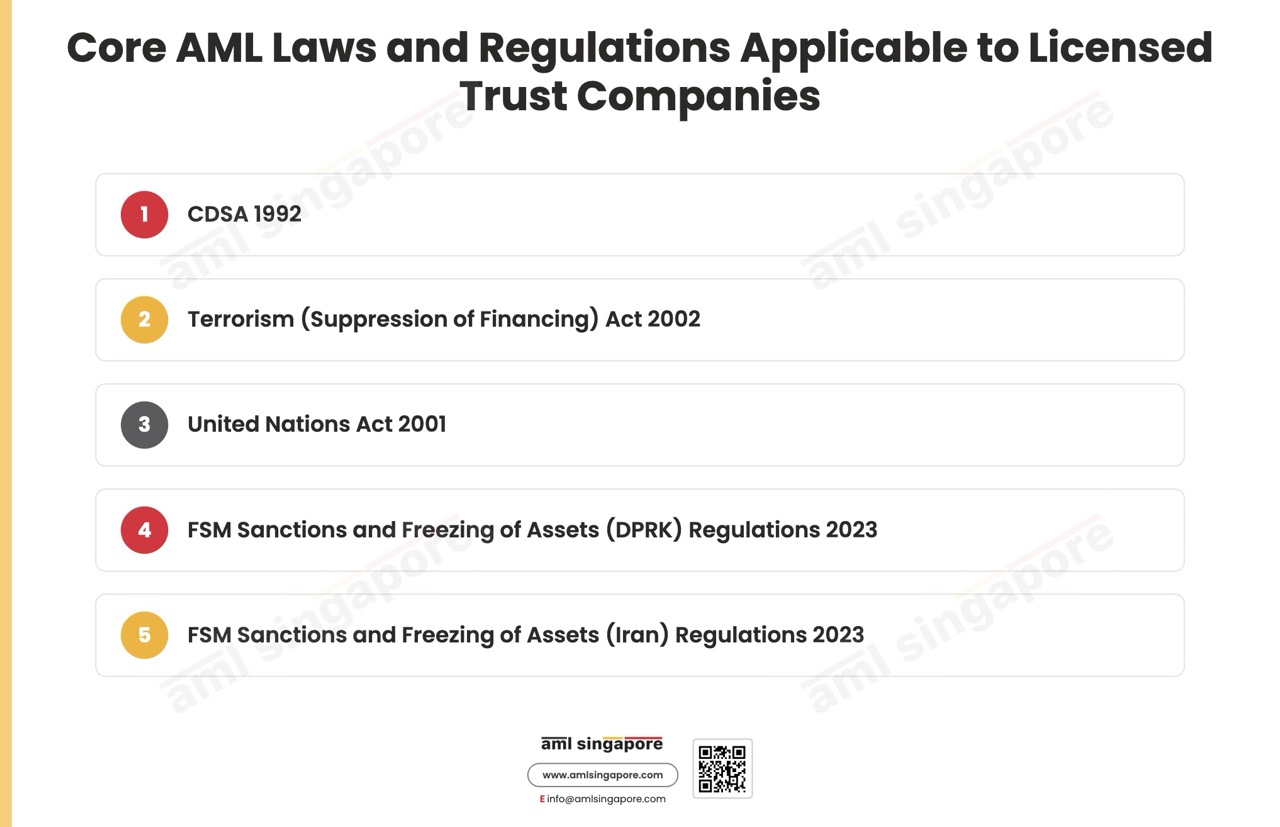
The Corruption, Drug Trafficking and Other Serious Crimes (Confiscation of Benefits) Act 1992
The CDSA sets out the money laundering offences in Singapore and provides for confiscation of criminal proceeds. Section 45 requires a person who, in the course of business, knows or has reasonable grounds to suspect that property represents the proceeds of or was used or is intended to be used in connection with drug dealing or criminal conduct to disclose the knowledge or suspicion to the Suspicious Transaction Reporting Officer as soon as reasonably practicable.
The Terrorism (Suppression of Financing) Act 2002
The TSOFA prohibits dealing with property that a person knows or has reasonable grounds to believe is owned or controlled by or on behalf of a terrorist or terrorist entity. A person who has possession, custody or control of terrorist property, or information about a transaction involving such property, must immediately inform the Commissioner of Police.
The United Nations Act 2001
The United Nations Act 2001 provides the legal framework for implementing certain obligations arising from United Nations Security Council decisions through regulations. For licensed trust companies, applicable sanctions obligations may arise under specific regulations made under the Financial Services and Markets Act 2022.
The Financial Services and Markets (Sanctions and Freezing of Assets of Persons, DPRK) Regulations 2023
The Financial Services and Markets (Sanctions and Freezing of Assets of Persons – Democratic People’s Republic of Korea) Regulations 2023 apply to every financial institution within the meaning of the Financial Services and Markets Act 2022. They impose prohibitions and asset freeze requirements relating to designated persons and specified activities, transactions and assets, together with information requirements.
The Financial Services and Markets (Sanctions and Freezing of Assets of Persons, Iran) Regulations 2023
The Financial Services and Markets (Sanctions and Freezing of Assets of Persons – Iran) Regulations 2023 apply to every financial institution within the meaning of the Financial Services and Markets Act 2022. They provide for the freezing of specified assets and prohibit specified forms of assistance, services, funds, assets, resources and financial services relating to designated items and persons.
Overarching AML Laws and Regulations Applicable to Licensed Trust Companies in Singapore
These instruments cut across the regime and give a trust company practical means to discharge its reporting duties and recognise terrorism financing when it surfaces in a trust relationship.
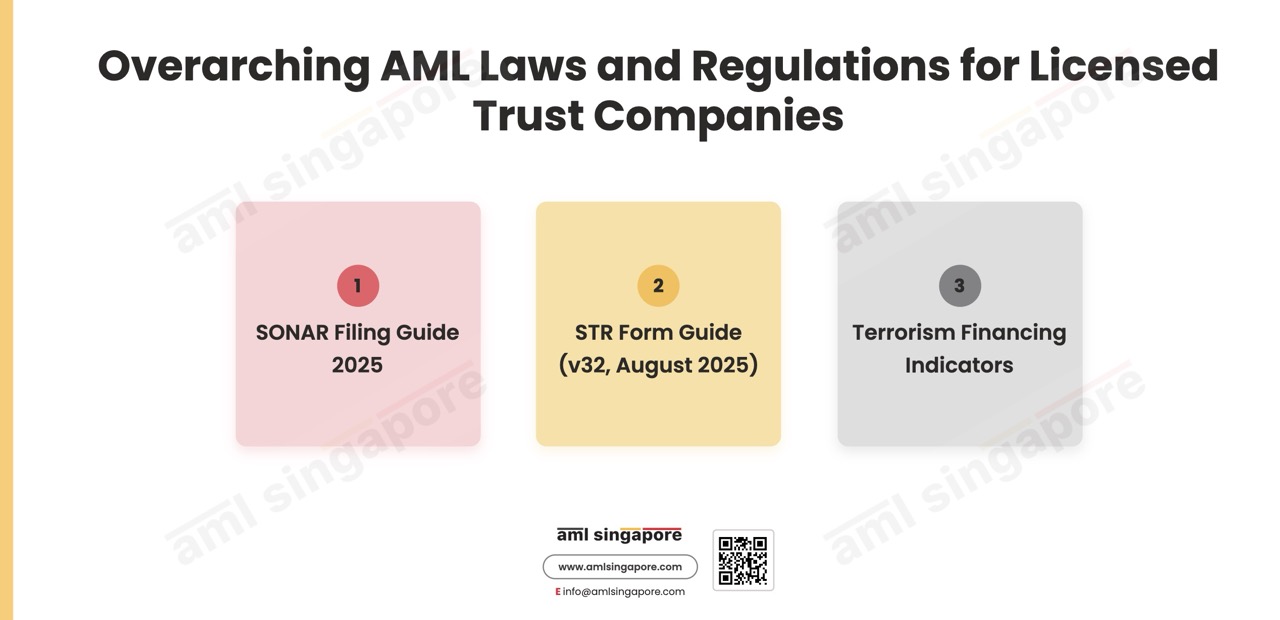
Getting Started with SONAR, for STR Filers (2025)
SONAR is the STRO Online Notices and Reporting platform through which a licensed trust company lodges its suspicious transaction reports electronically. It walks a filer through registration, user roles and submission, and it is the channel by which the section 45 CDSA duty is discharged. A trust company’s compliance function relies on it to file promptly and to keep proof of each filing.
Form Guide for the STR Form (Version 12 August 2025)
A guide to the current suspicious transaction report form. It explains how each field is completed, from the reporting firm’s particulars to the grounds for suspicion, and it calls for a unique internal reference on every filing. For a trust company, it is the reference a compliance officer uses to file a report that captures the settlor, the structure and the parties clearly.
Terrorism Financing Indicators
A red flag reference from STRO that sorts terrorism financing indicators into due diligence anomalies, unusual fund movement and transactions lacking economic purpose. For a trust company it helps flag terrorism financing typologies, including the misuse of legal arrangements and unexplained cross border settlements, and supports the decision to file a terrorism financing report.
National Risk Assessments Applicable to Licensed Trust Companies in Singapore
Singapore publishes national risk assessments covering money laundering, terrorism financing and proliferation financing risks. Licensed trust companies should consider the relevant findings of these assessments when assessing and managing their own risks under MAS Notice TCA N03.
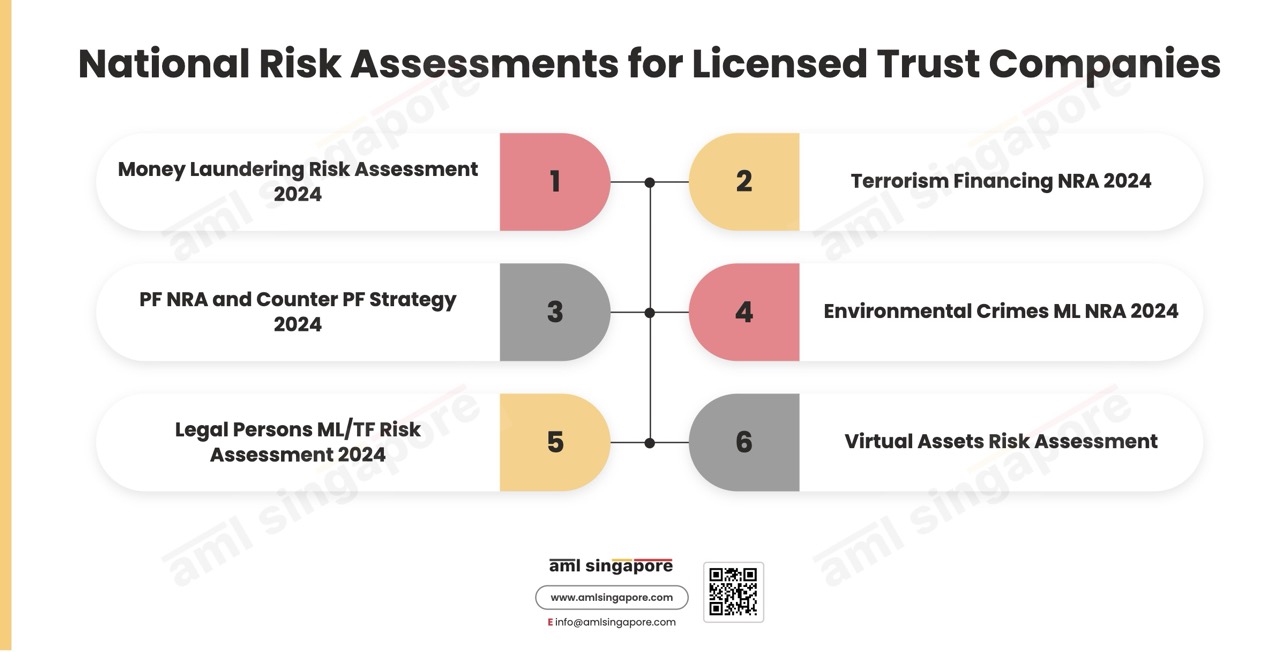
Money Laundering National Risk Assessment Singapore 2024
The 2024 national money laundering assessment identifies the licensed trust company sector as a medium high money laundering risk sector. The assessment highlights factors including complex structures and high net worth clients. Trust companies should consider these findings when assessing and managing their own money laundering risks.
Terrorism Financing National Risk Assessment 2024
The 2024 Money Laundering and Terrorism Financing Risk Assessment of Legal Arrangements assesses express trusts where the trustee is a trust company as having a low terrorism financing risk. Licensed trust companies nevertheless remain subject to the applicable AML/CFT requirements under MAS Notice TCA N03.
Proliferation Financing National Risk Assessment and Counter PF Strategy 2024
The assessment identifies sanctions evasion, misuse of legal persons and dual use trade among the proliferation financing risks. For a trust company, these risks may arise through the structures and parties connected with a trust. Trust companies should apply the applicable customer due diligence, risk assessment and sanctions controls required under the relevant regulatory framework.
Environmental Crimes Money Laundering National Risk Assessment (May 2024)
The Environmental Crimes Money Laundering National Risk Assessment examines the laundering of proceeds from environmental crimes. Its findings may be relevant to a trust company’s risk assessment where a trust, settlor or underlying business has connections with activities associated with environmental crime.
Money Laundering and Terrorism Financing Risk Assessment of Legal Persons (2024)
The Money Laundering and Terrorism Financing Risk Assessment of Legal Arrangements assesses express trusts where the trustee is a trust company as medium high money laundering risk and low terrorism financing risk. The assessment identifies the misuse of trusts to conceal the origin and beneficial ownership of criminal proceeds as a key money laundering risk.
Virtual Assets (Digital Payment Tokens) Risk Assessment (2024)
This assessment reviews Singapore’s exposure to virtual assets. It reaches a trust company where digital assets are settled into or held within a trust, and it informs the attention a trust company gives to the source and control of tokens held in a structure it administers.
Licensed Trust Company Sector ML/TF Risk Snapshot
Money laundering: medium high, driven by complex cross border structures, high net worth clients and the concealment of beneficial ownership that trusts can enable (ML NRA 2024, chapters 7.1 and 7.6).
Beneficial ownership: the central risk, since a trust separates legal ownership from benefit; a trust company must identify the settlor, trustee, protector, beneficiaries and effective controllers of every structure.
Offsetting feature: trust companies do not carry out physical cash transactions, which lowers placement risk relative to cash intensive sectors (ML NRA 2024, chapter 7.6).
Proliferation and terrorism financing: mainly through the misuse of legal persons and arrangements to obscure a designated party (PF and TF NRAs 2024).
Sector Specific Guidance Applicable to Licensed Trust Companies in Singapore
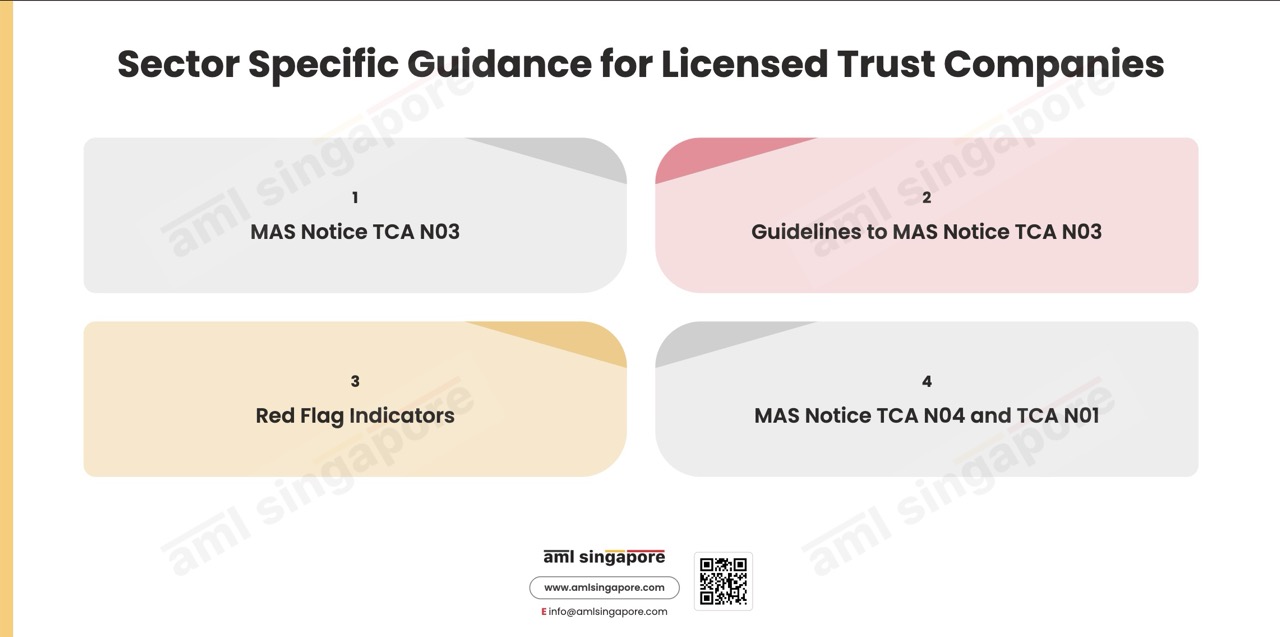
This is the core of a trust company’s obligations. MAS supervises licensed trust companies and issues the notices and guidance they must follow. The material divides into common instruments that apply across financial institutions and the specific instruments written for trust business, led by MAS Notice TCA N03 and its Guidelines
Common Guidelines for Licensed Trust Companies
MAS has issued AML/CFT guidance covering different financial sectors and specific risk areas. A licensed trust company should distinguish between guidance specifically applicable to trust companies and guidance directed at other types of financial institutions. Other MAS publications may provide useful supervisory context but should not be presented as directly applicable requirements unless their scope expressly covers trust companies.
The Financial Services and Markets Act 2022
The FSM Act 2022 is the law through which MAS conducts AML/CFT supervision and enforcement across the financial sector, and it supplies the section 16 power under which Notice TCA N03 is issued. It authorises the sanctions regulations a trust company screens against and gives MAS its inspection and direction powers. Because an AML/CFT breach can draw a penalty of up to S$1 million, the Act carries the enforcement weight behind the notice.
Circular AMLD 01/2018: Use of MyInfo and CDD for Non Face to Face Business Relations
Under this circular, the Government’s MyInfo service qualifies as a reliable and independent source of a customer’s core identity data. Where a trust company verifies a Singapore resident party through MyInfo, it can lean on that data rather than gathering documents afresh, subject to the circular’s safeguards for impersonation risk. Its use is narrower here than in retail sectors, since many trust parties are non resident.
Circular AMLD 01/2022: Non Face to Face Customer Due Diligence Measures
This circular sets MAS’s expectations for onboarding parties without face to face contact, common where a settlor or beneficiary is overseas. It cautions that a video or selfie check on its own may fall short, recommends a second, independent channel for higher risk parties, and expects any onboarding technology to be assessed by the firm and approved by its board and senior management.
Circular AMLD 02/2023: ML/TF Risks in the Wealth Management Sector
This circular speaks directly to a trust company, which MAS counts within the wealth management sector alongside private banks and external asset managers. It calls for firmer board oversight, review of due diligence and quality assurance, and for looking through trusts and holding vehicles to the real beneficial owners, and it treats a settlor who withdraws rather than answer questions as a reason to consider a report.
Circular AMLD 08/2024: Establishing the Sources of Wealth of Customers
MAS guidance addresses how financial institutions should establish a customer’s source of wealth using a risk proportionate approach. The extent of corroboration should take account of materiality and relevance and should be commensurate with the customer’s risk profile.
Circular AMLD 05/2026: Risk Proportionate Source of Wealth Establishment
A 2026 circular that recalibrates the source of wealth expectations. MAS wants the work kept effective, efficient and proportionate to risk, so legitimate wealth is not held up. A trust company should concentrate corroboration on material or higher risk wealth, avoid repeated or unreasonable requests once a settlor’s position is understood, and keep escalation for genuine red flags.
Circular AMLD 11/2023: Ensuring Effective Detection of Sanctions Related Risks
MAS requires firms to detect and manage sanctions risk, including unilateral sanctions imposed by other jurisdictions that bear on cross border structures. The board must set the risk appetite, and the circular describes a lookback review after a designation, so a trust company can catch a party or asset that entered a structure before a name was listed.
Circular AMLD 12/2024: Audit of AML/CFT Policies, Procedures and Controls
This circular concerns the independent audit that forms a firm’s third line of defence. A trust company must run an audit function that tests whether its AML/CFT controls actually work, resource it with suitable expertise, give priority to higher risk areas such as beneficial ownership identification and complex structures, and benchmark against industry best practice.
Strengthening AML/CFT Controls on Misuse of Legal Persons and Complex Structures (August 2023)
This MAS paper is the most on point of the common guidance for a trust company, since it addresses exactly the trusts, foundations and layered corporate structures a trust company creates and administers. Its case studies expose failures to identify the true beneficial owner, and it expects a trust company to benchmark itself and to make sure it can see through every layer of a structure it is asked to run.
AML/CFT Supervisory Expectations from Recent Inspections (October 2024)
Drawn from recent inspections, this paper groups MAS’s expectations under five headings: treating multiple nationalities and investment migration links as risk factors, catching document red flags, testing whether a settlor’s source of wealth holds up, backing a report or an exit with real mitigation, and sharing information across business lines.
Best Practices in Relation to Risks in Wealth Management (May 2025)
An industry paper for firms serving wealthy clients, consolidating case studies on private investment companies, trusts, sanctions and geopolitical events and remote onboarding. It is squarely relevant to a trust company, and it confirms that where a private bank or external manager sits alongside the trust, the trust company must still satisfy its own due diligence duties on the parties to the structure.
Effective Practices to Detect and Mitigate the Risk from Misuse of Legal Persons (June 2019)
This MAS paper is about guarding against shell and front companies over the life of a relationship. It offers multi factor risk assessment, red flag lists, network link analysis and staff training, and it makes the point that one red flag alone rarely decides the matter. A trust company creating corporate vehicles within trusts should weigh several signals together before it acts.
Guidance for Effective AML/CFT Transaction Monitoring Controls (September 2018)
This paper gathers MAS’s inspection based expectations for transaction monitoring. A trust company sees fewer, larger movements than a bank, so the guidance is applied proportionately, but its themes, tuning what to look for, keeping data clean and recording how alerts are handled, still shape how a trust company monitors distributions and settlements against what it knows of a structure.
Guidance to Capital Markets Intermediaries on Enhancing AML/CFT Frameworks and Controls (January 2019)
Written for capital markets intermediaries, this MAS guidance on governance, risk awareness and execution. These findings must be appropriately revised and applied to a trust company. It is persuasive good practice on board accountability, the three lines of defence and how a firm resources its AML/CFT programme.
Guidelines on Risk Management Practices, Internal Controls (July 2024)
A prudential guideline covering MAS’s expectations for a firm’s control environment and its business process controls. It addresses customer due diligence only lightly and defers to the AML/CFT notices and guidelines for the detail, so for a trust company it supplies the internal controls scaffolding, from segregation of duties to management reporting, that the AML/CFT programme is built around rather than a source of AML duties in itself.
Guidelines on Provision of Digital Advisory Services (October 2018)
A conduct guideline for digital or robo advisory services. It touches a trust company only in the uncommon case where the same group also offers automated investment advice. Its AML/CFT relevance is narrow: the reminder that any non face to face channel needs adequate ML/TF controls and must manage impersonation risk.
Sound Practices to Counter Proliferation Financing (August 2018)
Drawing on MAS’s thematic reviews, this paper addresses proliferation financing linked to DPRK and Iran sanctions evasion. It describes how firms should strengthen controls, watch higher risk parties and counterparties, and recognise typologies such as shell companies with nominee directors, which are exactly the vehicles a trust company must be alert to when it is asked to administer an opaque structure.
Strengthening Financial Institutions' CFT Controls (May 2023)
Grounded in an industry survey, this MAS information paper concerns countering the financing of terrorism. It restates the duty to freeze and report designated party assets and sets expectations for screening, escalation and prompt, good quality reporting, each of which a trust company applies to the trust relevant parties and effective controllers of every structure.
Specific Guidelines for Licensed Trust Companies
These are the instruments written for trust business. Two of them, MAS Notice TCA N03 and its Guidelines, are the rulebook a trust company lives by, so they are covered in full below. The remaining instruments support or supplement them.
MAS Notice TCA N03 on Prevention of Money Laundering and Countering the Financing of Terrorism, Trust Companies
MAS Notice TCA N03 is the AML/CFT notice applicable to licensed trust companies and private trust companies exempted from licensing under the Trust Companies Act 2005. It is issued under section 16 of the Financial Services and Markets Act 2022 and took effect from 1 July 2025. The Notice establishes requirements relating to risk assessment, customer due diligence, record keeping, suspicious transaction reporting and internal AML/CFT controls.
The Notice defines trust relevant parties to include the persons and categories specified in the Notice, including the settlor, trustee, protector, beneficiary, class of beneficiaries and object of a power, together with other persons covered by the definition. A trust company must obtain the required information and identify and verify effective controllers in accordance with the Notice.
The trust company must retain the required customer due diligence and transaction records for the periods specified in Notice TCA N03. These include at least five years after termination of the business contact or completion of the relevant transaction, subject to the applicable record retention requirements and any requirements relating to investigations or suspicious transaction reports.
Customer due diligence is one of the core compliance obligations. A trust company may not establish business contact on an anonymous or fictitious name basis, and it must perform customer due diligence when it establishes business contact with any trust relevant party, when it suspects money laundering or terrorism financing, or when it doubts information, it holds. It must identify and verify each trust relevant party from reliable, independent sources, identify any person acting for a party, identify connected parties, and identify and verify the effective controllers, the natural persons who ultimately own or control each party. Where a party is a legal person or arrangement, the trust company must understand its ownership and control structure and the purpose of the trust it is administering.
Simplified due diligence is available only where risk is demonstrably low. Enhanced due diligence is mandatory for politically exposed persons, requiring senior management approval, establishment of source of wealth and source of funds, and enhanced monitoring, and for other higher risk situations, which for a trust company include opaque structures, nominee arrangements and personal asset holding vehicles. The settlor’s source of wealth is a particular focus, since the settlor endows the trust. A trust company may rely on a qualifying third party, such as a bank or another regulated financial institution, for elements of due diligence, but it remains responsible for its own obligations.
The remaining paragraphs complete the framework. Records of the trust relevant parties, the structure and the due diligence must be kept for at least five years, and the Notice disapplies certain personal data access rights, so controls are not tipped off. Suspicions must be reported to the Suspicious Transaction Reporting Office through a single internal reference point, mindful of the tipping off offence in section 57 of the CDSA, and the trust company must maintain internal policies, a group policy where it is part of a financial group, an AML/CFT compliance officer at management level, an independent audit function and regular training. Unlike the banking and payments notices, there is no wire transfer or correspondent chapter, because a trust company administers structures rather than moving customer funds.
Guidelines to MAS Notice TCA N03 (the Primary Guidance for Trust Companies)
The Guidelines to Notice TCA N03 are the primary guidance a trust company works with, and they are given the fullest treatment here. They are dated July 2025, and their chapters mirror the paragraphs of the Notice, so a trust company can read each obligation next to its explanation. They are guidance and not binding rules, yet MAS makes clear that how far a firm observes them can feed into its overall view of the firm, including how well its board and senior management exercise oversight, so in practice they are the benchmark a trust company is measured against.
The Guidelines open with the sector’s risk profile. Because a trust separates legal ownership from benefit, the sector’s defining exposure is the concealment of who really owns and controls an asset, and the risk is heightened by complex, multi jurisdiction structures and high net worth settlors. The Guidelines confirm that proliferation financing is treated as part of money laundering throughout, and they set out the accountability model: the board and senior management own AML/CFT effectiveness, supported by the three lines of defence, with front office and party facing functions understood as the first line.
On the risk based approach, a trust company must assess its money laundering and terrorism financing risk not only for individual parties but on an enterprise wide basis, taking in its target markets and segments, the profile and number of higher risk trust relevant parties, the countries they connect to and the types of structure it offers, and including overseas branches and subsidiaries where it is part of a financial group. The enterprise wide assessment must be approved by senior management, should combine qualitative and quantitative analysis, must incorporate the findings of Singapore’s national risk assessments, and should be refreshed when a material change occurs.
The customer due diligence chapter is the longest, and it is built around the trust. It explains how to identify and verify each trust relevant party, the settlor, trustee, protector and beneficiaries or the class or objects of a power, and how to treat a beneficiary who is named by characteristics or class rather than individually, verifying identity by the time of distribution at the latest.
It sets the widely used benchmark that a beneficial owner or effective controller is generally a natural person who owns more than 25% of an entity, while making clear that anyone who controls a party through other means is caught regardless of any percentage. It works through nominee arrangements, underlying companies and foundations, the structures a trust company meets constantly, and it addresses non face to face onboarding of overseas parties and the measures that counter impersonation.
The enhanced due diligence chapter carries a heavy load for this sector. It defines politically exposed persons in line with the FATF standard, and it draws the important distinction between source of wealth and source of funds: source of wealth is the origin of the settlor’s entire body of wealth and how it was acquired, while source of funds is the origin of the particular assets settled into the trust.
A trust company should corroborate the settlor’s source of wealth against reliable, independent sources, focus on material or higher risk wealth, and apply enhanced due diligence to the structures that warrant it, including where there are reasonable grounds to suspect the assets are proceeds of serious crime, in which case it should decline or exit. Screening guidance requires every party to be screened regardless of risk, and sanctions hits to be frozen or escalated without delay.
The remaining chapters complete the picture. Reliance is distinguished from outsourcing, where the trust company keeps responsibility for ongoing monitoring, and it may rely on a bank or other regulated institution for elements of due diligence while remaining accountable. Record keeping, suspicious transaction reporting, where the general standard is no later than five business days after suspicion is established, and the chapters on the compliance officer, audit and training complete the operational detail.
A dedicated section on proliferation financing directs a trust company to screen against the latest United Nations Security Council lists and to freeze without delay, and worked examples in the appendices illustrate the due diligence and the suspicious patterns, such as a reluctant settlor or an unexplained change of beneficiary, that trust business is likely to see.
Red Flag Indicators for Licensed Trust Company Trust Business
An MAS red flag reference written for trust business. It lists the indicators a trust company should watch for, such as a trust relevant party who is reluctant to provide normal information, a structure or transaction that uses unnecessary complexity, a mismatch between a settlor’s known profile and the source of the settled assets, and an unexplained change of beneficiary or protector. It is the sector specific companion to the general terrorism financing indicators and feeds directly into a trust company’s monitoring and its decision to report.
MAS Notice TCA N04 (Reporting of Suspicious Activities and Incidents of Fraud)
MAS Notice TCA N04 requires licensed trust companies and private trust companies exempted from licensing to lodge a report with MAS upon discovery of suspicious activities and incidents of fraud that are material to the safety, soundness or reputation of the trust company. The report is separate from a suspicious transaction report submitted to the Suspicious Transaction Reporting Office under the AML/CFT framework.
MAS Notice TCA N01 (Effecting Arrangements by Licensed Trust Companies or Exempt Persons)
A conduct notice made under sections 15(1)(a) and 15(1)(b) of the Trust Companies Act. It governs how a licensed trust company or an exempt person may effect certain arrangements during trust business. It is not an AML instrument, but it forms part of the regulatory frame within which a trust company operates and within which its AML/CFT controls sit.
The Trust Relevant Parties a Licensed Trust Company must identify
Notice TCA N03 is built around identifying everyone connected to a trust. The table below sets out who must be identified and what the trust company must do.
|
Party |
Who they are |
What the trust company must do |
|
Settlor |
The person who creates the trust and provides its assets |
Identify and verify; establish source of wealth and funds |
|
Trustee |
The person who holds and administers the trust assets, often the trust company itself |
Identify and verify |
|
Protector |
A person with power to oversee or direct the trustee |
Identify and verify; understand the powers held |
|
Beneficiaries, class or objects of a power |
Those who benefit, or may benefit, from the trust |
Identify and verify each, or the class or objects, by distribution at the latest |
|
Connected parties |
Directors or those with executive authority over a legal person party |
Identify |
|
Effective controllers |
The natural persons who ultimately own or control any party |
Identify and verify |
|
The trust structure |
The underlying companies, foundations and arrangements |
Understand the ownership and control structure and the purpose of the trust |
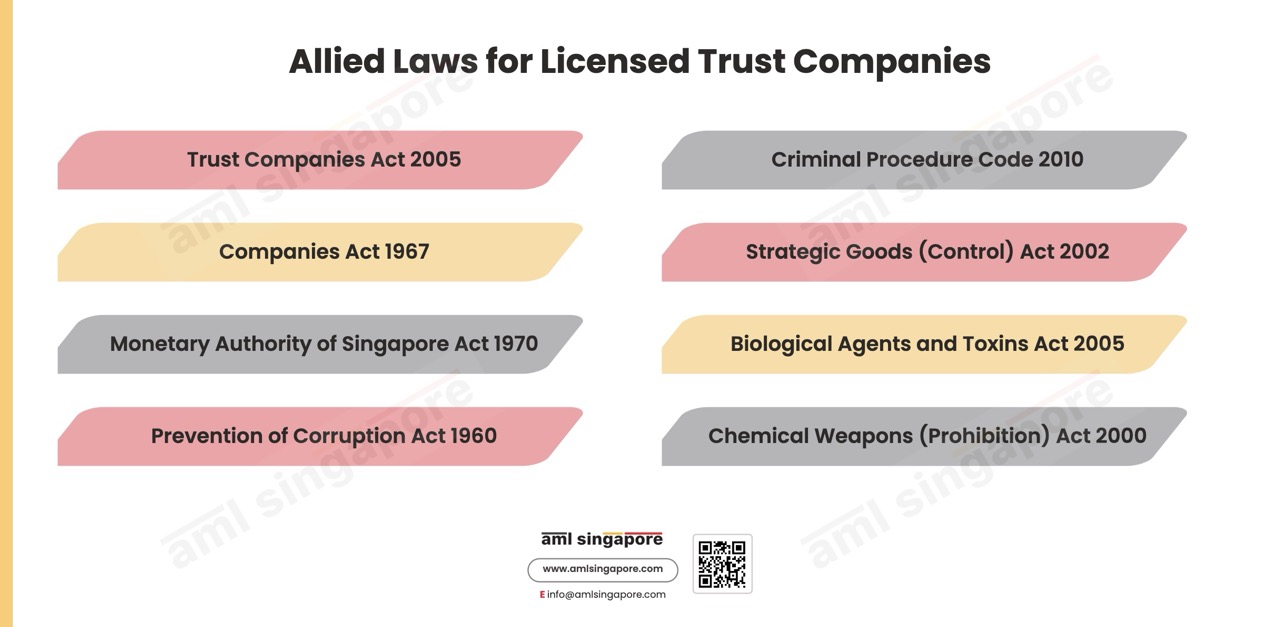
Allied Laws Applicable to Licensed Trust Companies in Singapore
These statutes are not primarily AML instruments, but each supports the regime: some license and govern trust companies, others give investigators their powers, and others create the predicate offences and proliferation controls a trust company screens against.
The Trust Companies Act 2005
The statute that constitutes the sector. It requires a company carrying on trust business in Singapore to hold a trust business licence under section 5, defines trust business and the exemptions from it, and gives MAS its supervisory and enforcement powers over the sector. Holding that licence is what brings a firm within Notice TCA N03.
The Companies Act 1967
Singapore’s general company law statute. What carries weight for AML is its register of registrable controllers’ regime, mirrored in a central ACRA register, which a trust company relies on and verifies when it identifies the controllers of the underlying companies it creates and administers within trust structures.
The Monetary Authority of Singapore 1970
The Monetary Authority of Singapore Act 1970 establishes MAS and sets out its functions and powers. The specific AML/CFT requirements applicable to licensed trust companies are imposed through MAS Notice TCA N03 under the Financial Services and Markets Act 2022.
The Prevention of Corruption Act 1960
The Prevention of Corruption Act 1960 is Singapore’s principal legislation addressing corruption offences. Proceeds of corruption may constitute proceeds of criminal conduct for the purposes of Singapore’s money laundering laws. Accordingly, corruption related risks may be relevant to a trust company’s customer due diligence, source of wealth assessment and suspicious transaction monitoring.
The Criminal Procedure Code 2010
The Criminal Procedure Code 2010 contains investigative and procedural powers that may be relevant to investigations involving trust companies and trust property. Where a lawful order or other legal requirement applies to a trust company, the company must comply with the applicable requirements.
The Strategic Goods (Control) Act 2002
The Strategic Goods (Control) Act 2002 regulates the transfer, transit, transhipment and brokering of strategic goods and related activities. Its relevance to a trust company depends on the activities, assets and parties involved in a particular trust structure and should not be presented as a general AML screening obligation arising from the Act itself.
The Biological Agents and Toxins Act 2005
The Biological Agents and Toxins Act 2005 regulates specified activities involving biological agents and toxins. Its relevance to a trust company depends on the activities, assets and parties involved in a particular structure and should not be presented as a general AML screening obligation under the Act itself.
The Chemical Weapons (Prohibition) Act 2000
The Chemical Weapons (Prohibition) Act 2000 gives effect to Singapore’s obligations under the Chemical Weapons Convention and regulates prohibited activities involving chemical weapons. Its relevance to a trust company depends on the activities and parties involved and should not be presented as a standalone AML screening requirement.
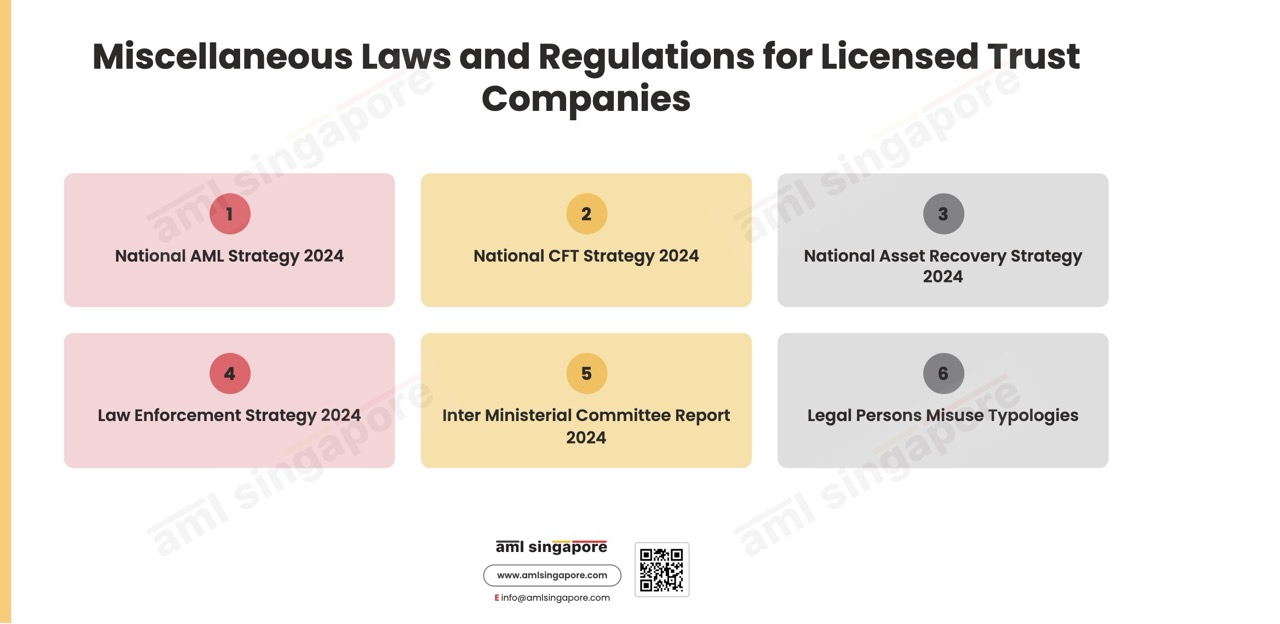
Miscellaneous Laws and Regulations Applicable to Licensed Trust Companies in Singapore
These national strategies, committee reports and typologies set the direction of Singapore’s regime and the public private partnership a trust company operates within. They carry no binding force, but they direct how MAS supervises and supply many of the typologies a trust company builds into its screening.
National Anti Money Laundering Strategy 2024
Singapore’s national AML blueprint, built on the pillars of Prevent, Detect and Enforce. A trust company sits within the Prevent pillar, where MAS commits to risk based supervision of financial institutions and to the beneficial ownership transparency a trust company both relies on and helps deliver when it identifies the people behind a structure.
National Strategy for Countering the Financing of Terrorism 2024
Updated in 2024 alongside the terrorism financing risk assessment, this five part strategy covers coordinated risk identification, strong legal and sanctions frameworks, a robust regulatory regime, decisive enforcement and international partnership. It signals the direction a trust company’s terrorism financing controls should take.
National Asset Recovery Strategy 2024
Singapore’s strategy to detect, deprive and deliver on the proceeds of crime, citing billions recovered in recent years. A trust company is a partner in it, since trust assets can be the subject of production orders and restraint, and prompt cooperation, including on the beneficial ownership of a structure, is expected.
Singapore Law Enforcement Strategy to Combat Money Laundering (October 2024)
A joint strategy of Singapore’s money laundering investigation agencies that names focus areas and key actions and relies on two way information flows with financial institutions. It frames the enforcement backdrop a trust company supports through its reporting and its cooperation on the ownership of the structures it runs.
Inter Ministerial Committee on Anti Money Laundering Report (October 2024)
The review that followed a large money laundering case, recommending measures on the misuse of corporate structures, the duties of gatekeepers and better information sharing. Its themes land squarely on a trust company, which is a classic gatekeeper for legal persons and arrangements, and it marks the firmer supervisory stance the sector now sits under.
Legal Persons: Misuse Typologies and Best Practices (2018)
A typologies paper on the ways companies and partnerships get misused, giving a trust company the red flags for beneficial ownership and structure checks. It is directly useful for a sector that creates and administers holding companies, foundations and special purpose vehicles within trusts.
International Standards Applicable to Licensed Trust Companies in Singapore
Singapore’s regime is built to meet the FATF standards, and Notice TCA N03 tracks them closely, especially the standards on the transparency of legal arrangements. These instruments are the least sector specific of all, yet they explain why the domestic rules look the way they do and hand a trust company the typologies and methods supervisors expect it to track.
The FATF Recommendations (updated June 2026)
The 40 Recommendations are the global AML/CFT and counter proliferation standard behind every obligation on a trust company. Recommendation 25, on the transparency of trusts and other legal arrangements, is the direct source of the trust relevant party and beneficial ownership duties in Notice TCA N03.
Mutual Evaluation Report of Singapore (May 2026)
The 2026 evaluation by the FATF and the Asia/Pacific Group gauges how well Singapore’s regime works in practice. It frames supervisory expectations across the financial sector, including how Singapore supervises its trust and company service providers for the misuse of legal arrangements.
Methodology for Assessing Technical Compliance and Effectiveness (updated June 2026)
The methodology the FATF uses to assess technical compliance with the Recommendations and the effectiveness of a country’s system. It defines the yardstick by which Singapore, and by extension its trust companies, are measured, and it informs MAS’s supervisory expectations.
FATF Guidance on Politically Exposed Persons (Recommendations 12 and 22, 2013)
Explains how a provider identifies politically exposed persons and applies enhanced due diligence: senior management approval, establishing source of wealth and funds, and enhanced ongoing monitoring.
Guidance on Beneficial Ownership of Legal Persons (March 2023)
Guidance issued under the revised Recommendation 24 on how to obtain and verify beneficial ownership information, shaping how a trust company pins down the beneficial owners of the underlying companies it administers within trust structures.
Best Practices on Beneficial Ownership for Legal Persons (October 2019)
A collection of country best practices for keeping beneficial ownership information adequate, accurate and up to date, backing a trust company’s use of registries and multiple sources when it identifies the controllers of underlying companies.
Concealment of Beneficial Ownership (July 2018)
A joint FATF and Egmont Group typologies report on how criminals hide beneficial ownership through intermediaries and structures, including trusts. It is one of the most relevant international papers for a trust company, giving it the red flags to detect concealment in the very arrangements it is asked to create.
Risk Based Approach: Beneficial Ownership and Transparency of Legal Arrangements (March 2024)
Guidance focused on Recommendation 25 and trusts and similar arrangements, the international standard closest to a trust company’s core business. It helps the trust company assess and mitigate the risk in a structure and identify the parties behind it.
FATF Guidance on Counter Proliferation Financing (February 2018)
Guidance on carrying out the financial provisions of Security Council resolutions against weapons of mass destruction proliferation, under which a trust company must screen and freeze without delay in line with Recommendation 7.
Guidance on Proliferation Financing Risk Assessment and Mitigation (June 2021)
Explains how a firm should assess and mitigate proliferation financing risk after the amendments to Recommendations 1 and 2, which brought proliferation financing within the risk assessment duty across the financial sector.
Guidance on Digital Identity (March 2020)
Helps a trust company decide whether a digital identity system is reliable and independent enough for customer due diligence under a risk based approach, which matters for the remote onboarding of overseas settlors and beneficiaries.
Artificial Intelligence and Deepfakes: Impacts on ML/TF/PF
A forward looking FATF scan of how artificial intelligence and deepfakes threaten preventive systems, for example synthetic identities defeating the remote onboarding of an overseas party, alongside AI’s uses in screening and network analysis.
Money Laundering from Environmental Crime (July 2021)
A typologies report on laundering the proceeds of environmental crime, flagging the red flags a trust company may see where a settlor’s wealth or an underlying business is linked to commodity, resource or forestry activity.
Trade Based Money Laundering, Private Sector Handout
A concise handout on trade based money laundering techniques, relevant to a trust company where an underlying company within a structure trades goods, since over and under invoicing and phantom shipments can move value through such vehicles.
Summary of Key Instruments
The table below distils the instruments a licensed trust company relies on most, what type each is, whom it binds, and the core obligation it places on the trust company. A quick reference to keep beside you, not a substitute for the fuller sections above.
|
Instrument |
Type |
Who it binds |
Core obligation for a trust company |
|
CDSA 1992 |
Statute |
All persons and trust companies |
Report suspicions (STR), do not tip off, keep records |
|
Terrorism (Suppression of Financing) Act 2002 |
Statute |
All persons and trust companies |
Freeze terrorist property; inform the authorities |
|
FSM Sanctions Regulations (DPRK, Iran) 2023 |
Regulations |
All financial institutions |
Freeze designated persons’ assets; report to MAS |
|
MAS Notice TCA N03 |
Notice (FSM Act s16) |
Licensed trust companies and private trust companies exempted from licensing |
Identify trust relevant parties and comply with applicable CDD, EDD, STR, record keeping and internal control requirements |
|
Guidelines to TCA N03 |
Guidelines |
Licensed trust companies and applicable private trust companies |
Guidance on meeting the requirements of the Notice; observance may be considered in MAS supervision |
|
Notice TCA N04 |
Notice (TCA) |
Licensed trust companies |
Report suspicious activity and fraud to MAS |
|
Trust Companies Act 2005 |
Statute |
Trust companies (s 5) |
Licenses and governs trust business |
|
MAS Act 1970 |
Statute |
MAS and trust companies |
Source of MAS supervisory authority |
|
ML, TF and PF NRAs 2024 |
Risk assessments |
Whole system |
Feed the trust company’s enterprise wide risk assessment |
|
FATF Recommendations |
International standard |
Global baseline |
R.25 transparency of legal arrangements underpins the rules |
Conclusion
For a licensed trust company in Singapore, the AML/CFT framework combines Singapore’s criminal and sanctions legislation with MAS regulatory requirements. Notice TCA N03 establishes specific AML/CFT requirements for trust companies, including risk assessment, customer due diligence, record keeping, suspicious transaction reporting and internal controls. The Trust Companies Act 2005 provides the licensing and regulatory framework for trust business, while applicable sanctions legislation imposes separate obligations concerning designated persons and prohibited activities.
The instruments interlock. A trust company’s enterprise wide risk assessment should consider the relevant national risk assessments; its due diligence and beneficial ownership obligations arise primarily from MAS Notice TCA N03 and its applicable Guidelines; its licensing and conduct obligations arise under the Trust Companies Act; and its sanctions and proliferation financing obligations arise from the applicable Singapore legislation and regulations. FATF standards provide the international framework against which Singapore’s AML/CFT/CPF regime is assessed.
Frequently Asked Questions
MAS Notice TCA N03 is the anti money laundering and countering the financing of terrorism notice for licensed trust companies, issued under section 16 of the Financial Services and Markets Act 2022. It is read together with the Guidelines to Notice TCA N03, which explain how to meet each requirement.
Under Notice TCA N03 the trust relevant parties are the settlor, the trustee, the protector, and the beneficiary, class of beneficiaries or object of a power of a trust. A trust company must identify and verify each of them, along with any person acting for them, their connected parties and their effective controllers, the natural persons who ultimately own or control each party.
Yes. A trust company must identify and verify the beneficiaries, and where beneficiaries are described by class or by objects of a power rather than named, it must obtain enough information to identify each beneficiary at the latest by the time a distribution is made or the beneficiary exercises a vested right.
Under Notice TCA N03 and the source of wealth circulars, a trust company should take reasonable steps to establish where the settlor’s wealth comes from and how it was acquired, corroborate it against reliable independent sources in proportion to risk, and escalate what it cannot stand up. The settlor is a focus because the settlor endows the trust with its assets.
Singapore’s 2024 money laundering assessment identifies licensed trust companies as a medium high money laundering risk sector. The assessment highlights factors including complex structures and high net worth clients. The assessment should be considered when a trust company assesses and manages its own money laundering risks.
The Guidelines address suspicious transaction reporting and the applicable reporting requirements. A trust company should submit a suspicious transaction report to the Suspicious Transaction Reporting Office when the applicable statutory threshold is met and within the applicable prescribed period.
About the Author

Pathik Shah
FCA, CAMS, CISA, CS, DISA (ICAI), FAFP (ICAI)
Pathik is a Chartered Accountant with more than 26 years of experience in governance, risk, and compliance. He helps companies with end-to-end AML compliance services, from conducting Enterprise- Wide Risk Assessments to implementing the robust AML Compliance framework. He has played a pivotal role as a functional expert in developing and implementing RegTech solutions for streamlined compliance.