AML Laws and Regulations for Casinos in Singapore
In a Nutshell
A casino in Singapore handles significant volumes of cash and chips, and cash intensive activity is an important feature of its money laundering risk. Singapore casinos are regulated by the Gambling Regulatory Authority rather than the Monetary Authority of Singapore.
The binding sector specific AML, CFT and CPF requirements for casino operators are principally set out in the Casino Control Act 2006 and the Casino Control (Prevention of Money Laundering, Terrorism Financing and Proliferation Financing) Regulations 2009, which have been updated on 21 September 2026 The Regulations provide for cash transaction reporting, customer due diligence, beneficial ownership identification and verification, ongoing monitoring, enhanced customer due diligence, suspicious transaction reporting and related controls.
The Casino Control Act 2006 and the Casino Control (Prevention of Money Laundering, Terrorism Financing and Proliferation Financing) Regulations 2009 establish the principal sector specific AML, CFT and CPF requirements applicable to casino operators. The Regulations require cash transaction reporting for specified cash transactions of S$10,000 or more and provide for customer due diligence, beneficial ownership identification and verification, ongoing monitoring, enhanced customer due diligence, suspicious transaction reporting and other control requirements.
Singapore’s 2024 Money Laundering National Risk Assessment assesses the money laundering threat to casinos as moderately high. It identifies cash intensity, the anonymity associated with cash and the largely foreign patron base as relevant characteristics of the sector, while also noting that the randomness and potential losses associated with gambling can reduce the attractiveness of casinos as a laundering channel.
Around this core sit the criminal and sanctions statutes that bind every business, the national risk assessments, the gambling and corporate laws the operators work within, and the FATF standards. Each instrument below is taken in turn, in plain words, with the exact source it draws on.
AML Laws and Regulations for Casinos in Singapore
A casino turns cash into chips and chips back into cash all day long, and that simple fact is why it sits under a demanding anti money laundering regime. This guide sets out the laws and regulations that apply to a casino operator in Singapore, from the criminal statutes that make money laundering an offence to the detailed rulebook the Gambling Regulatory Authority enforces on the casino floor.
The framework is best read in layers. The criminal and sanctions laws sit at the base. Above them is the instrument a casino works with every gaming day, the Casino Control (Prevention of Money Laundering, Terrorism Financing and Proliferation Financing) Regulations 2009, together with the Casino Control Act that licenses and regulates the sector. Alongside these are Singapore’s national risk assessments, the gambling and corporate laws relevant to casino operations, and the FATF standards that provide the international framework for AML, CFT and CPF measures. The domestic obligations applicable to casinos arise from Singapore legislation and subsidiary legislation.
Because casinos handle cash, chips and gaming transactions, they can be exposed to typologies involving the purchase of chips with illicit funds, limited or no genuine gambling activity and subsequent redemption of chips. The 2024 Money Laundering National Risk Assessment identifies large cash buy ins and pay outs with minimal gambling and exchanges of chips through fictitious gambling activities as vulnerabilities in the casino sector. These risks are relevant to the casino’s customer due diligence, ongoing monitoring and reporting controls. Any specific wagering or conversion requirement should be stated only where supported by the applicable current Casino Control legislation, regulations or official Gambling Regulatory Authority material.
This exposure is the classic placement of illicit money: a large buy in followed by minimal play and a cash out of clean looking winnings, and the layering that cross border patrons can add. These risks are relevant to the casino’s customer due diligence, ongoing monitoring and reporting controls. Any specific wagering or conversion requirement should be stated only where supported by the applicable current Casino Control legislation, regulations or official Gambling Regulatory Authority material.
Singapore's Casino Sector at a Glance
There are two casinos in Singapore, both supervised by the Gambling Regulatory Authority (Money Laundering National Risk Assessment 2024, chapter 8.4).
Total gaming revenue for the two casinos was around S$5.26 billion as at the end of 2023, generated by voluminous daily transactions of widely varying size (ML NRA 2024, chapter 8.4).
Risk rating: the money laundering threat to casinos is assessed as moderately high, and the sector is more vulnerable than most, driven by cash intensity and a largely foreign patron base whose source of funds sits overseas (ML NRA 2024, chapter 8.4).
Core AML Laws and Regulations for Casinos in Singapore
These statutes and sanctions regulations form part of the wider legal framework relevant to money laundering, terrorism financing and proliferation financing. Their applicability to a casino depends on the statutory provision or sanctions regulation involved, while the Casino Control Regulations establish the principal sector specific AML, CFT and CPF requirements for casino operators.
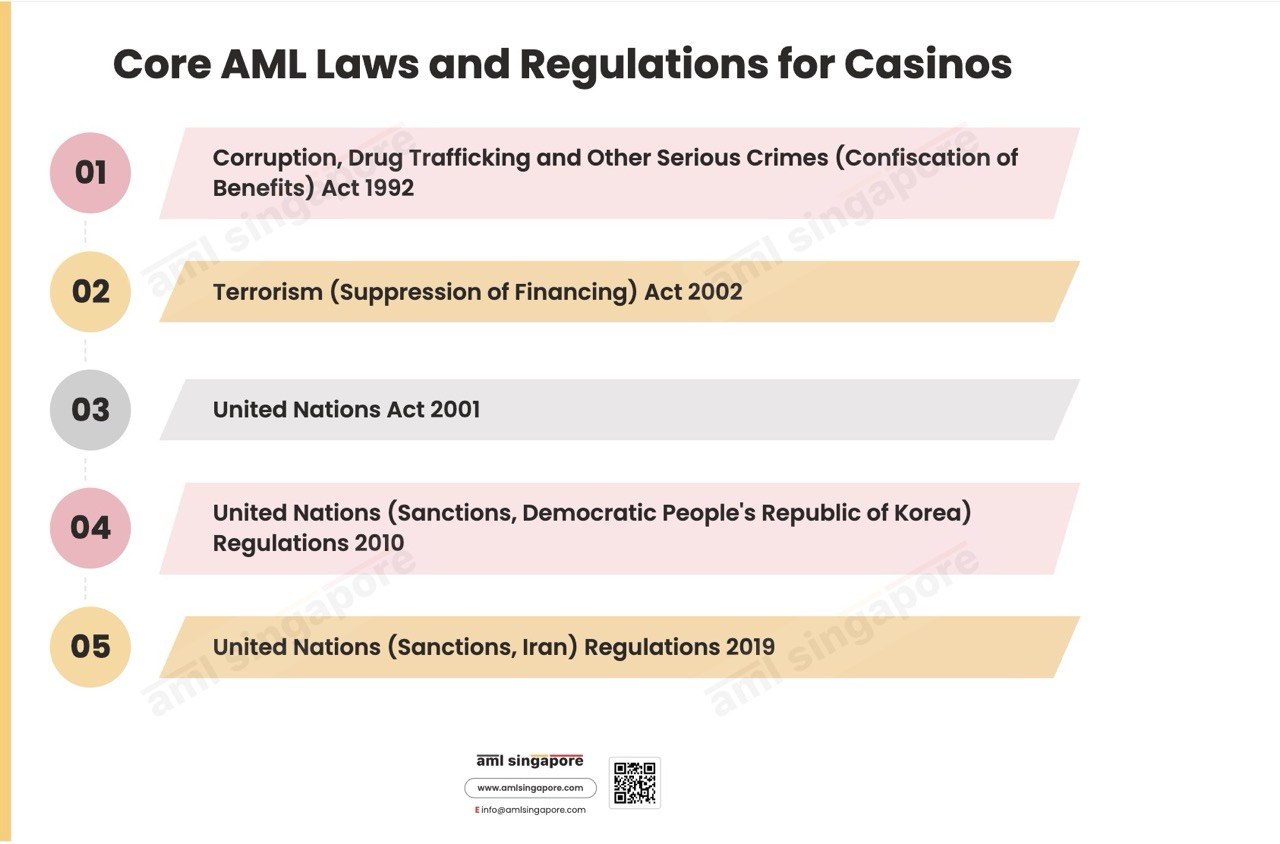
The Corruption, Drug Trafficking and Other Serious Crimes (Confiscation of Benefits) Act 1992
The CDSA contains Singapore’s principal offences relating to dealing with and concealing benefits from criminal conduct, together with provisions concerning suspicious transaction reporting and tipping off. A casino operator must comply with the applicable reporting requirements where the statutory conditions for disclosure are met. The Act also contains restrictions on revealing certain disclosures. The specific reporting obligation should therefore be stated by reference to the applicable provision rather than as an obligation arising whenever a casino knows or suspects that a patron’s funds are criminal.
The Terrorism (Suppression of Financing) Act 2002
The TSOFA contains prohibitions concerning the provision, collection, use, possession and dealing in property connected with terrorist acts or terrorist entities, together with disclosure requirements. A casino operator must comply with the applicable prohibitions and disclosure requirements where the statutory conditions are met. Any description of screening or targeted financial sanctions controls should be tied to the specific applicable law or sanctions requirements rather than presented as the sole means of complying with the TSOFA.
The United Nations Act 2001
The United Nations Act 2001 provides the statutory basis for regulations implementing specified United Nations Security Council measures in Singapore. A casino’s obligations therefore depend on the particular sanctions regulations applicable to the relevant activity or designated person. The casino should not be required by the United Nations Act itself to screen patrons and beneficial owners against designation lists.
The United Nations (Sanctions, Democratic People's Republic of Korea) Regulations 2010
The United Nations Sanctions Democratic People’s Republic of Korea Regulations 2010 implement specified United Nations sanctions measures relating to the Democratic People’s Republic of Korea and include prohibitions concerning dealings with property of designated persons and the provision of financial services and other resources. Any casino application should be tied to the prohibition and facts involved rather than stating generally that every patron account or transaction with a designated person is prohibited.
The United Nations (Sanctions, Iran) Regulations 2019
The United Nations Sanctions Iran Regulations 2019 implement specified United Nations sanctions measures relating to Iran and contain prohibitions including restrictions on dealing with funds and making funds available to or for the benefit of designated persons. The applicability of the Regulations depends on the relevant person, funds, transaction and prohibition. They should not be described as imposing a general casino specific screening requirement without identifying the applicable legal provision.
Overarching AML Laws and Regulations Applicable to Casinos in Singapore
These materials provide operational guidance and risk indicators relevant to suspicious transaction reporting. They should be read together with the statutory cash transaction reporting and suspicious transaction reporting requirements applicable to casino operators.
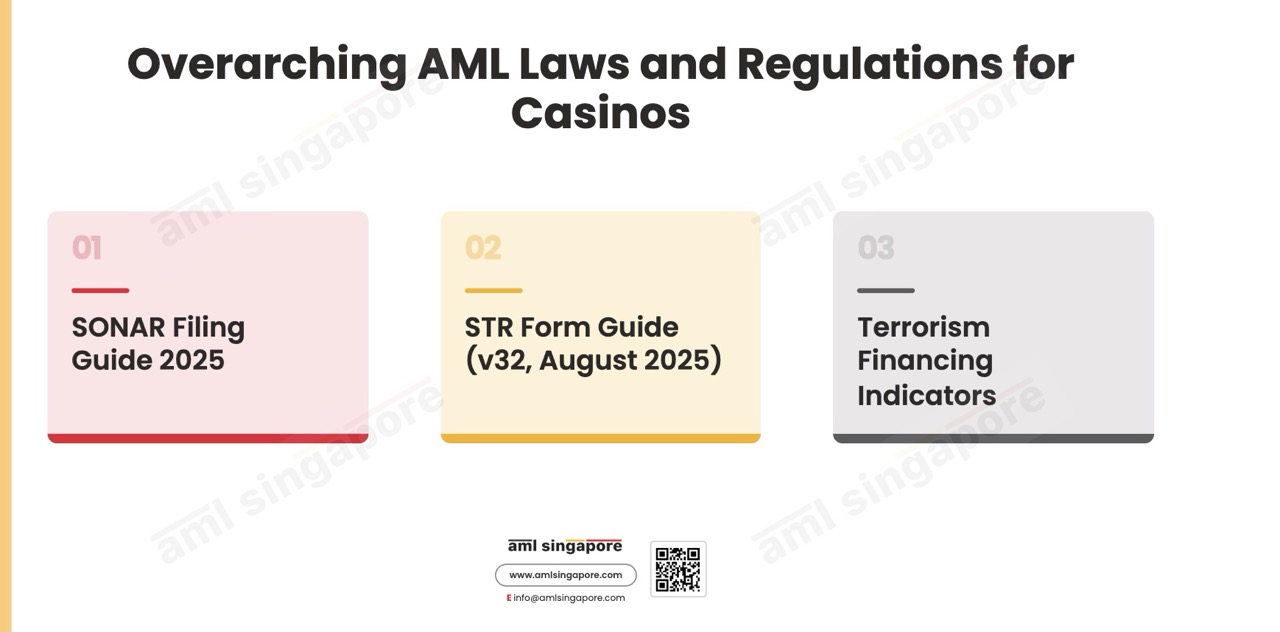
Getting Started with SONAR, for STR Filers (2025)
SONAR is the STRO Online Notices and Reporting platform used for electronic submission of suspicious transaction reports. Casino operators subject to suspicious transaction reporting requirements can use the platform to submit the required reports to the Suspicious Transaction Reporting Officer.
Form Guide for the STR Form (Version 12 August 2025)
A part by part walkthrough of the present suspicious transaction report form, laying out what in each field, from the reporting operator’s own details to the basis for the suspicion, and requiring a distinct internal reference on every report. A casino’s team reaches for it when it needs to report a patron whose gaming pattern or funds will not reconcile.
Terrorism Financing Indicators
A red flag reference from STRO that provides indicators that may assist in identifying potentially suspicious terrorism financing activity. For a casino, such indicators may support the assessment of whether activity warrants a suspicious transaction report under the applicable reporting requirements.
National Risk Assessments Applicable to Casinos in Singapore
Singapore publishes formal assessments of its money laundering, terrorism financing and proliferation financing risks. Casino operators should consider relevant findings from these assessments when assessing and mitigating their risks. The 2024 Money Laundering National Risk Assessment identifies casinos as a sector with a moderately high money laundering threat and highlights cash intensity and the largely foreign customer base as relevant vulnerabilities.
Money Laundering National Risk Assessment Singapore 2024
The national money laundering assessment devotes a section to casinos and rates the threat as moderately high. It records that the cash intensity of the floor, the anonymity of cash and a largely foreign patron base whose source of funds sits overseas make the sector more vulnerable, while noting that the randomness of gaming reduces its appeal as a reliable laundering channel. A casino should read these findings into its sector risk assessment.
Terrorism Financing National Risk Assessment 2024
The 2024 Terrorism Financing National Risk Assessment identifies the principal terrorism financing risks and higher risk sectors and channels in Singapore. It should be used by casino operators as relevant risk assessment material, but the article should not state that the direct terrorism financing threat on a casino floor is low unless a casino specific finding in the assessment expressly supports that conclusion.
Proliferation Financing National Risk Assessment and Counter PF Strategy 2024
The 2024 Proliferation Financing National Risk Assessment and Counter PF Strategy identify risks including the misuse of legal persons, sanctions evasion and trade involving dual use goods. Casino operators should consider relevant proliferation financing and targeted financial sanctions risks within their risk based controls. The article should not characterise the casino sector’s exposure as remote or state that patron screening alone carries the sector’s counter proliferation obligations unless an official source specifically supports those statements.
Environmental Crimes Money Laundering National Risk Assessment (May 2024)
The Environmental Crimes Money Laundering National Risk Assessment examines money laundering risks associated with environmental crimes, including offences involving wildlife and natural resources. Its findings can provide relevant risk context for casino operators when assessing higher risk customers and transactions, but the assessment should not be presented as imposing a separate environmental crime reporting obligation on casinos.
Money Laundering and Terrorism Financing Risk Assessment of Legal Persons (2024)
The Legal Persons Risk Assessment identifies risks associated with the misuse of legal persons. Where a patron account is held by a legal person, the casino operator must comply with the beneficial ownership identification and verification requirements in the Casino Control Regulations and identify the beneficial owners in accordance with those requirements.
Virtual Assets (Digital Payment Tokens) Risk Assessment (2024)
The Virtual Assets or Digital Payment Tokens Risk Assessment examines the risks associated with digital payment token activity in Singapore. Where relevant to a casino operator’s risk assessment, its findings may inform the assessment of transactions or source of funds involving digital payment tokens. The article should not imply that the assessment creates a separate DPT specific obligation for casino operators.
Casino Sector ML/TF Risk Snapshot
Money laundering: moderately high threat and a sector assessed as more vulnerable than most, driven by cash intensity and a largely foreign patron base (ML NRA 2024, chapter 8.4).
Main feature to watch: large cash buy ins with minimal play, chip exchanges without genuine gambling, and the cash out of clean looking winnings (ML NRA 2024, chapter 8.4).
Mitigant: gaming carries a real chance of loss, which makes a casino a less reliable place to wash money and reduces its appeal to criminals (ML NRA 2024, chapter 8.4).
Controls: the Gambling Regulatory Authority licenses operators, employees and market agents, and requires cash transaction reports, patron due diligence and an internal controls code (ML NRA 2024, chapter 8.4).
Sector Specific Guidance Applicable to Casinos in Singapore
This is the core of a casino operator’s sector specific obligations. The sector is regulated by the Gambling Regulatory Authority rather than MAS. The principal AML, CFT and CPF requirements are contained in the Casino Control Regulations, made under the Casino Control Act, together with applicable casino internal control requirements.
The Casino Control (Prevention of Money Laundering, Terrorism Financing and Proliferation Financing) Regulations 2009
The Casino Control (Prevention of Money Laundering, Terrorism Financing and Proliferation Financing) Regulations 2009 are the binding AML/CFT rulebook for a casino operator, which has been updated on 21 September 2026. Made under the Casino Control Act 2006 and administered by the Gambling Regulatory Authority, they are built around the patron and the patron account, the credit, cheque cashing or deposit account a casino opens for a customer, and around the cash that flows across the cage. They set two reporting duties that run in parallel: a cash transaction report driven by size and a suspicious transaction report driven by suspicion, and they wrap both in a system of patron due diligence and record keeping.
The first duty is to file a cash transaction report with a Suspicious Transaction Reporting Officer for every qualifying cash transaction involving cash in or cash out of S$10,000 or more in a single transaction, and for multiple cash transactions entered into by or on behalf of a patron where the applicable aggregate threshold is reached during the relevant gaming day. The cash transaction reporting requirement is separate from suspicious transaction reporting.
The second layer is patron due diligence. A casino operator must comply with the applicable customer due diligence requirements when it opens a patron account, carries out a cash transaction of S$4,000 or more in a single transaction, receives S$4,000 or more in a single transaction for deposit into a deposit account, or in other circumstances specified by the Regulations. The Regulations also require identification and verification of beneficial owners of patron accounts and provide for ongoing monitoring and enhanced customer due diligence for higher risk patrons.
The Regulations require enhanced customer due diligence for higher risk patrons. The applicable measures include reasonable steps to establish the source of wealth and funds and obtaining senior management approval where required by the Regulations. The measures should be applied according to the risk presented by the patron and the circumstances specified in the Regulations.
It must monitor a patron’s gaming and transactions on an ongoing basis and alert to the patterns the national assessment highlights: a large buy-in followed by little play, chip exchanges without genuine gambling, or a request to convert funds that the patron’s wagering does not support. Enhanced measures follow the risk rather than a fixed list.
The Regulations require casino operators to maintain the records required by the applicable provisions, including records connected with cash transaction reports, customer identification and verification and relevant transactions. The applicable record keeping requirements should be stated by reference to the current Regulations, including the specific requirements concerning cash transaction reports and supporting records. The Regulations also contain a separate requirement concerning independent audit.
The Regulations require a casino operator to maintain the prescribed framework for preventing money laundering, terrorism financing and proliferation financing, provide training, maintain a suspicious transaction reporting framework and comply with the independent audit requirement. The suspicious transaction reporting framework must include appropriate policies, controls and procedures for detecting suspicious transactions and making suspicious transaction reports. These requirements operate together with the customer due diligence, ongoing monitoring and record keeping provisions in the Regulations.
The Casino Control Act 2006
The Casino Control Act 2006 establishes the statutory framework for casino regulation and contains provisions concerning casino internal controls and customer due diligence measures to combat money laundering, terrorism financing and the financing of proliferation of weapons of mass destruction. The Gambling Regulatory Authority of Singapore administers the casino regulatory framework. The detailed AML, CFT and CPF requirements are supplemented by the Casino Control Regulations made under the Act. It has been updated on 21 September 2026
The Casino Control Act establishes suitability requirements for casino licensees and provides the Gambling Regulatory Authority with regulatory powers over casino operators. The Authority may consider matters relevant to the suitability of an applicant and casino licensee, including matters concerning reputation, business associations and financial or other relevant considerations. The Act also provides for casino licensing and conditions attached to licences. The licensing regime therefore forms part of the wider regulatory framework supporting the integrity of casino operators.
The Act reaches the people on the floor as well as the operator. A person must not exercise the functions of a special employee except in accordance with a special employee licence granted by the Gambling Regulatory Authority under the Casino Control Act. The Authority provides different categories of special employee licences and applies suitability requirements to applicants. The Act provides for licensing of international market agents and international market agent representatives. The Gambling Regulatory Authority assesses applicants against the statutory suitability criteria and may take regulatory action where applicable. There is currently no licensed international market agent in Singapore.
The Act is also the source of the operator’s detailed control obligations. The Casino Control Act requires a casino operator to implement an approved system of internal controls and contains specific provisions concerning customer due diligence measures to combat money laundering, terrorism financing and proliferation financing. The Internal Controls Code issued by the Gambling Regulatory Authority provides additional operational requirements. The current AML Regulations expressly define the Code as the Internal Controls Code for Casino Operators issued by the Authority. Through this code, the high level duties in the Regulations become concrete procedures at every point where cash, chips and patrons meet, and the regulator can inspect against a written standard the operator has committed to.
The Casino Control Act contains wider controls concerning credit, casino operations, the movement and conversion of funds and chips, exclusion orders and visit limits. These provisions form part of the broader regulatory framework within which casino operators conduct their activities. Certain requirements concerning transactions involving the conversion of money are also relevant to the casino’s AML controls and should be described by reference to the applicable current requirements rather than by characterising the wider gambling controls as AML measures.
Finally, the Act supplies the enforcement and the guardrails. It empowers the Gambling Regulatory Authority to investigate, to issue directions and to discipline an operator that falls short, and it carries offences and penalties that sit behind the AML duties. It also houses the wider social and integrity safeguards of the casino regime, from controls on credit and on the conversion of funds to the exclusion framework, several of which double as money laundering controls by limiting how freely cash and chips can move. Read with the Regulations and the internal controls code, the Act frames a sector that is licensed, supervised and accountable at every level from the boardroom to the gaming table. It is the reason a casino’s anti money laundering programme is not a bolt on but part of the licence to operate, since the same regulator that admits an operator to the market can constrain, penalise or ultimately remove it for failing to keep money laundering out.
The Reporting and Due Diligence Thresholds a Casino Applies
The casino regime is built on clear monetary triggers. The table below sets out the thresholds and the action each one requires under the Regulations 2009.
Trigger | What the casino must do under the Regulations 2009 |
Cash in or cash out of S$10,000 or more | File a cash transaction report with STRO, for a single transaction or for multiple transactions aggregating to the threshold in a gaming day (regulation 3) |
Opening a patron account | Identify and verify the patron before or on opening a credit, cheque cashing or deposit account (regulations 8 and 9) |
Cash transaction of S$4,000 or more | Identify and verify the patron for the transaction (regulation 11) |
Deposit of S$4,000 or more | Identify and verify the patron making the deposit (regulation 12) |
A higher risk patron | Apply enhanced due diligence, including establishing source of wealth and funds (regulation 14) |
Any reasonable suspicion of ML or TF | File a suspicious transaction report, separately from and in addition to any cash transaction report (regulation 19) |
Casino Specific Safeguards Beyond Ordinary Due Diligence
The casino regime layers licensing and operational controls on top of standard due diligence. The table below draws them out.
|
Safeguard |
How the casino regime goes beyond ordinary customer due diligence |
|
Licensing and probity |
The Gambling Regulatory Authority licenses the casino operator and vets its repute, associations and source of funds under the Casino Control Act |
|
Special employee licences |
Employees performing casino operations are required to obtain the applicable special employee licence, with suitability and probity requirements applying to applicants. |
|
International market agents |
Agents who bring in foreign patrons are subject to a strict licensing regime and probity checks; none is currently licensed |
|
Internal Controls Code |
Operators must run a detailed system of internal controls approved by the regulator, covering AML procedures across the floor and the cage |
|
The wagering test on conversions |
Any discussion of controls governing the conversion or redemption of casino funds, chips or other instruments should be supported by the applicable current Casino Control legislation, regulations or Internal Controls Code. The statement that a patron must have wagered a large proportion of the original funds is too specific to retain without an identified official GRA source establishing that precise requirement. |
Allied Laws Applicable to Casinos in Singapore
These statutes are not primarily AML instruments, but each supports the regime: some constitute the gambling regulator and the wider gambling framework, others govern the legal persons behind a corporate patron, and others give investigators their powers or create the offences a casino screens against.
The Gambling Regulatory Authority of Singapore Act 2022
The Gambling Regulatory Authority of Singapore Act 2022 reconstituted the Casino Regulatory Authority of Singapore as the Gambling Regulatory Authority of Singapore. The Act establishes the Authority and sets out its functions and powers in relation to gambling regulation. The Casino Control Act 2006 separately contains the statutory framework for casino licensing and casino regulation.
The Gambling Control Act 2022
The Gambling Control Act 2022 consolidates the law concerning unlawful gambling and the regulation of authorised gambling services outside casinos, while also making consequential amendments to the Casino Control Act 2006 and other legislation. It should therefore not be described simply as the overarching statute governing gambling in Singapore, because the Casino Control Act continues to provide the specific statutory framework for casinos.
The Prevention of Corruption Act 1960
The Prevention of Corruption Act 1960 is Singapore’s principal anti corruption statute. Corruption offences can generate proceeds that may become relevant to money laundering risk assessment. The Act also contains a specific presumption of corruption in the circumstances set out in section 8.
The Criminal Procedure Code 2010
The Criminal Procedure Code 2010 provides the general procedural framework for criminal investigations and proceedings. However, the casino operator’s obligations in response to a particular production requirement, investigation or disclosure request depend on the specific statutory power or order involved. The Casino Control Act itself contains investigation, information gathering, search and seizure powers relevant to casino regulation. The paragraph should therefore not state as a rule that every production order requires the casino to remain silent to the patron unless the applicable secrecy or non disclosure provision is identified.
The Strategic Goods (Control) Act 2002
Governs the transfer and brokering of strategic and dual use goods, the proliferation financing nexus a casino may meet only at a distance, where a higher risk patron’s wealth derives from a business that touches such trade, adding a strand to the source of funds enquiry.
The Biological Agents and Toxins Act 2005
The Biological Agents and Toxins Act 2005 regulates specified biological agents and toxins and prohibits specified activities involving them. It forms part of Singapore’s broader legal framework addressing weapons of mass destruction and proliferation risks.
The Chemical Weapons (Prohibition) Act 2000
The Chemical Weapons (Prohibition) Act 2000 gives domestic effect to Singapore’s obligations under the Chemical Weapons Convention and prohibits specified activities involving chemical weapons and related substances.
Miscellaneous Laws and Regulations Applicable to Casinos in Singapore
These national strategies, committee reports and typologies set the direction of Singapore’s regime and the public private partnership a casino operates within. They carry no binding force, but they steer how supervisors act and supply many of the typologies a casino builds into its monitoring.
National Anti Money Laundering Strategy 2024
Singapore’s national AML blueprint, built on the pillars of Prevent, Detect and Enforce. A moneylender sits within the Prevent pillar, where the authorities commit to risk based supervision and to the beneficial ownership transparency a moneylender relies on for due diligence on a corporate borrower.
National Strategy for Countering the Financing of Terrorism 2024
Renewed in 2024 alongside the terrorism financing risk assessment, this strategy moves on five fronts at once, coordinating risk identification, strengthening the legal and sanctions architecture, keeping oversight firm, driving enforcement and broadening international cooperation. It signals where a casino should steer its terrorism financing controls.
National Asset Recovery Strategy 2024
Singapore’s National Asset Recovery Strategy sets out the national approach to tracing, restraining, seizing, confiscating and recovering criminal assets. For a casino operator, obligations concerning production of information, cooperation with investigations and the handling of property subject to legal restraint arise from the applicable legislation, orders or directions rather than from the strategy itself.
Singapore Law Enforcement Strategy to Combat Money Laundering (October 2024)
The Singapore Law Enforcement Strategy to Combat Money Laundering sets out law enforcement priorities and actions for combating money laundering. It provides enforcement and policy context for casino operators, while the reporting obligations of casino operators arise from the applicable legislation and Casino Control Regulations.
Inter Ministerial Committee on Anti Money Laundering Report (October 2024)
The review conducted after a large money laundering case, recommending measures on the misuse of structures, the duties of gatekeepers and better information sharing. Its themes reach a cash intensive gatekeeper like a casino and mark the firmer supervisory stance the wider sector now sits under.
Legal Persons: Misuse Typologies and Best Practices (2018)
A typologies paper on the ways companies and partnerships are misused. It is useful to a casino where a patron account is opened for or funded by a corporate vehicle, giving the red flags for the look through to the natural person behind it.
International Standards Applicable to Casinos in Singapore
Singapore’s AML, CFT and CPF framework is assessed against the FATF standards. The FATF Recommendations identify casinos as designated non financial businesses and professions and include specific customer due diligence requirements for casinos. The FATF Recommendations are international standards and do not themselves constitute Singapore domestic law. Domestic obligations applicable to Singapore casinos arise from Singapore legislation and subsidiary legislation.
The FATF Recommendations (updated June 2026)
The FATF Recommendations provide international standards for AML, CFT and CPF measures. Recommendations 22 and 23 address designated non financial businesses and professions, including casinos, in relation to customer due diligence and other preventive measures. They are international standards and do not themselves constitute Singapore domestic law. The domestic obligations applicable to Singapore casinos arise from Singapore legislation and subsidiary legislation.
Methodology for Assessing Technical Compliance and Effectiveness (updated June 2026)
The FATF Methodology is used to assess technical compliance with the FATF Recommendations and the effectiveness of a country’s AML, CFT and CPF framework. It is an assessment methodology and should not be described as prescribing the Gambling Regulatory Authority’s supervisory expectations for casino operators.
Mutual Evaluation Report of Singapore (May 2026)
The FATF and Asia/Pacific Group Mutual Evaluation Report of Singapore was published on 6 May 2026 and assessed Singapore’s AML, CFT and CPF framework based on an on site visit conducted in July 2025. The report assesses Singapore’s overall effectiveness and technical compliance with the FATF Recommendations. It should not be described as establishing the Gambling Regulatory Authority’s specific supervisory expectations unless the relevant casino findings are cited directly.
FATF Guidance on Politically Exposed Persons (Recommendations 12 and 22, 2013)
Provides international guidance on identifying and managing the risks associated with politically exposed persons, including enhanced due diligence measures concerning source of wealth, source of funds, senior management approval and ongoing monitoring. The specific measures applicable to casino operators arise from Singapore’s domestic legal and regulatory requirements.
Guidance on Beneficial Ownership of Legal Persons (March 2023)
Guidance under the revised Recommendation 24 on obtaining and verifying beneficial ownership information, shaping how a casino identifies the natural person behind a patron account held in a corporate name.
Best Practices on Beneficial Ownership for Legal Persons (October 2019)
A collection of country best practices for keeping beneficial ownership information adequate, accurate and up to date, backing a casino’s use of independent sources when it looks through a corporate patron.
Concealment of Beneficial Ownership (July 2018)
A FATF and Egmont Group typologies report on how criminals hide beneficial ownership through nominees and layered structures, giving a casino the red flags where a patron account seems to be operated for someone kept out of sight.
Risk Based Approach: Beneficial Ownership and Transparency of Legal Arrangements (March 2024)
Guidance under Recommendation 25 on trusts and similar arrangements, of narrow but real use to a casino where a trust or similar structure stands behind the funds a patron brings to the floor.
FATF Guidance on Counter Proliferation Financing (February 2018)
Provides international guidance on implementing the financial provisions of relevant Security Council measures concerning proliferation financing. The specific screening, freezing and other targeted financial sanctions obligations applicable to a casino operator arise from the relevant Singapore legislation and sanctions regulations, rather than directly from FATF Recommendation 7.
Guidance on Proliferation Financing Risk Assessment and Mitigation (June 2021)
Guides assessing and mitigating proliferation financing risk in line with the FATF risk based framework. Relevant findings may inform a casino operator’s risk assessment and controls, subject to the requirements of Singapore’s domestic legal and regulatory framework.
Money Laundering from Environmental Crime (July 2021)
A FATF examination of how money made from environmental crime travels through the financial system. It matters to a casino only at the margin, where a higher risk patron’s stake could trace to illegal logging, mining or the wildlife trade.
Guidance on Digital Identity (March 2020)
Provides international guidance on the use of digital identity systems for customer identification and verification. Its relevance to casino operators should be considered alongside the identification and verification requirements in the Casino Control Regulations.
Artificial Intelligence and Deepfakes: Impacts on ML/TF/PF
A forward looking FATF scan of how artificial intelligence and deepfakes threaten preventive systems, for example, synthetic identities defeating patron verification, alongside the uses of such tools in monitoring gaming activity.
Summary of the Key Instruments
The table below distils the instruments a casino relies on most, what type each is, whom it binds, and the core obligation it places on the operator. It is a quick reference to sit beside the detail, and the fuller sections above remain the authoritative account.
|
Instrument |
Type |
Binds |
Core obligation for a casino |
|
CDSA 1992 |
Statute |
Everyone |
Report suspected criminal proceeds; do not tip off |
|
TSOFA 2002 |
Statute |
Everyone |
Do not deal in terrorist property; screen and report |
|
UN Act sanctions regulations (DPRK, Iran) |
Regulations |
All persons |
Screen for and freeze designated persons without delay |
|
Casino Control (PMLTFPF) Regulations 2009 |
Regulations (binding) |
Casino operators |
Cash transaction reports, patron CDD, records, STR |
|
Casino Control Act 2006 |
Statute |
Casino operators |
Licence, vet employees and agents, internal controls |
|
GRA of Singapore Act 2022 |
Statute |
The regulator |
Constitute the Gambling Regulatory Authority |
|
FATF Recommendations |
Standard |
Countries/DNFBPs |
Designate casinos; global CDD standard |
Conclusion
For a casino in Singapore, the AML, CFT and CPF framework is established principally by the Casino Control Act and the Casino Control Regulations, together with other applicable legislation. The framework includes cash transaction reporting, customer due diligence, beneficial ownership identification and verification, enhanced customer due diligence for higher risk patrons, ongoing monitoring, suspicious transaction reporting, risk management controls, training and independent audit requirements. The current version of the Casino Control Regulations should be used when describing the applicable requirements. The Gambling Regulatory Authority is the sector regulator for casinos.
The instruments interlock. A casino’s risk assessment can draw on the national risk assessments; its due diligence and cash reporting obligations arise principally from the Casino Control Regulations; its licensing framework, employee and international market agent requirements and internal controls framework are established under the Casino Control Act; and its sanctions controls arise from the applicable Singapore sanctions legislation and regulations. The FATF standards provide international standards and assessment criteria, but do not themselves replace Singapore’s domestic legal requirements. The Gambling Regulatory Authority is the regulator for Singapore’s casinos.
Contact us and prevent your business from being used as a conduit to commit financial crimes.
Frequently Asked Questions
Singapore’s two casinos, are supervised for anti money laundering purposes by the Gambling Regulatory Authority, not the Monetary Authority of Singapore. Their rulebook is the Casino Control (Prevention of Money Laundering, Terrorism Financing and Proliferation Financing) Regulations 2009, made under the Casino Control Act 2006.
A cash transaction report is a report that a casino operator files with a Suspicious Transaction Reporting Officer for qualifying cash transactions involving cash in or cash out of S$10,000 or more in a single transaction, or for multiple qualifying cash transactions that meet the applicable aggregate threshold during the relevant gaming day. The cash transaction reporting requirement is separate from suspicious transaction reporting.
A casino operator must perform customer due diligence when it opens a patron account, enters into a cash transaction of S$4,000 or more in a single transaction, receives S$4,000 or more in a single transaction for deposit into a deposit account, or has a reasonable suspicion that a patron is engaged in money laundering, terrorism financing or proliferation financing. The operator must also identify and verify beneficial owners where applicable and apply enhanced customer due diligence to higher risk patrons, including establishing and verifying source of wealth and source of funds as required by the Regulations.
Singapore’s 2024 Money Laundering National Risk Assessment identifies casinos as presenting a moderately high money laundering threat and discusses the sector’s exposure to risks associated with cash intensive activity and its foreign patron base. The assessment also considers the inherent characteristics of casino gambling when discussing the attractiveness of casinos as a laundering channel. The assessment should be cited directly for the specific risk findings and should not be expanded into a broader conclusion unless that conclusion is expressly supported by the assessment.
The article should not state a specific wagering threshold or requirement unless the current Internal Controls Code or another official Gambling Regulatory Authority source is cited for that requirement. The general AML framework requires casinos to identify, assess and mitigate money laundering, terrorism financing and proliferation financing risks and to monitor relevant transactions and activity.
A casino operator must comply with the applicable suspicious transaction reporting requirements when the statutory conditions for reporting are met. The suspicious transaction reporting requirement is separate from cash transaction reporting. The applicable provisions concerning tipping off and disclosure of information must also be observed. Any specific reporting threshold or wording should be taken from the current applicable legislation and official STRO guidance. Our guide to STR red flags explains common triggers, such as a large buy in followed by minimal play.
About the Author

Pathik Shah
FCA, CAMS, CISA, CS, DISA (ICAI), FAFP (ICAI)
Pathik is a Chartered Accountant with more than 26 years of experience in governance, risk, and compliance. He helps companies with end-to-end AML compliance services, from conducting Enterprise- Wide Risk Assessments to implementing the robust AML Compliance framework. He has played a pivotal role as a functional expert in developing and implementing RegTech solutions for streamlined compliance.