AML Laws and Regulations for Capital Market Service Providers in Singapore
In a Nutshell
A Capital Market Intermediary is a holder of a capital markets services (CMS) licence under the Securities and Futures Act 2001, or a person exempted from holding one, carrying on a regulated activity such as dealing in capital markets products, fund management or advising on corporate finance.
The principal AML/CFT rulebook for capital markets intermediaries is MAS Notice SFA 04 N02 and its Guidelines, issued under the Financial Services and Markets Act 2022. They set the risk based approach, customer due diligence, beneficial ownership, enhanced due diligence for politically exposed persons, correspondent accounts, digital token value transfers, record keeping, suspicious transaction reporting and audit.
Singapore’s 2024 Money Laundering National Risk Assessment identifies layering as a relevant money laundering risk for capital markets activities, particularly given the liquidity and marketability of capital markets products.
Around this core sit the criminal and sanctions statutes, the national risk assessments, the Securities and Futures Act and its regulations, and the FATF international standards. This guide maps the principal instruments relevant to capital markets intermediaries, in plain language, with the source for each.
AML Laws and Regulations for Capital Market Service Providers in Singapore
Capital markets move value quickly and in forms that are easy to convert, which is exactly what makes them attractive to those who need to disguise the origin of illicit funds. A capital markets intermediary, which MAS uses as the relevant regulatory term, therefore has extensive anti money laundering and countering the financing of terrorism obligations even though it rarely handles physical cash. This guide sets out the laws and regulations that apply to a capital markets intermediary in Singapore, from the criminal statutes that make money laundering an offence to the detailed rulebook the Monetary Authority of Singapore (MAS) enforces.
The framework is best read in layers. The criminal and sanctions laws sit at the base. Above them is the instrument a provider works with daily, MAS Notice SFA 04 N02, together with its Guidelines. Alongside these run Singapore’s national risk assessments, the Securities and Futures Act that licenses the sector, and the FATF standards that shape the whole regime. Each instrument below is described for what it means to a licensed intermediary, not in the abstract.
Capital markets transactions may present risks at different stages of money laundering. The MAS Guidelines note that capital markets transactions are more likely to be used at the layering stage than at the placement stage because liquid and marketable assets can facilitate the transformation and movement of illicit proceeds.
Singapore's Capital Markets Sector at a Glance
As at end 2023 there were approximately 189 brokers dealers, more than 780 fund management companies (excluding external asset managers) and around 138 external asset managers licensed or registered in Singapore (Money Laundering National Risk Assessment 2024, paragraphs 7.11.4, 7.8.3 and 7.7.2).
Singapore’s assets under management stood at about S$4.9 trillion, with roughly 76% sourced from investors outside Singapore (ML NRA 2024).
Risk ratings: Broker dealers and corporate finance advisory firms are assessed to pose medium low ML risk (ML NRA 2024, paragraph 7.11.10)
Core AML Laws and Regulations Applicable to Capital Market Service Providers in Singapore
These statutes and sanctions regulations establish key offences, reporting duties and targeted financial sanctions relevant to capital markets intermediaries. The CDSA establishes the suspicious transaction reporting framework for money laundering, while the TSOFA establishes terrorism financing offences and disclosure obligations. Separate sanctions regulations impose asset freezing and other prohibitions in specified circumstances. The MAS AML/CFT framework is layered on top of these requirements.
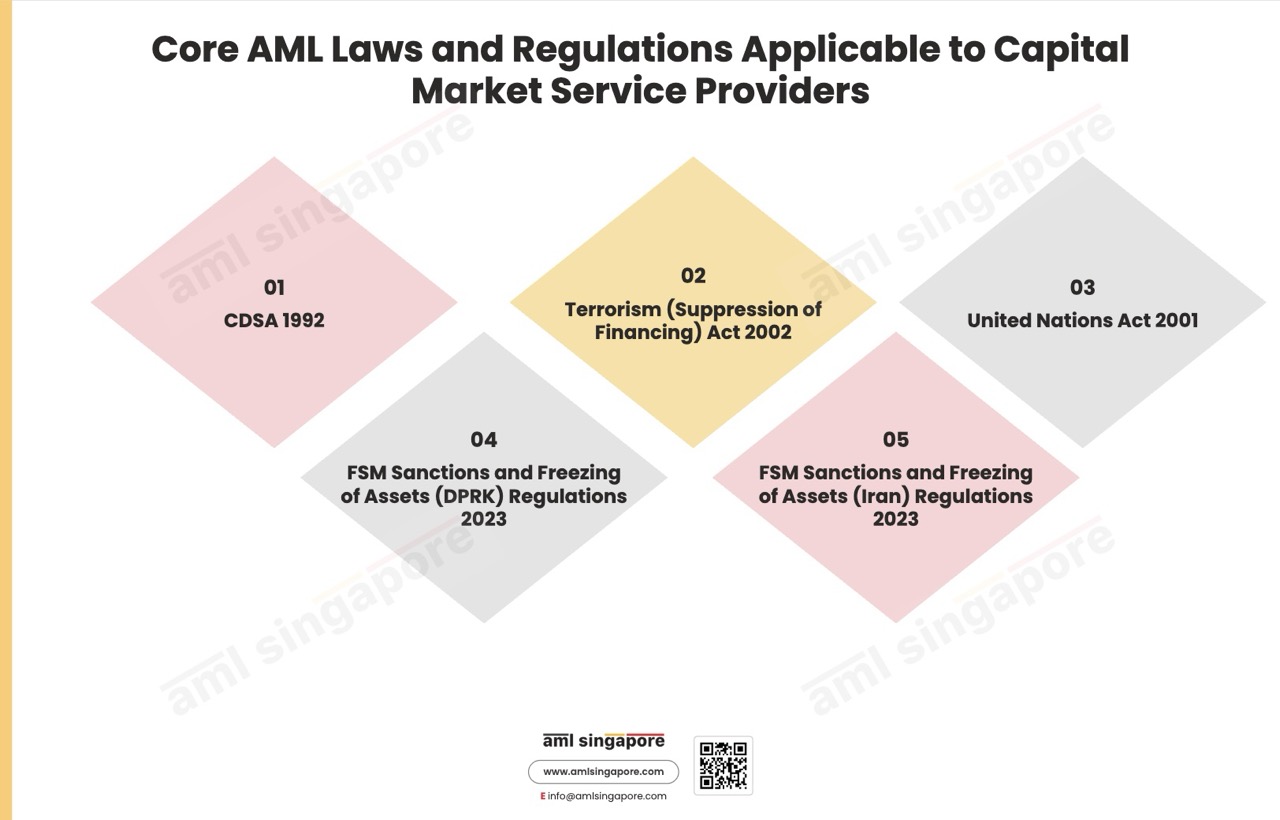
The Corruption, Drug Trafficking and Other Serious Crimes (Confiscation of Benefits) Act 1992
The CDSA establishes offences relating to money laundering and provides for the confiscation of benefits derived from drug dealing and criminal conduct. It also contains requirements relating to disclosure of suspicions and tipping off. Capital markets intermediaries must comply with the applicable suspicious transaction reporting requirements under the CDSA and the relevant MAS requirements. The Terrorism (Suppression of Financing) Act 2002.
The Terrorism (Suppression of Financing) Act 2002
The TSOFA criminalises various forms of terrorism financing and contains offences relating to terrorist property. It also contains disclosure, tipping off, seizure, freezing and confiscation provisions. Capital markets intermediaries must comply with the applicable terrorism financing and targeted financial sanctions requirements.
The United Nations Act 2001
The United Nations Act 2001 enables Singapore to give effect to obligations arising from United Nations Security Council resolutions through regulations. Applicable sanctions requirements may also be imposed under regulations made under the Financial Services and Markets Act 2022.
The Financial Services and Markets (Sanctions and Freezing of Assets of Persons, DPRK) Regulations 2023
Made by MAS under the Financial Services and Markets Act 2022, these regulations implement United Nations sanctions relating to the DPRK and impose asset freezing and other prohibitions on financial institutions within their scope. A capital markets intermediary within scope must comply with the applicable freezing, dealing and reporting requirements in respect of designated persons and property.
The Financial Services and Markets (Sanctions and Freezing of Assets of Persons, Iran) Regulations 2023
The Iran regulations implement relevant United Nations sanctions, including measures relating to Security Council Resolution 2231. They impose asset freezing and other restrictions in respect of designated persons and specified activities, subject to applicable exemptions. Capital markets intermediaries should comply with the applicable screening, freezing and prohibition requirements.
Overarching AML Laws and Regulations Applicable to Capital Market Service Providers in Singapore
These instruments cut across the whole regime and give a provider the practical means to discharge its reporting duties and to recognise terrorism financing when it appears in a trading or advisory relationship.
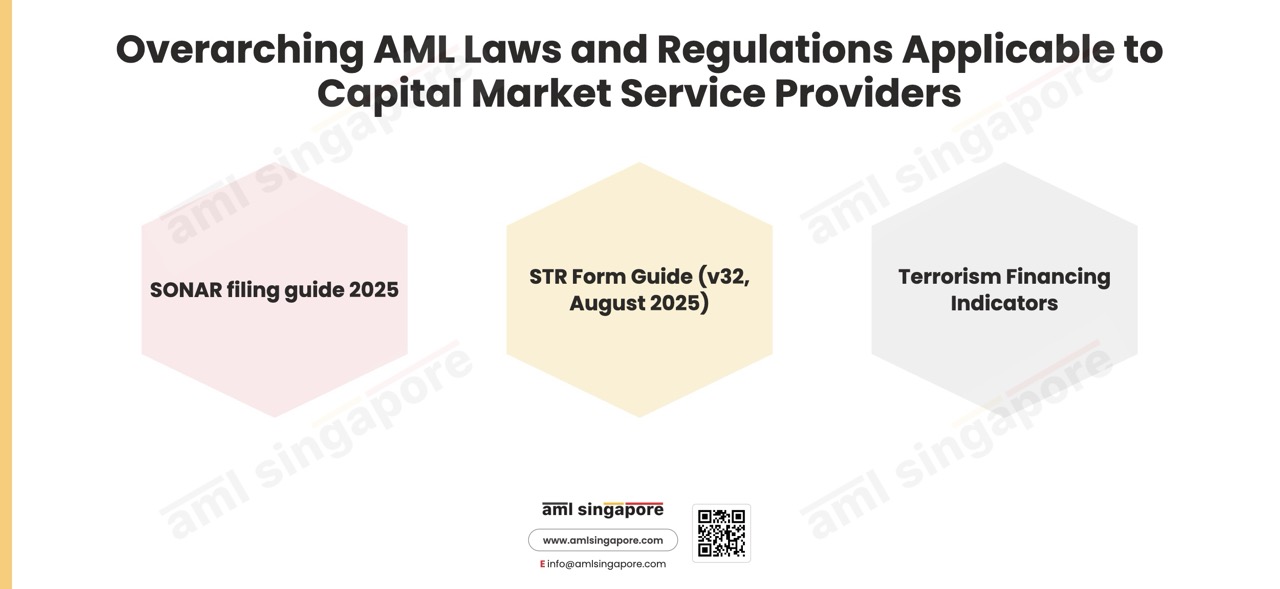
Getting Started with SONAR, for STR Filers (2025)
SONAR is the STRO Online Notices and Reporting platform used for the electronic submission of suspicious transaction reports. Capital markets intermediaries within the applicable reporting requirements use the platform to submit STRs to STRO.
Form Guide for the STR Form (Version 12 August 2025)
A field level guide to the current suspicious transaction report form. It sets out how to complete each tab, from the reporting institution’s details to the grounds for suspicion and provides for a unique internal reference for every report. For a securities or fund business, it is the reference a compliance officer uses to file an accurate, complete report without delay.
Terrorism Financing Indicators
A red flag list from STRO grouping terrorism financing indicators by due diligence anomalies, unusual fund movement and transactions lacking economic purpose. It helps a capital markets intermediary identify potential terrorism financing risks, including misuse of non profit organisations and unusual cross border transfers, and supports the assessment and escalation of potentially suspicious activity.
National Risk Assessments Applicable to Capital Market Service Providers in Singapore
Singapore publishes formal assessments of its money laundering, terrorism financing and proliferation financing risks. The Guidelines to MAS Notice SFA 04 N02 state that a capital markets intermediary should incorporate the results of Singapore’s National ML/TF Risk Assessment into its enterprise wide ML/TF risk assessment process.
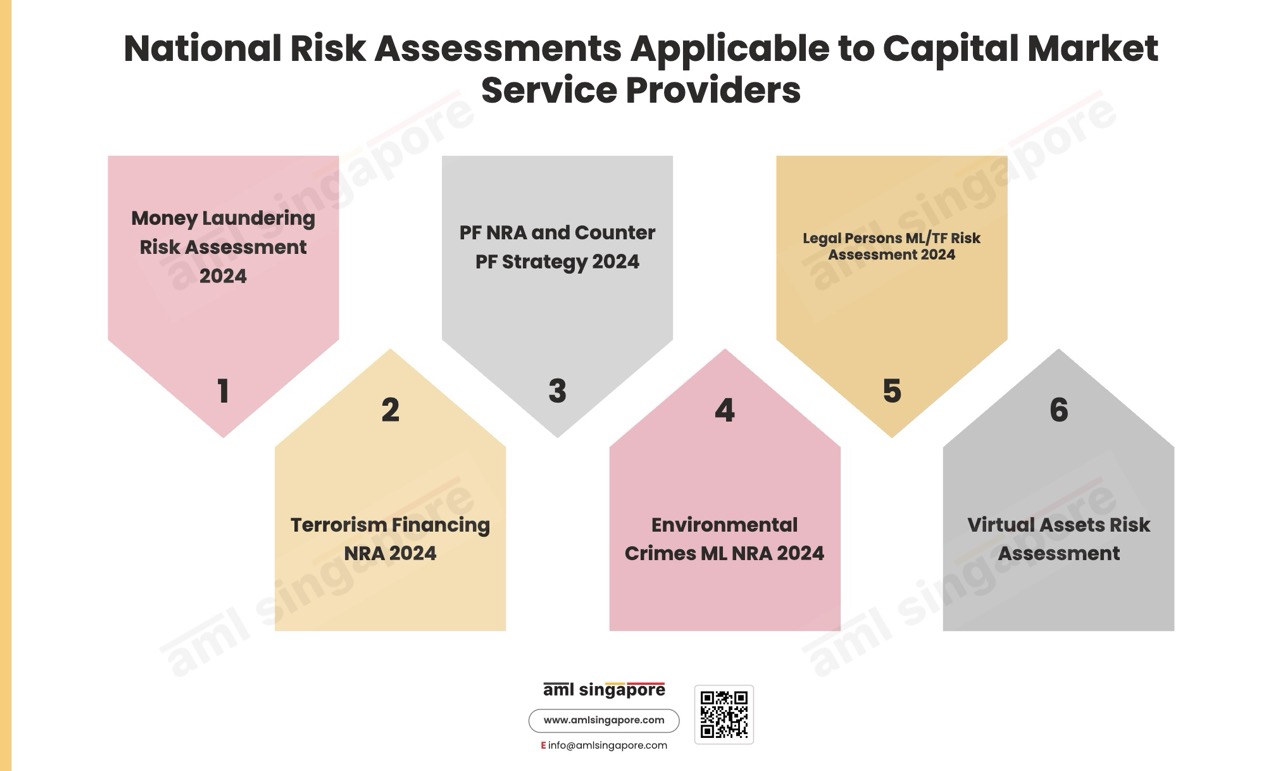
Money Laundering National Risk Assessment Singapore 2024
The 2024 Money Laundering National Risk Assessment assesses capital markets sub sectors individually. For broker dealers and corporate finance advisory firms, the assessment identifies cross border layering of illicit funds as a key ML risk and notes that limited exposure to higher risk jurisdictions and insignificant physical cash receipts relative to customer funds handled help mitigate vulnerability.
Terrorism Financing National Risk Assessment 2024
The terrorism financing national risk assessment identifies the principal terrorism financing risks and typologies relevant to Singapore. Although certain financial channels receive greater attention in the assessment, capital markets intermediaries should consider the findings when assessing their own terrorism financing risks.
Proliferation Financing National Risk Assessment and Counter PF Strategy 2024
The proliferation financing national risk assessment identifies risks including the misuse of legal persons, dual use goods and sanctions evasion. For a capital markets intermediary, exposure may arise through corporate customers, complex ownership structures, higher risk jurisdictions and transactions connected with proliferation sensitive activities. Beneficial ownership controls, risk assessment and targeted financial sanctions controls are therefore relevant components of its counter proliferation financing framework.
Environmental Crimes Money Laundering National Risk Assessment (May 2024)
The assessment examines money laundering risks associated with environmental crime, including risks arising from environmental crime proceeds. It may be relevant to a capital market intermediary where its customers or transactions have exposure to sectors vulnerable to such risks.
Money Laundering and Terrorism Financing Risk Assessment of Legal Persons (2024)
The assessment examines the money laundering and terrorism financing risks associated with the misuse of legal persons. It is relevant to capital markets intermediaries that onboard companies, funds and other legal structures and supports the importance of identifying and verifying beneficial owners.
Virtual Assets (Digital Payment Tokens) Risk Assessment (2024)
This assessment examines Singapore’s money laundering and terrorism financing risks arising from virtual assets and digital payment tokens. It is relevant to a capital market intermediary where its business has exposure to digital payment token activities or related risks. Digital CMP tokens are separately defined under MAS Notice SFA 04 N02 and should not be treated as synonymous with digital payment tokens. The specific CDD and value transfer requirements for digital CMP tokens arise from Notice SFA 04 N02 itself.
Capital Markets Sector ML/TF Risk Snapshot
Capital Markets Sector ML/TF Risk Snapshot
Money laundering: Capital markets transactions are more likely to be used at the layering stage because capital markets products can be converted into different types of assets, particularly where they are liquid and marketable (Guidelines to MAS Notice SFA 04 N02, paragraphs 1 4 3 and 1 4 4).
External asset managers: medium high ML risk, with the 2024 ML NRA identifying factors including high net worth and PEP customers, complex structures and cross border transactions (ML NRA 2024, paragraph 7.7).
Fund managers, broker dealers, corporate finance firms: medium low ML risk under the 2024 ML NRA (ML NRA 2024, paragraphs 7.8 and 7.11).
Proliferation and terrorism financing: Capital markets intermediaries should consider the relevant findings of Singapore’s 2024 PF and TF risk assessments when assessing their own risks and implementing appropriate risk mitigation and targeted financial sanctions controls.
Sector Specific Guidance Applicable to Capital Market Service Providers in Singapore
This is the core of a provider’s obligations. MAS supervises capital markets intermediaries and issues the notices and guidance they must follow. The material divides into common instruments that apply across financial institutions and the specific instruments written for capital markets, led by MAS Notice SFA 04 N02 and its Guidelines.
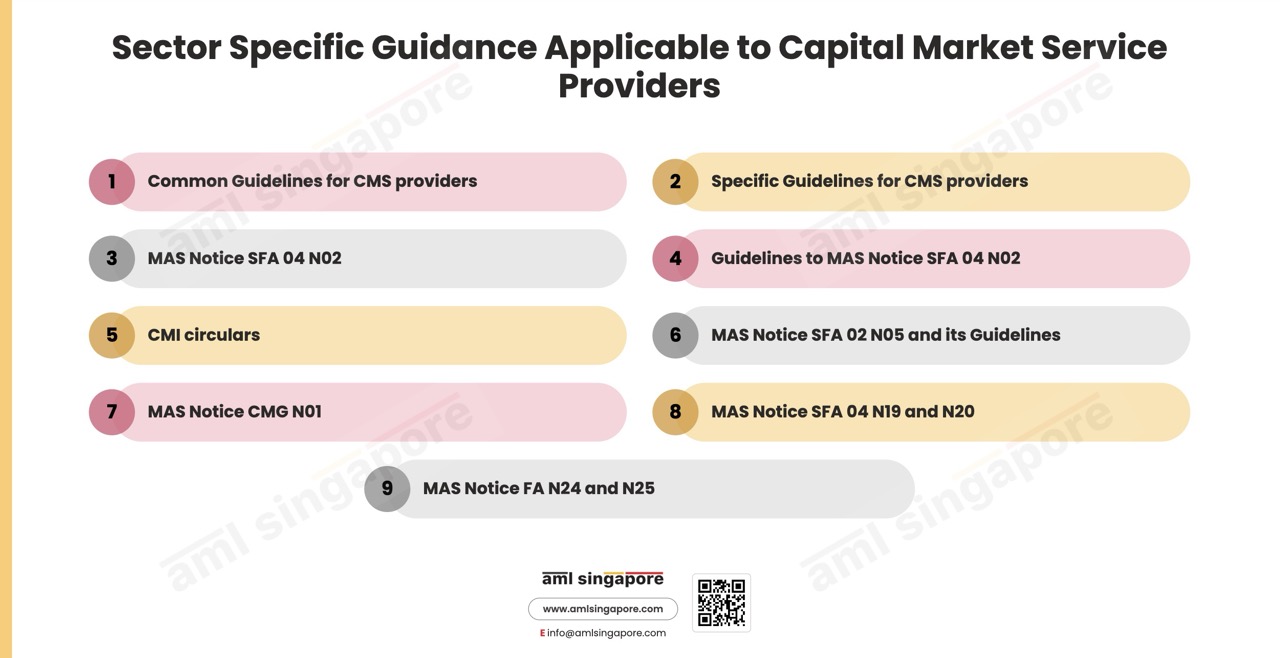
Common Guidelines for Capital Market Service Providers
These MAS instruments apply across financial institutions and shape how a provider designs its controls. They do not replace Notice SFA 04 N02; they explain MAS’s supervisory expectations on themes such as source of wealth, transaction monitoring, legal person misuse, sanctions and audit.
The Financial Services and Markets Act 2022
The Financial Services and Markets Act 2022 provides MAS with statutory powers relating to international obligations and the prevention of money laundering and terrorism financing. Section 16 provides the statutory basis for requirements concerning the prevention of money laundering and terrorism financing, including MAS Notice SFA 04 N02.
Circular AMLD 01/2018: Use of MyInfo and CDD for Non Face to Face Business Relations
MAS recognises MyInfo as a source that a capital markets intermediary may use to obtain and verify customer information for customer due diligence, subject to the applicable requirements and safeguards. Use of MyInfo does not remove the intermediary’s responsibility to satisfy the applicable CDD requirements, and the intermediary should apply additional measures where the information available through MyInfo is insufficient or where impersonation or other non face to face risks remain.
Circular AMLD 01/2022: Non Face to Face Customer Due Diligence Measures
This circular develops MAS’s expectations for onboarding natural and legal persons without face to face contact, the norm for online trading and digital fund platforms. It warns that video conferencing alone may be insufficient, recommends a second channel check for higher risk accounts, and requires any onboarding technology to be assessed by the firm and approved by its board and senior management.
Circular AMLD 02/2023: ML/TF Risks in the Wealth Management Sector
MAS reminds firms serving wealthy clients, that the sector carries higher inherent risk. It calls for stronger board oversight, due diligence review and quality assurance, and for looking through trusts, holding companies and investment wrappers to the ultimate beneficial owners, and it treats a client who withdraws rather than answer questions as a reason to consider a report.
Circular AMLD 08/2024: Establishing the Sources of Wealth of Customers
This circular guides firms on establishing a customer’s source of wealth before business relations begin. It expects a provider to take reasonable means to establish the source of wealth and to corroborate it independently against documents or public sources, applying the principles of materiality, prudence and relevance, and to escalate cases it cannot corroborate to senior management.
Circular AMLD 05/2026: Risk Proportionate Source of Wealth Establishment
A calibrating circular issued in 2026. MAS stresses that source of wealth work should be effective, efficient and proportionate to risk, so legitimate investors are not burdened. A capital markets intermediary is told to focus corroboration on material or higher risk wealth, avoid repeated or unreasonable requests, and escalate genuine red flags rather than apply a uniform standard to every client.
Circular AMLD 11/2023: Ensuring Effective Detection of Sanctions Related Risks
MAS requires firms to detect and manage sanctions risk, including unilateral sanctions imposed by other jurisdictions that matter for cross border securities and fund flows. The board must set the risk appetite, and the circular describes a lookback review of transactions after a designation, covering at least corporate accounts and the preceding period, to catch value moved through intermediaries before the designation.
Circular AMLD 12/2024: Audit of AML/CFT Policies, Procedures and Controls
This addresses the independent audit that forms a provider’s third line of defence. A capital markets intermediary must maintain an audit function that regularly tests the effectiveness of its AML/CFT controls, resource it with suitable expertise, prioritise higher risk areas, and benchmark against the industry best practice paper, with MAS encouraging data analytics for sampling and anomaly detection.
Strengthening AML/CFT Controls on Misuse of Legal Persons and Complex Structures (August 2023)
An MAS information paper from inspections that found firms intermediating concerning flows through trusts, foundations and layered structures. Through case studies, it shows failures to identify true beneficial owners and to join up source of wealth concerns, and it expects a provider whose clients are frequently corporate vehicles to benchmark itself and remediate under senior management oversight.
AML/CFT Supervisory Expectations from Recent Inspections (October 2024)
MAS sets out expectations from recent inspections across five areas: treating multiple nationalities and investment migration links as risk factors, detecting document red flags, testing the plausibility of source of wealth, taking real risk mitigation after a report or exit, and sharing customer information across business units. Each speaks directly to how a capital markets intermediary runs client due diligence.
Best Practices in Relation to Risks in Wealth Management (May 2025)
An industry paper for firms serving wealthy clients, consolidating case studies on private investment companies and trusts, sanctions and geopolitical events, remote onboarding, investment migration clients.
Effective Practices to Detect and Mitigate the Risk from Misuse of Legal Persons (June 2019)
An MAS paper on defending against shell and front companies across the client lifecycle. It sets out multi factor risk assessment, red flag lists, network link analysis and staff training, and stresses that a single red flag is rarely conclusive, so a provider onboarding corporate clients should weigh several factors together before it acts.
Guidance for Effective AML/CFT Transaction Monitoring Controls (September 2018)
MAS’s expectations for transaction monitoring, drawn from inspections. It covers risk based calibration of parameters and thresholds, back testing, data integrity, alert handling and documentation, and the treatment of outsourced first level alert review. For a securities business monitoring trade flows, it warns against closing alerts on generic grounds without confirming that the risk is genuinely addressed.
Guidance to Capital Markets Intermediaries on Enhancing AML/CFT Frameworks and Controls (January 2019)
This MAS guidance provides supervisory observations and good practices concerning AML/CFT frameworks and controls for capital markets intermediaries. It should be read alongside the current MAS Notice SFA 04 N02 and its current Guidelines and should not be treated as a substitute for those requirements.
Guidelines on Risk Management Practices, Internal Controls (July 2024)
This prudential guideline sets MAS’s expectations for a firm’s control environment and business process controls. It touches customer due diligence only at a high level and defers to the AML/CFT Notices and Guidelines for the details, so for a capital markets intermediary it supplies the internal controls scaffolding around which the AML/CFT programme is organised rather than a source of AML obligations.
Guidelines on Provision of Digital Advisory Services (October 2018)
Primarily a conduct guideline for digital or robo advisory services, directly relevant to a capital markets intermediary that offers automated advice or discretionary management online. Its AML/CFT content is brief: a digital adviser must still have adequate ML/TF controls under the applicable notice and must manage the impersonation risks of a non face to face model. It is included as part of the framework for a provider offering those services.
Sound Practices to Counter Proliferation Financing (August 2018)
An MAS paper from thematic reviews on countering proliferation financing linked to DPRK and Iran sanctions evasion. It addresses control uplift, higher risk client and counterparty monitoring, and typologies such as shell companies with nominee directors. It matters to a capital markets intermediary with cross border corporate clients or correspondent relationships exposed to dual use trade.
Strengthening Financial Institutions' CFT Controls (May 2023)
An MAS information paper from an industry survey on countering the financing of terrorism. It restates the duty to freeze and report designated party assets and sets expectations on screening, data analytics, escalation and the timely, quality filing of reports, all of which a capital markets intermediary applies to its clients and trade counterparties.
Specific Guidelines for Capital Market Service Providers
These are the instruments written for capital markets intermediaries. Two of them, MAS Notice SFA 04 N02 and its Guidelines, are the rulebook a provider lives by, so they are covered in full below. The other notices apply to a provider when, and to the extent that, it carries on the activity each one governs.
MAS Notice SFA 04 N02 on Prevention of Money Laundering and Countering the Financing of Terrorism, Capital Markets Intermediaries
Notice SFA 04 N02 is the binding AML/CFT rulebook for the sector. It is issued under section 16 of the Financial Services and Markets Act 2022 and applies to every holder of a capital markets services licence under the Securities and Futures Act, and to persons exempted from holding one under paragraphs 3(1)(d), 3A(1)(d) and 7(1)(b) of the Second Schedule to the SF (Licensing and Conduct of Business) Regulations. The current version took effect on 1 July 2025. The Notice provides that money laundering risks include proliferation financing risks, so references to money laundering and money laundering risks in the Notice are construed accordingly.
The Notice defines the circumstances in which a person is treated as a customer and when a business relationship arises for a capital markets intermediary. Investors in an investment vehicle managed by the intermediary are generally treated as customers, subject to the specific exemptions in paragraph 6.16. Accordingly, a fund manager must determine whether the applicable customer identification, beneficial ownership and other CDD requirements apply to the investment vehicle and its investors, considering the relevant exemptions.
After the underlying principles, the Notice requires a provider to identify, assess and understand its ML/TF risk across its customers, the countries it and its customers operate in, and its products, services and channels, and to apply a risk based approach with senior management approved policies and enhanced measures where risk is higher. New products and technologies must be risk assessed before launch, with attention to features that favour anonymity.
Customer due diligence is the core. A provider may not keep anonymous or fictitious name accounts, and it must perform customer due diligence when it establishes business relations, when it undertakes an occasional transaction above S$20,000, when it undertakes a digital CMP token transaction or value transfer, when it suspects money laundering or terrorism financing, or when it doubts the veracity or adequacy of information previously obtained.
It must identify and verify the customer from reliable and independent sources, identify any person acting for the customer and that person’s authority, identify relevant connected parties, and identify and verify beneficial owners in accordance with the applicable ownership and control requirements. Where the customer is a legal person or legal arrangement, the provider must understand its ownership and control structure and the purpose and intended nature of the business relationship.
The Notice then requires ongoing monitoring of every relationship: a provider must scrutinise transactions against its knowledge of the client, pay special attention to complex, unusually large or unusual patterns with no apparent purpose, keep due diligence information current, and screen clients, connected parties and beneficial owners against sanctions and other lists.
Simplified due diligence is available only where risk is demonstrably low, and never where the FATF has called for countermeasures or where suspicion exists. Enhanced due diligence is mandatory for politically exposed persons, requiring senior management approval, establishment of source of wealth and source of funds, and enhanced monitoring, and for other higher risk situations the provider identifies, such as opaque shell structures or personal asset holding vehicles.
The later paragraphs address specialised activities. A provider may rely on a qualifying third party for due diligence but never for ongoing monitoring, and it remains responsible for its own obligations. Correspondent account services, for example, where a foreign securities firm opens a trading account with a Singapore intermediary, require the provider to assess the respondent, understand each party’s responsibilities and obtain senior management approval, and it may never deal with a shell institution.
Digital CMP token value transfers are subject to specific value transfer information requirements under paragraph 10A of Notice SFA 04 N02. For transfers exceeding S$1,500, additional originator information must accompany the transfer, subject to the provisions governing intermediary institutions.
The Notice also contains specific requirements for lower value transfers. Records required under the Notice must generally be retained for at least five years. The Notice contains specific limitations and exceptions concerning access to personal data for compliance with the AML/CFT framework. Suspicious transaction reporting must be made to STRO in accordance with the Notice, while the applicable Guidelines provide further guidance on filing timelines.
Finally, a provider must maintain adequate internal policies, a group policy across its branches and subsidiaries, an AML/CFT compliance officer at management level, an independent audit function, and regular training for its employees, officers and representatives.
Guidelines to MAS Notice SFA 04 N02 (the Primary Guidance for CMS providers)
The Guidelines to Notice SFA 04 N02 are the primary guidance a capital markets intermediary works with, and they are given the fullest treatment here. They are dated 1 July 2025, and their chapters mirror the paragraphs of the Notice, so a provider can read each obligation next to its explanation. They are guidance rather than binding rules, but MAS states that the degree of a firm’s observance may affect its overall assessment of the firm, including the quality of its board and senior management oversight, so in practice they set the standard the provider is measured against.
The Guidelines open with the sector’s money laundering profile. Because capital markets transactions are no longer predominantly cash based, they are more likely to be used at the layering stage than at placement, and the ease with which liquid, marketable assets can be converted into other assets makes them attractive for disguising the origin of funds. That framing runs through the rest of the document.
On accountability, the Guidelines confirm that ultimate responsibility rests with the board and senior management, describe the three lines of defence, and, distinctively for this sector, extend the training and control duties to the firm’s appointed representatives as well as its employees and officers.
On the risk based approach, a provider must assess ML/TF risk not only for individual clients but on an enterprise wide level, consolidating risk across business units, products and channels, including overseas branches and subsidiaries for a Singapore incorporated firm. The enterprise wide assessment must be approved by senior management, should combine qualitative and quantitative analysis, must incorporate the findings of Singapore’s national risk assessments, and should be reviewed at least once every two years or when a material trigger event occurs, such as a new client segment, product or channel.
The customer due diligence chapter is the longest, and it is where the sector’s structure shows. It explains verification using documents that are hardest to forge, and it works through fund distribution in detail: where the firm is the primary manager of a fund, the underlying investors are the fund’s beneficial owners, and where a fund is distributed through banks or advisers using omnibus accounts, the end investors are beneficial owners of the firm’s customer, so the provider must either look through or obtain confirmation that a FATF regulated distributor is carrying out the checks.
On ownership, the Guidelines set the widely used benchmark that a beneficial owner is generally a natural person who owns more than 25% of an entity, while making clear that anyone who controls the customer through significant influence is a beneficial owner regardless of any percentage. They address customer due diligence for non face to face relationships, which dominate online trading, and require additional anti impersonation checks.
On timing, the Guidelines state that completion of verification should not exceed 30 business days after the establishment of business relations. If verification remains incomplete after 30 business days, the CMI should suspend the business relationship and refrain from further transactions, subject to the limited treatment described in the Guidelines.
If verification remains incomplete after 120 business days, the CMI should terminate the business relationship. The Guidelines also recognise securities trades as an example where completion of verification may be deferred where necessary to avoid interrupting time critical execution, provided appropriate limits and closer monitoring are applied.
Screening guidance requires all identified parties to be screened regardless of risk, confirmed sanctions matches to be acted on without delay, and a report to be filed no later than one business day after suspicion is established in sanctions cases, with fuzzy matching calibrated to the firm’s risk and four eye checks on sanctions alerts.
The enhanced due diligence chapter defines politically exposed persons in line with the FATF standard, confirms that domestic PEPs include at least Ministers and Members of Parliament, and draws the important distinction between source of wealth and source of funds: source of wealth is the origin of the client’s entire body of wealth and how it was acquired, while source of funds is the origin of the particular money involved.
A provider should corroborate this information using reliable, independent sources, focus on material or higher risk wealth, and, where it cannot corroborate, assess the residual risk and apply mitigation such as senior management approval and enhanced monitoring.
For higher risk business such as private banking and wealth management for high net worth clients, the Guidelines point to the sound practices in the MAS Private Banking Controls paper, and they expect a provider to reject a prospective client where there are reasonable grounds to suspect the assets are proceeds of serious crime, including wilful foreign tax evasion, applying enhanced due diligence to the relationships that warrant it.
The remaining chapters complete the picture. Reliance is distinguished from outsourcing: a firm may outsource certain functions, but it remains responsible for complying with its AML/CFT obligations. Correspondent account guidance gives the example of a foreign securities firm trading through a Singapore intermediary and addresses nested relationships. The Guidelines also address record keeping and suspicious transaction reporting, including the applicable filing expectations, while the chapters on the compliance officer, audit and training complete the operational detail.
A dedicated chapter on proliferation financing directs a provider to screen against the latest United Nations Security Council lists, freeze without delay and watch for proliferation indicators, and two appendices give worked examples of customer due diligence information by customer type and of suspicious transactions, including investment related and tax crime patterns that a securities or fund business is likely to see.
Circular CMI 02/2015 (Holders of a CMS Licence for Dealing in Capital Markets Products)
Addressed to holders of a capital markets services licence for dealing in capital markets products, this circular sets out common findings and good practices arising from MAS’s thematic inspections of broker dealers. It identifies areas for improvement in AML/CFT measures and business conduct, including policies and procedures, customer due diligence, ongoing monitoring and trading controls. It should be read as supervisory guidance on the findings and good practices identified by MAS, rather than as a standalone source of current AML/CFT obligations.
Circular CMI 04/2015 (Holders of a CMS Licence for Advising on Corporate Finance)
This circular sets out common findings and good practices arising from MAS’s thematic inspections of licensed and exempt corporate finance firms. It covers AML/CFT practices, record keeping and staff trading, and provides supervisory observations and examples of good practices identified during the inspections. It should be read as supervisory guidance on MAS’s inspection findings rather than as a standalone source of current AML/CFT obligations.
MAS Notice CMG N01 (Reporting of Suspicious Activities and Incidents of Fraud)
MAS Notice CMG N01 establishes a separate reporting requirement for specified financial market entities in relation to suspicious activities and incidents of fraud that may materially affect their safety, soundness or reputation. The reporting obligation to MAS is separate from any suspicious transaction report that must be filed with the Suspicious Transaction Reporting Office under the applicable AML/CFT requirements.
MAS Notice SFA 02 N05 (Approved Exchanges and Recognised Market Operators)
MAS Notice SFA 02 N05 sets out AML/CFT requirements applicable to approved exchanges and recognised market operators within its scope. It is relevant to a capital markets group only where it carries on activities falling within the scope of the Notice.
Guidelines to MAS Notice SFA 02 N05
These Guidelines accompany Notice SFA 02 N05 and guide approved exchanges and recognised market operators on the AML/CFT requirements in the Notice. They elaborate on areas including the risk based approach, customer due diligence, enhanced due diligence, reliance and reporting, and should be read together with the Notice. They are relevant to a capital markets group to the extent that it operates an approved exchange or recognised market operator.
MAS Notice SFA 04 N19 (Cross Border Arrangements, Foreign Related Corporations)
MAS Notice SFA 04 N19 applies to specified persons and qualifying cross border arrangements within the scope of the Securities and Futures regulatory framework. It should be considered where the intermediary conducts activities covered by the relevant exemption framework.
MAS Notice SFA 04 N20 (Cross Border Arrangements, Foreign Offices)
MAS Notice SFA 04 N20 applies to specified capital markets services licensees and exempt persons in relation to qualifying activities carried out through foreign offices within the scope of the relevant cross border exemption framework.
MAS Notice FAA N24 (Specified Financial Advisers, Cross Border Arrangements
MAS Notice FAA N24 applies to specified financial advisers and qualifying cross border arrangements within the scope of the Financial Advisers regulatory framework. It is relevant only where the intermediary also carries on financial advisory activities covered by the Notice.
MAS Notice FAA N25 (Licensed and Exempt Financial Advisers, Cross Border Foreign Offices)
MAS Notice FAA N25 applies to specified financial advisers and qualifying activities carried out through foreign offices within the scope of the applicable Financial Advisers cross border framework. It should not be presented as a general AML/CFT Notice for capital markets intermediaries.
Allied Laws Applicable to Capital Market Service Providers in Singapore
These statutes are not primarily AML instruments, but each supports the regime: some license and govern capital markets intermediaries, others give investigators their powers, and others create the predicate offences, and proliferation controls a provider screens against.
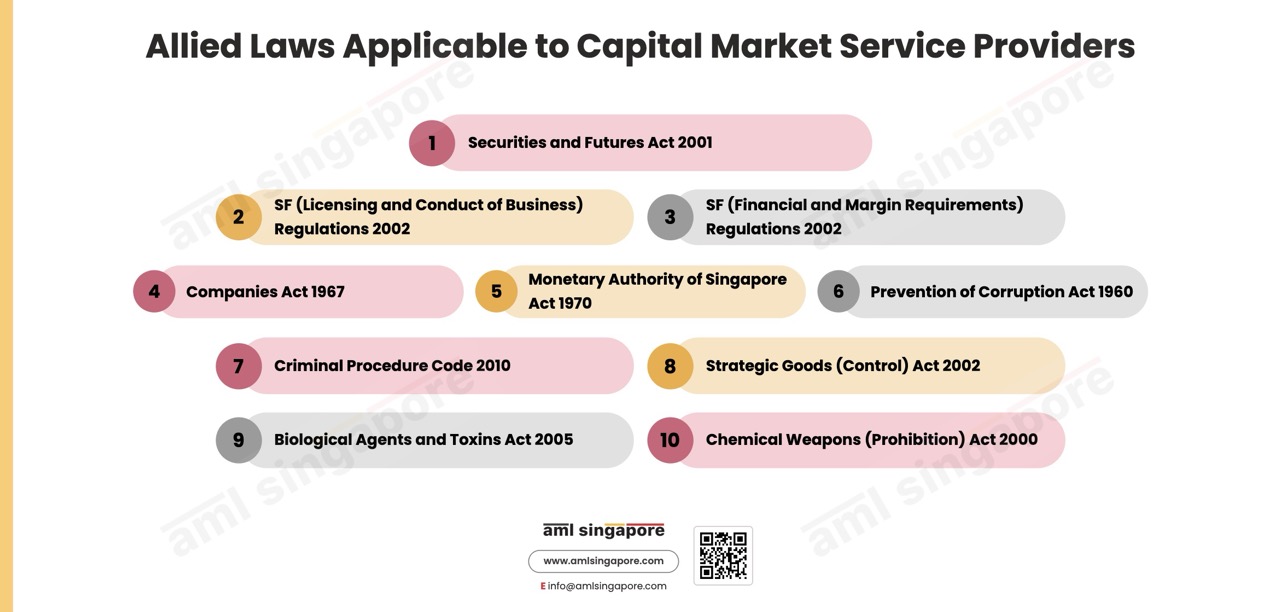
The Securities and Futures Act 2001
The primary statute governing the licensing of the sector. Section 82 generally requires a person carrying on a regulated activity to hold a capital markets services licence unless an applicable exemption applies. The Second Schedule to the Securities and Futures Act sets out the regulated activities for which a capital markets services licence may be required. The current Second Schedule should be consulted for the applicable activities and licensing requirements. Section 86 provides for the grant of a capital markets services licence.
The Securities and Futures (Licensing and Conduct of Business) Regulations 2002
Subsidiary legislation governing how CMS licences are granted and how licensees must conduct business, including the handling and segregation of customers’ moneys and assets. It is the source of the licensing exemptions that the CMS notices cross refer to, including the corporate finance adviser exemption in paragraph 7(1)(b) of its Second Schedule.
The Securities and Futures (Financial and Margin Requirements) Regulations 2002
Prudential rules that set the base capital and financial resources requirements for a CMS licensee and the duty to notify MAS when capital falls short. Not an AML instrument, but it underpins the financial soundness of a provider and the notification discipline that sits alongside its AML controls.
The Companies Act 1967
The Companies Act 1967 contains requirements relating to registrable controllers of companies and supports Singapore’s beneficial ownership transparency framework. Information from the relevant registers may assist customer due diligence but does not replace a capital markets intermediary’s obligation to identify and verify beneficial owners under the applicable AML/CFT requirements. Information from the registrable controller’s framework can support a capital markets intermediary’s customer due diligence, but it does not replace the intermediary’s obligation to independently identify and verify beneficial owners in accordance with MAS Notice SFA 04 N02 and its Guidelines.
The Monetary Authority of Singapore 1970
The Monetary Authority of Singapore Act 1970 establishes MAS and sets out its statutory functions and powers. It is part of the institutional framework under which MAS regulates the financial sector, but it should not be described as the statutory source of the DPRK sanctions regulations or as the principal source of the AML/CFT obligations imposed by Notice SFA 04 N02.
The Prevention of Corruption Act 1960
The Prevention of Corruption Act 1960 establishes offences relating to corruption. Proceeds derived from predicate offences may be relevant to a capital markets intermediary’s money laundering risk assessment and customer due diligence.
The Criminal Procedure Code 2010
The Criminal Procedure Code 2010 contains investigative and procedural powers, including provisions relating to production, search, seizure and orders concerning property. A capital markets intermediary must comply with applicable orders made under the relevant legislation.
The Strategic Goods (Control) Act 2002
The Strategic Goods (Control) Act 2002 regulates brokering and related activities, making it relevant where a provider’s customers or transactions are exposed to strategic goods or dual use items. It may be relevant to capital markets intermediaries where customers or transactions have exposure to activities covered by the Act.
The Biological Agents and Toxins Act 2005
The Biological Agents and Toxins Act 2005 regulates activities involving specified biological agents and toxins and contains offences and controls relevant to biological weapons risks. It may be relevant to proliferation financing risk assessment where a customer or transaction has a relevant connection.
The Chemical Weapons (Prohibition) Act 2000
The Chemical Weapons (Prohibition) Act 2000 implements Singapore’s obligations under the Chemical Weapons Convention and establishes offences and controls relating to chemical weapons. It may be relevant to proliferation financing risk assessment and sanctions screening where applicable.
Miscellaneous Laws and Regulations Applicable to Capital Market Service Providers in Singapore
These national strategies, committee reports and typologies set the direction of Singapore’s regime and the public private partnership a provider operates within. They are not binding rules, but they shape supervision and supply the typologies a provider screens for.
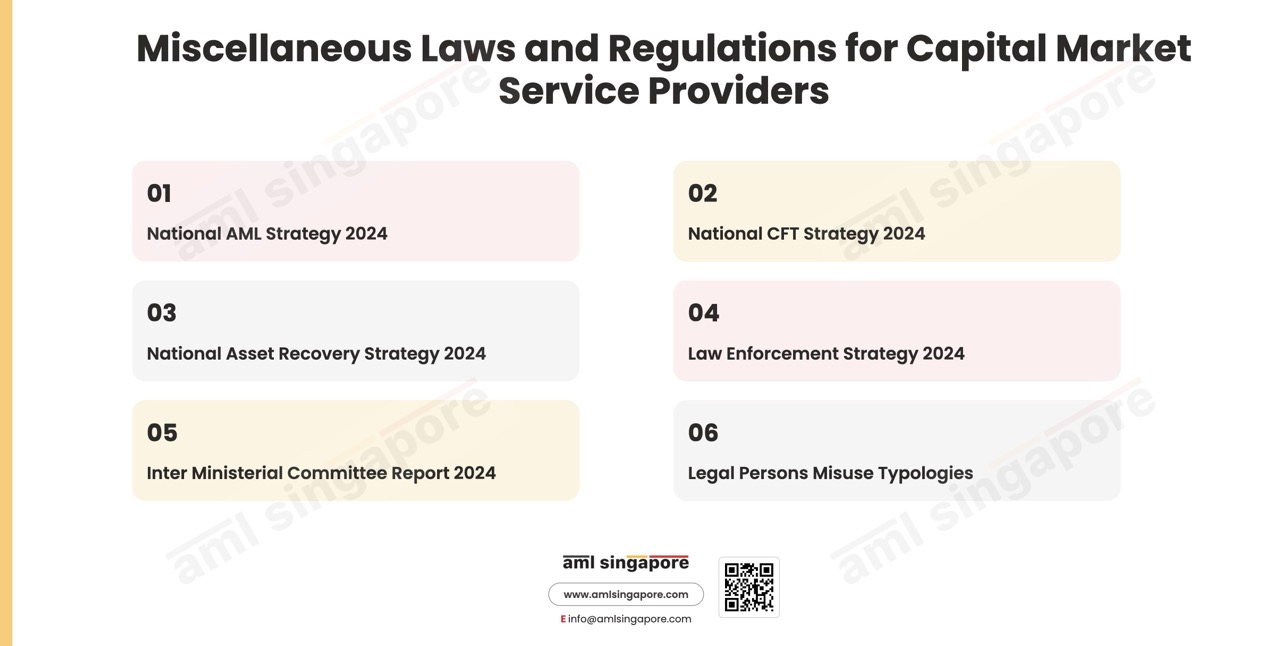
National Anti Money Laundering Strategy 2024
Singapore’s National Anti Money Laundering Strategy is structured around the pillars of Prevent, Detect and Enforce. It provides a national strategic framework for addressing money laundering risks and is not itself a source of binding AML/CFT obligations for individual capital markets intermediaries.
National Strategy for Countering the Financing of Terrorism 2024
Singapore’s National Strategy for Countering the Financing of Terrorism provides the national strategic framework for addressing terrorism financing risks. It is a policy strategy and does not itself impose binding AML/CFT requirements on individual capital markets intermediaries.
National Asset Recovery Strategy 2024
Singapore’s National Asset Recovery Strategy sets out the national approach to detecting, freezing, seizing and confiscating criminal assets and strengthening asset recovery efforts. It is a national strategy rather than a source of direct AML/CFT obligations for capital markets intermediaries.
Singapore Law Enforcement Strategy to Combat Money Laundering (October 2024)
The joint strategy of Singapore’s money laundering investigation agencies, setting focus areas and key actions and relying on public private information flows with financial institutions. It frames the enforcement environment a capital markets intermediary supports through its reporting.
Inter Ministerial Committee on Anti Money Laundering Report (October 2024)
The review following a major money laundering case, recommending measures on corporate structure misuse, gatekeepers and information sharing. Its themes, especially the misuse of legal persons, bear directly on a sector whose clients are frequently corporate vehicles and funds.
Legal Persons: Misuse Typologies and Best Practices (2018)
An industry typologies paper on the misuse of companies and partnerships, giving the red flags a provider uses in beneficial ownership and corporate account screening. It is particularly useful for a sector that onboards holding companies, funds and special purpose vehicles.
International Standards Applicable to Capital Market Service Providers in Singapore
Singapore’s regime is built to meet the FATF standards, and Notice SFA 04 N02 tracks them closely. These instruments are the least sector specific, but they explain why the domestic rules take the shape they do and give a provider the typologies and methods supervisors expect it to keep pace with.
The FATF Recommendations (updated June 2026)
The FATF Recommendations provide international standards for combating money laundering, terrorism financing and proliferation financing. They are not Singapore legislation and do not themselves impose statutory obligations on individual capital markets intermediaries.
Mutual Evaluation Report of Singapore (May 2026)
The 2026 FATF and Asia Pacific Group Mutual Evaluation assesses Singapore’s AML/CFT framework for technical compliance and effectiveness. It provides an international assessment of Singapore’s overall regime and does not itself impose obligations on individual capital markets intermediaries.
Methodology for Assessing Technical Compliance and Effectiveness (updated June 2026)
The methodology FATF uses to assess countries’ technical compliance with the FATF Recommendations and the effectiveness of their AML, CFT and counter proliferation financing systems. It provides the assessment framework used in Singapore’s mutual evaluation and is an international assessment methodology rather than a binding source of obligations for individual capital markets intermediaries.
FATF Guidance on Politically Exposed Persons (Recommendations 12 and 22, 2013)
Explains how a provider identifies politically exposed persons and applies enhanced due diligence: senior management approval, establishing source of wealth and funds, and enhanced ongoing monitoring.
Guidance on Beneficial Ownership of Legal Persons (March 2023)
Guidance following the revised Recommendation 24 on obtaining and verifying beneficial ownership information, informing how a provider identifies the beneficial owners of corporate clients and distinguishes legal from beneficial ownership.
Best Practices on Beneficial Ownership for Legal Persons (October 2019)
Country best practices for adequate, accurate and timely beneficial ownership information, supporting a provider’s use of registries and multiple sources when it onboards corporate clients and funds.
Concealment of Beneficial Ownership (July 2018)
A joint FATF and Egmont Group typologies report on how criminals hide beneficial ownership through intermediaries and structures, giving a provider the red flags to detect concealment behind corporate clients.
Risk Based Approach: Beneficial Ownership and Transparency of Legal Arrangements (March 2024)
Guidance focused on Recommendation 25 and trusts and similar arrangements, helping a provider assess and mitigate risk when it onboards trustees, funds and legal arrangements.
FATF Guidance on Counter Proliferation Financing (February 2018)
Guidance on implementing the financial provisions of Security Council resolutions against weapons of mass destruction proliferation, requiring a provider to screen and freeze without delay under Recommendation 7.
Guidance on Proliferation Financing Risk Assessment and Mitigation (June 2021)
Sets out how a provider assesses and mitigates proliferation financing risk following the amended Recommendations 1 and 2, which extended risk assessment duties to proliferation financing.
Guidance on Digital Identity (March 2020)
Helps a provider decide whether a digital identity system is reliable and independent enough for customer due diligence under a risk based approach, which matters for remote onboarding of trading and fund clients.
Artificial Intelligence and Deepfakes: Impacts on ML/TF/PF
A forward looking FATF scan of how artificial intelligence and deepfakes threaten preventive systems, for example, synthetic identities defeating remote onboarding, alongside AI’s uses in compliance.
Money Laundering from Environmental Crime (July 2021)
A typologies report on laundering the proceeds of environmental crime, flagging the red flags a provider may see in commodity, resource and forestry linked clients and financing.
Trade Based Money Laundering, Private Sector Handout
A concise handout on trade based money laundering techniques, relevant to a provider that finances trade or onboards trading companies, such as over and under invoicing and phantom shipments.
Summary of Key Instruments
The table below distils the instruments a capital markets intermediary relies on most, what type each is, whom it binds, and the core obligation it places on a provider. It is a quick reference, not a substitute for the sections above.
|
Instrument |
Type |
Who it binds |
Core obligation for a provider |
|
CDSA 1992 |
Statute |
All persons and providers under CDSA obligations |
Report suspicions (STR), do not tip off, keep records |
|
Terrorism (Suppression of Financing) Act 2002 |
Statute |
All persons and providers under TSOFA obligations |
Freeze terrorist property; inform the authorities |
|
FSM Sanctions Regulations (DPRK, Iran) 2023 |
Regulations |
Financial institutions within scope |
Freeze designated persons’ assets; report to MAS |
|
MAS Notice SFA 04 N02 |
Notice (FSM Act s16) |
All CMS licensees and exempt persons |
Risk based CDD, EDD, monitoring, STR, records, audit |
|
Guidelines to SFA 04 N02 |
Guidelines |
All capital markets intermediaries |
How to meet the Notice; observance affects MAS assessment |
|
Notice CMG N01 |
Notice (SFA) |
CMS licensees and market participants |
Report suspicious activity and fraud to MAS on Form F1 |
|
Securities and Futures Act 2001 |
Statute |
CMS licensees |
Licensing of the seven regulated activities |
|
MAS Act 1970 |
Statute |
MAS and the financial sector |
Establishes MAS and its statutory functions and powers |
|
ML, TF and PF NRAs 2024 |
Risk assessments |
Whole system |
Feed the provider’s enterprise wide risk assessment |
|
FATF Recommendations |
International standard |
Global baseline |
Inform and influence the domestic AML/CFT framework |
Conclusion
The criminal statutes establish relevant money laundering and terrorism financing offences and reporting or disclosure obligations, while applicable sanctions regulations impose asset freezing and other restrictions within their scope. Notice SFA 04 N02 and its Guidelines establish the principal AML/CFT framework for capital markets intermediaries, including risk assessment, customer due diligence, enhanced due diligence, ongoing monitoring, record keeping and suspicious transaction reporting. Because capital markets transactions can be used at the layering stage, a provider’s controls must address trading and investment flows as well as relevant cash risks.
The instruments interlock. A provider’s enterprise wide risk assessment draws on the national risk assessments; its due diligence and beneficial ownership workflows from Notice SFA 04 N02 and its Guidelines; its licensing and conduct obligations come from the Securities and Futures Act and its regulations; and its sanctions and proliferation controls draw on the FSM Act sanctions regulations and the FATF standards. Understanding how they fit together is what lets a firm build controls that are defensible rather than merely present.
Capital markets services licensees share their core anti money laundering instrument, MAS Notice SFA 04 N02, with two adjacent sectors, and our companion guides explain how the same Notice applies to external asset managers and to fund management companies.
Frequently Asked Questions
MAS Notice SFA 04 N02 is the anti money laundering and countering the financing of terrorism notice for capital markets intermediaries, issued under section 16 of the Financial Services and Markets Act 2022. It is read together with the Guidelines to Notice SFA 04 N02, which explain how to meet each requirement.
A holder of a capital markets services licence under the Securities and Futures Act, carrying on one of the seven regulated activities such as dealing in capital markets products, fund management, advising on corporate finance or providing custodial services, together with certain persons exempted from holding a licence. These are among the persons within the scope of Notice SFA 04 N02.
The Securities and Futures Act 2001. Section 82 generally requires a person carrying on a regulated activity to hold a capital markets services licence, unless an applicable exemption applies. Section 86 provides for the grant of a capital markets services licence and requires MAS to specify the regulated activity or activities to which the licence relates. Notice SFA 04 N02 separately specifies the licensed and the exempt persons within its scope.
Generally, investors in an investment vehicle managed by a capital markets intermediary may fall within the customer due diligence requirements, subject to the specific exemptions in paragraph 6.16 of MAS Notice SFA 04 N02.
A capital markets intermediary must file a suspicious transaction report with the Suspicious Transaction Reporting Office when the applicable legal reporting requirements are met. The applicable filing timelines should be followed in accordance with the current MAS Notice, Guidelines and applicable sanctions requirements.
Notice CMG N01 requires a provider to report suspicious activities and fraud incidents to MAS on a prescribed form where they are material to its safety, soundness or reputation. It is a prudential report to the regulator and is separate from, and additional to, the suspicious transaction report a provider files with the STRO under the AML/CFT notices.
Yes. Notice SFA 04 N02 contains specific requirements relating to digital CMP token transactions and value transfers, including applicable customer due diligence, screening and value transfer information requirements. The applicable thresholds and conditions should be stated by reference to the current Notice.
About the Author

Pathik Shah
FCA, CAMS, CISA, CS, DISA (ICAI), FAFP (ICAI)
Pathik is a Chartered Accountant with more than 26 years of experience in governance, risk, and compliance. He helps companies with end-to-end AML compliance services, from conducting Enterprise- Wide Risk Assessments to implementing the robust AML Compliance framework. He has played a pivotal role as a functional expert in developing and implementing RegTech solutions for streamlined compliance.