AML Laws and Regulations for Fund Management Companies in Singapore
In a Nutshell
A fund management company, or FMC, manages investment funds and portfolios for customers. An FMC carrying on fund management under a capital markets services licence is subject to the Securities and Futures Act and the applicable MAS regulatory requirements. The former registered fund management company regime should not be presented as a current licensing category.
For AML/CFT purposes, an FMC must comply with MAS Notice SFA 04 N02, Notice to Capital Markets Service Licensees and Exempt Persons on Prevention of Money Laundering and Countering the Financing of Terrorism.
The Guidelines on Licensing and Conduct of Business for Fund Management Companies (SFA 04 G05) expressly require an FMC to comply with the AML/CFT requirements set out in SFA 04 N02. The Notice and Guidelines cover requirements including the risk based approach, customer due diligence, enhanced measures for higher risk customers including politically exposed persons, reliance on third parties, record keeping and suspicious transaction reporting.
Singapore’s 2024 assessment places fund management companies, other than external asset managers, in the medium low money laundering risk band. They typically serve accredited or institutional investors, deal in no physical cash, and execute through supervised brokers and banks, though foreign sourced assets and cross border flows keep the risk real.
Wrapped around this core are the criminal and sanctions statutes, the national risk assessments, the Securities and Futures Act that licenses the sector, and the FATF standards.
AML Laws and Regulations for Fund Management Companies in Singapore
A fund management company raises and manages money for investors and puts it to work in the markets, and because much of that money is sourced from abroad, its anti money laundering duties are real even though it never handles cash. This guide sets out the laws and regulations that apply to a fund management company in Singapore, from the criminal statutes that make money laundering an offence to the detailed rulebook the Monetary Authority of Singapore (MAS) enforces on a fund management company.
The framework is best read in layers. The criminal and sanctions laws sit at the base. Above them is the instrument an FMC works with, MAS Notice SFA 04 N02, together with its Guidelines. Running beside these are Singapore’s national risk assessments, the Securities and Futures Act that licenses the sector, and the FATF standards behind the whole regime. Every instrument below is explained for a fund management company specifically, not in general terms.
Because an FMC manages investments rather than moving cash, its exposure is less placement than the layering of value through funds, complex structures and cross border flows, and the risk that an investor’s money is not what it seems. That is why customer due diligence on investors, and the oversight of any outsourced controls, are at the heart of what follows.
Singapore's Fund Management Companies at a Glance
There were more than 780 fund management companies in Singapore, other than external asset managers, as at the end of 2023, in a steadily growing sector serving regional and global investors (Money Laundering National Risk Assessment 2024, chapter 7.8).
FMCs provide advisory and discretionary fund management and place trades with brokers and banks to carry out their strategies; a large share of their assets under management is sourced from investors outside Singapore (ML NRA 2024, chapter 7.8).
Risk rating: the sector is assessed in the medium low money laundering risk band, because FMCs typically serve accredited or institutional investors, deal in no physical cash, and execute through supervised brokers and banks (ML NRA 2024, chapter 7.8).
Core AML Laws and Regulations for Fund Management Companies in Singapore
These statutes and sanctions regulations form important parts of Singapore’s AML/CFT/CPF framework. They establish criminal offences, suspicious transaction reporting obligations, asset freezing and other sanctions related requirements, while MAS Notice SFA 04 N02 sets out the principal AML/CFT requirements applicable to capital markets intermediaries within its scope.
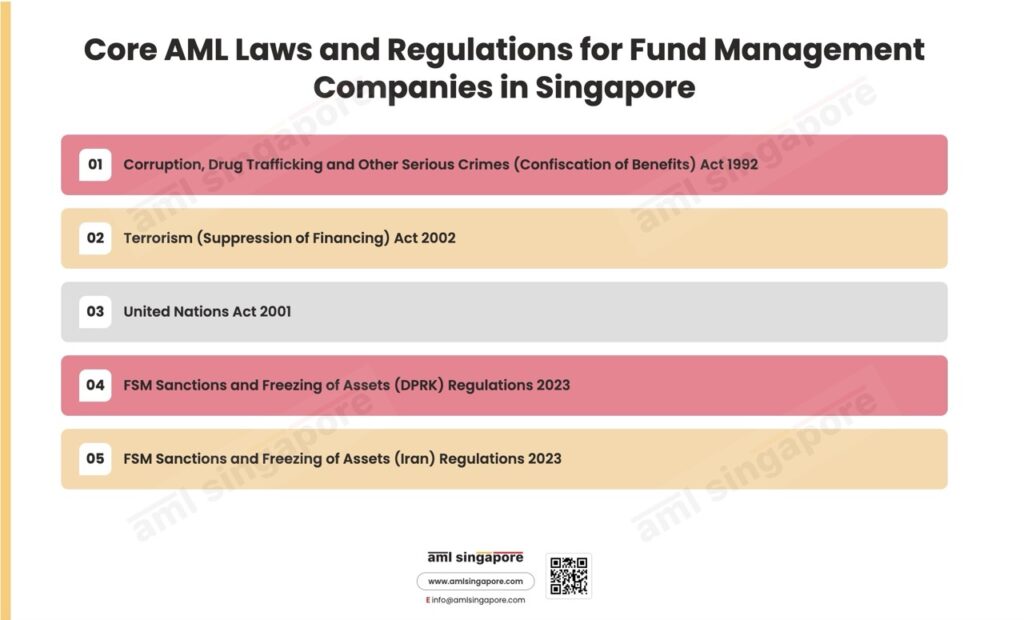
The Corruption, Drug Trafficking and Other Serious Crimes (Confiscation of Benefits) Act 1992
The CDSA establishes Singapore’s money laundering offences, confiscation framework and suspicious transaction reporting regime. Where an FMC knows or has reasonable grounds to suspect that property may represent the proceeds of criminal conduct, the applicable suspicious transaction reporting obligation under the CDSA is triggered. The Act also contains tipping off offences that are relevant when an FMC is handling a suspicious relationship or transaction.
The Terrorism (Suppression of Financing) Act 2002
The Terrorism (Suppression of Financing) Act 2002 establishes offences relating to the financing of terrorism and dealings with terrorist property. For an FMC, the Act is relevant where customer, beneficial ownership or transaction information indicates possible exposure to terrorist property or terrorism financing. The FMC must comply with the applicable reporting, disclosure, freezing and other obligations under Singapore’s terrorism financing and targeted financial sanctions framework.
The United Nations Act 2001
The United Nations Act 2001 provides the statutory framework for giving effect to certain United Nations Security Council measures through subsidiary legislation. For an FMC, the relevant obligations arise from the applicable Singapore sanctions legislation and regulations made under the relevant statutory framework.
The Financial Services and Markets (Sanctions and Freezing of Assets of Persons, Democratic People's Republic of Korea) Regulations 2023
Issued by MAS under the Financial Services and Markets Act 2022, these regulations bring United Nations sanctions on North Korea into force and bind every financial institution, so an FMC is covered. It must freeze a designated person’s assets without delay, must not accept or manage money for them, and must report to MAS, with liability that does not depend on having known that a party was designated.
The Financial Services and Markets (Sanctions and Freezing of Assets of Persons, Iran) Regulations 2023
The Iran regulations, likewise, issued by MAS under the FSM Act 2022, give Security Council Resolution 2231 domestic effect. An FMC must freeze designated persons’ assets and must not provide services that could support proliferation sensitive activity, save for narrow exemptions. The live duty is the screening of the investor and any beneficial owner against the sanctions lists.
Overarching AML Laws and Regulations Applicable to Fund Management Companies in Singapore
These instruments run across the whole regime and give an FMC the practical means to meet its reporting duties and to recognise terrorism financing when it surfaces in a client relationship.
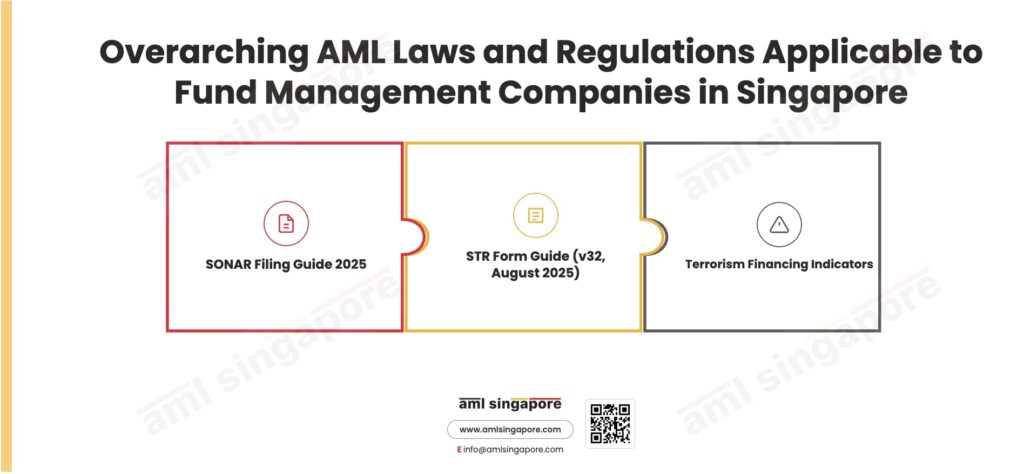
Getting Started with SONAR, for STR Filers (2025)
SONAR is the STRO Online Notices and Reporting platform through which an FMC files its suspicious transaction reports electronically. It takes a filer through registration, user role assignment, and submission. SONAR is the STRO’s electronic reporting platform used by reporting entities to submit suspicious transaction reports. An FMC’s compliance function relies on it to file on time and to keep proof of each report.
Form Guide for the STR Form (Version 12 August 2025)
A part by part guide to completing the current suspicious transaction report form. It sets out what each field requires, from the reporting firm’s particulars to the grounds for suspicion, and it calls for a distinct internal reference on every filing. For an FMC, it is the reference a compliance officer uses to submit a full, well supported report on a suspicious client or transaction.
Terrorism Financing Indicators
A red flag reference from STRO that sorts terrorism financing signals into due diligence anomalies, unusual movement of funds and transactions with no economic purpose. For an FMC, it helps surface terrorism financing in a portfolio, such as a transfer routed through an unconnected third party, and supports the decision to file a terrorism financing report.
National Risk Assessments Applicable to Fund Management Companies in Singapore
Singapore publishes formal assessments of where its money laundering, terrorism financing and proliferation financing risks lie. The national risk assessments provide important national level risk information that an FMC should consider when identifying, assessing and understanding its ML/TF risks under the risk based framework. For this sector, the assessments are reassuring but specific: fund management companies are rated in the lower half of the fund sector, tempered by their institutional client base and their reliance on supervised intermediaries.
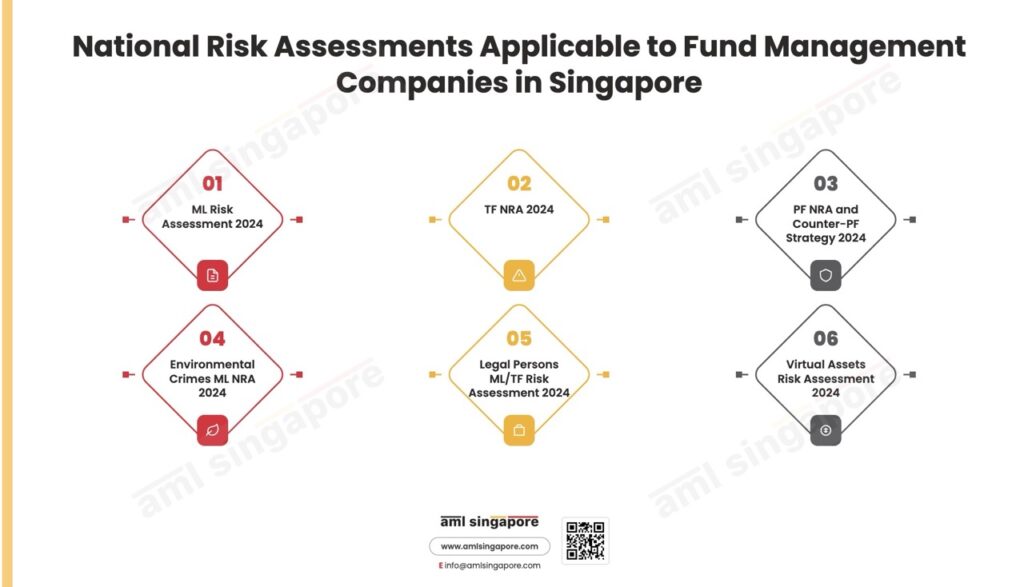
Money Laundering National Risk Assessment Singapore 2024
The national money laundering assessment gives fund management companies, other than external asset managers, their own section and places them in the medium low risk band. It records a moderate threat for money laundering, because fund management could be used to integrate illicit proceeds, although law enforcement has not observed any such misuse in Singapore, and moderate vulnerability to money laundering, as FMCs typically serve accredited or institutional investors, deal in no physical cash, and execute through supervised brokers and banks. An FMC should incorporate these findings into its sector risk assessment.
Terrorism Financing National Risk Assessment 2024
The terrorism financing assessment does not concentrate on fund managers explicitly, but an FMC is not exempt. The Terrorism Financing National Risk Assessment provides national level information on terrorism financing threats, vulnerabilities and typologies. An FMC should consider relevant findings when assessing its own TF risks and designing proportionate controls.
Proliferation Financing National Risk Assessment and Counter PF Strategy 2024
This assessment identifies sanctions evasion, the misuse of legal persons and dual use trade as the foremost proliferation channels. For an FMC, the exposure runs through a corporate client or a complex structure with an opaque owner, which is why beneficial ownership work and sanctions screening are crucial to counter proliferation financing.
Environmental Crimes Money Laundering National Risk Assessment (May 2024)
A review of how the proceeds of environmental crime, from the illegal wildlife trade to illegal logging, are laundered. It does not explicitly rate FMCs, however, its relevance to an FMC arises where a client’s wealth may be derived from such activity. Its relevance to an FMC is primarily risk based, for example where information concerning a customer’s source of wealth or source of funds indicates possible exposure to proceeds of environmental crime.
Money Laundering and Terrorism Financing Risk Assessment of Legal Persons (2024)
This assessment identifies significant ML/TF vulnerabilities associated with legal persons and examines how different types of legal persons may be misused. It matters to an FMC whose investors often invest through companies, trusts and holding vehicles, and it reinforces the duty to look through the structure to identify the natural persons who own or control it.
Virtual Assets (Digital Payment Tokens) Risk Assessment (2024)
This assessment reviews the country’s exposure to virtual asset activity. Its bearing on an FMC depends on the mandate: it bears little on a traditional fund but matters where an investor’s wealth or a fund strategy touches digital payment tokens, in which case that source deserves closer attention.
Fund Management Company Sector ML/TF Risk Snapshot
Money laundering: medium low risk band, because FMCs typically serve accredited or institutional investors and law enforcement has not observed misuse of the sector in Singapore (ML NRA 2024, chapter 7.8).
What tempers the risk: no physical cash, an accredited or institutional client base with low PEP exposure, and trades executed through supervised brokers and banks, which adds a layer of scrutiny (ML NRA 2024, chapter 7.8).
Where risk remains: a large share of assets under management is sourced from outside Singapore, giving some exposure to cross border flows and higher risk jurisdictions (ML NRA 2024, chapter 7.8).
Supervision: MAS has flagged that FMCs should strengthen oversight of outsourced control functions and improve their risk assessments and enhanced due diligence (ML NRA 2024, chapter 7.8).
Sector Specific Guidance Applicable to Fund Management Companies in Singapore
This is the core of an FMC’s obligations. MAS supervises Fund Management Companies and issues the notice and guidance they follow. This section covers the common instruments that apply across financial institutions and the specific instruments written for fund management companies, led by MAS Notice SFA 04 N02 and its Guidelines.
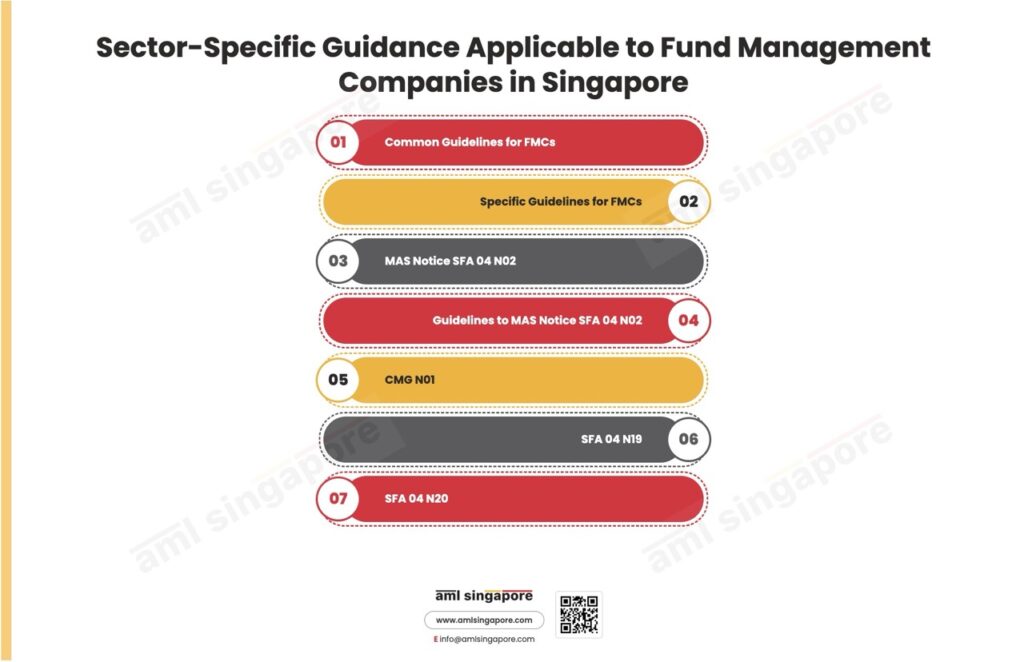
Common Guidelines for Fund Management Companies
These MAS instruments apply across financial institutions and define how an FMC designs its controls. They do not replace Notice SFA 04 N02; they outline MAS’s supervisory expectations on themes such as source of wealth, transaction monitoring, misuse of legal persons, sanctions and audit, several of which bear on a cross border fund business and its outsourcing.
The Financial Services and Markets Act 2022
The Financial Services and Markets Act 2022 (FSMA) forms part of Singapore’s statutory framework for AML/CFT supervision and gives MAS powers relating to the prevention of money laundering and terrorism financing, including powers to issue directions or regulations and, in specified circumstances, to inspect financial institutions. These powers operate alongside the sector specific requirements.
Circular AMLD 01/2018: Use of MyInfo and CDD for Non Face to Face Business Relations
This circular provides guidance on using MyInfo as a verified source of identification information and on CDD measures for non face to face business relations. For an FMC onboarding a customer remotely, MyInfo may assist with identity verification, subject to the firm’s risk based CDD and additional safeguards against impersonation.
Circular AMLD 01/2022: Non Face to Face Customer Due Diligence Measures
This circular sets out MAS’s expectations for managing ML/TF risks arising from non face to face customer due diligence. For an FMC onboarding customers remotely, it is relevant to the use of technology and additional measures needed to address impersonation and verification risks, particularly for higher risk relationships.
Circular AMLD 02/2023: ML/TF Risks in the Wealth Management Sector
This circular addresses ML/TF risks in the wealth management sector and is relevant to an FMC whose business involves high net worth customers, private wealth structures or similar activities. It highlights expectations concerning governance, CDD and the identification of beneficial owners behind complex structures.
Circular AMLD 08/2024: Establishing the Sources of Wealth of Customers
This circular provides guidance on establishing the source of wealth of customers and their beneficial owners. For an FMC, it is particularly relevant to higher risk or material relationships and emphasises a risk based approach using the principles of materiality, prudence and relevance, with appropriate escalation where the source of wealth cannot be adequately established.
Circular AMLD 05/2026: Risk Proportionate Source of Wealth Establishment
This 2026 circular provides further guidance on establishing source of wealth in a risk proportionate manner. It emphasises effective and efficient processes and the application of materiality and relevance so that SOW checks are proportionate to the customer’s ML/TF risk.
Circular AMLD 11/2023: Ensuring Effective Detection of Sanctions Related Risks
This circular sets out MAS’s supervisory expectations for financial institutions to maintain effective controls to detect and manage sanctions related risks, including risks arising from sanctions imposed by other jurisdictions. The board sets the risk appetite, and the circular describes a lookback review once a party is designated. For an FMC, the practical effect is disciplined screening of clients and their beneficial owners, and a review of live mandates when a name is listed.
Circular AMLD 12/2024: Audit of AML/CFT Policies, Procedures and Controls
This circular sets out MAS’s expectations for the independent audit of AML/CFT policies, procedures and controls. For an FMC, the audit function should independently assess the effectiveness of its AML/CFT framework, including relevant outsourced arrangements, using an appropriately risk based approach.
Strengthening AML/CFT Controls on Misuse of Legal Persons and Complex Structures (August 2023)
This MAS supervisory paper highlights risks arising from the misuse of legal persons and complex structures. It is relevant to FMCs where customers or investment structures involve companies, trusts or other layered arrangements, and can be used as a supervisory reference when assessing beneficial ownership and control procedures.
AML/CFT Supervisory Expectations from Recent Inspections (October 2024)
This MAS supervisory paper summarises observations and expectations arising from recent AML/CFT inspections. Its themes are relevant to FMCs when reviewing customer risk assessment, documentation, source of wealth verification, escalation and information sharing arrangements.
Best Practices in Relation to Risks in Wealth Management (May 2025)
This MAS paper provides industry best practices concerning ML/TF risks in wealth management. It is particularly relevant to an FMC whose business involves high net worth customers, private investment structures, trusts or complex ownership arrangements.
Effective Practices to Detect and Mitigate the Risk from Misuse of Legal Persons (June 2019)
This MAS paper provides good practice measures for identifying and mitigating risks arising from the misuse of legal persons, including risk indicators, network analysis and staff training. It is relevant to FMCs dealing with customers or structures involving corporate vehicles and can support a risk based assessment of beneficial ownership and control.
Guidance for Effective AML/CFT Transaction Monitoring Controls (September 2018)
This MAS guidance sets out effective practices for AML/CFT transaction monitoring. For an FMC, the principles can be applied to the transaction and activity patterns relevant to its business, including subscriptions, redemptions, investment transactions and relevant cross border activity.
Guidance to Capital Markets Intermediaries on Enhancing AML/CFT Frameworks and Controls (January 2019)
This MAS guidance is directed at capital markets intermediaries and is directly relevant to FMCs operating as capital markets intermediaries. It sets out MAS’s supervisory expectations concerning governance, the three lines of defence and the resourcing and effectiveness of AML/CFT frameworks. It should be read alongside, rather than treated as a substitute for, the binding requirements in SFA 04 N02.
Guidelines on Risk Management Practices, Internal Controls (July 2024)
This MAS guideline provides broader expectations for internal controls and risk management. For an FMC, it provides supporting control infrastructure around the AML/CFT framework, including governance, segregation of duties, management oversight and control processes. The detailed AML/CFT requirements remain in the applicable AML/CFT Notices and related guidance.
Guidelines on Provision of Digital Advisory Services (October 2018)
This guideline is relevant to an FMC only where it provides digital advisory services within its scope. In that context, it addresses risks associated with online and non face to face business models, including impersonation risk.
Sound Practices to Counter Proliferation Financing (August 2018)
Drawing on MAS’s thematic reviews, this paper deals with proliferation financing tied to DPRK and Iran sanctions evasion. It sets out how firms should strengthen controls, watch higher risk investors and counterparties, and identify typologies such as shell companies with nominee directors. Although this paper arose from MAS’s thematic supervisory work with banks, it provides useful PF risk management practices for financial institutions more broadly. An FMC can use it as a supplementary reference when assessing proliferation financing and sanctions evasion risks relevant to its customers, counterparties and investment structures.
Strengthening Financial Institutions' CFT Controls (May 2023)
This paper sets out MAS’s observations and supervisory expectations concerning CFT controls, including screening, escalation and reporting. An FMC can use these expectations to assess and strengthen its CFT framework, particularly its controls for identifying designated persons and responding appropriately to relevant risks.
Specific Guidelines for Fund Management Companies
These are the principal MAS instruments relevant to a fund management company operating as a capital markets intermediary. MAS Notice SFA 04 N02 and the Guidelines to the Notice form the core AML/CFT framework for an FMC and are covered in detail below. The Guidelines on Licensing and Conduct of Business for Fund Management Companies (SFA 04 G05) sit alongside this AML/CFT framework, while other MAS notices may apply depending on the FMC’s activities and circumstances, including specified cross border arrangements.
MAS Notice SFA 04 N02 on Prevention of Money Laundering and Countering the Financing of Terrorism
Notice SFA 04 N02 is the binding AML/CFT notice applicable to capital markets intermediaries within its scope, including FMCs holding a capital markets services licence for fund management. The revised Notice took effect on 1 July 2025. The 2025 amendments also incorporated proliferation financing considerations into the framework. For an FMC, the relevant customer and connected parties must be identified according to the nature and structure of the relationship, including where investment or fund structures involve legal persons, trusts or other intermediaries.
The Notice requires a capital markets intermediary to identify, assess and understand its ML/TF risks and to apply a risk based approach to managing those risks. For an FMC, this assessment should take account of relevant customer, product, service, delivery channel and geographical risks. The framework also requires firms to assess the ML/TF risks associated with new products, practices and technologies before they are introduced.
Customer due diligence is a central part of the Notice. An FMC must conduct customer due diligence when establishing a business relationship and in the other circumstances specified by the Notice, including where there is a suspicion of ML/TF or where the firm has doubts about previously obtained customer identification information. An FMC must perform customer due diligence when it establishes business relations, when it suspects money laundering or terrorism financing, or when it doubts information, it holds. It must identify and verify the investor from reliable, independent sources, identify any person acting for the investor, identify the connected parties of a corporate investor, and identify and verify beneficial owners through cascading steps of ownership, then control, then senior management, using the benchmark of a natural person who owns more than 25% of an entity.
The Notice then scales the work to risk. Simplified due diligence is available only where risk is demonstrably low. Enhanced due diligence is mandatory for politically exposed persons, less common in an institutional book but still to be caught where an investor or a beneficial owner is one, requiring senior approval, establishment of source of wealth and source of funds and closer monitoring, and for other higher risk situations, including investors or structures connected to jurisdictions the FATF has called out. An FMC may rely on a qualifying third party for elements of due diligence but keeps responsibility for its own compliance, and a chapter on correspondent accounts governs the added checks for such relationships. The Notice also contains provisions concerning other AML/CFT measures whose applicability depends on the nature of the CMI’s activities and relationships.
The remaining paragraphs complete the framework. Records must be kept for at least five years. The Notice also contains provisions concerning the handling and disclosure of personal data in connection with AML/CFT compliance. Suspicions go to the Suspicious Transaction Reporting Office through a single internal reference point, mindful of the tipping off offence in section 57 of the CDSA, and the FMC must maintain internal policies, a group policy where it is part of a financial group, an AML/CFT compliance officer, an independent audit function and regular training.
Guidelines to MAS Notice SFA 04 N02 (the primary guidance for capital markets intermediaries)
The Guidelines to Notice SFA 04 N02 are the primary guidance an FMC works with, and they are given the fullest treatment here. They are dated July 2025, and their chapters mirror the paragraphs of the Notice, so an FMC can read each obligation beside its explanation. They are guidance and not binding rules, yet MAS makes clear that how far a firm observes them can feed into its overall view of the firm, so in practice they are the benchmark an FMC is measured against.
The Guidelines begin with the risk profile of a capital markets intermediary and lay down the accountability model, in which the board and senior management answer for AML/CFT effectiveness, backed by the three lines of defence. For an FMC, the emphasis falls on the risks MAS has stressed for the sector: cross border and foreign sourced assets, complex fund and ownership structures, and the oversight of any outsourced control functions, and the Guidelines confirm that proliferation financing is treated as part of money laundering throughout.
On the risk based approach, an FMC must assess its money laundering and terrorism financing risk on an enterprise wide basis, taking in its client types, its products and strategies, its distribution and its geographies, and including overseas operations where it is part of a group. The enterprise wide assessment must be signed off by senior management, should blend qualitative and quantitative analysis, must incorporate the findings of Singapore’s national risk assessments, and should be refreshed on a material change, a point MAS has singled out for the sector.
The customer due diligence chapter explains the identification and verification of customers, persons acting on their behalf, connected parties and beneficial owners. For legal persons and arrangements, it sets out the applicable ownership, control and senior management tests. The Guidelines also address non face to face relationships and the additional controls that may be appropriate where customers are onboarded remotely. Where relevant AML/CFT functions are outsourced, the FMC remains responsible for ensuring that the arrangements are appropriately governed and that its regulatory obligations continue to be met.
The enhanced due diligence chapter identifies who is a politically exposed person under the FATF standard and pulls apart two ideas that are easily blurred, source of wealth and source of funds: source of wealth is the origin of the investor’s entire wealth, while source of funds is the origin of the money in a particular subscription or transaction. For an FMC serving accredited and institutional investors, this is applied proportionately: the FMC should corroborate source of wealth in proportion to risk and apply enhanced due diligence where a PEP, a complex structure, a high risk jurisdiction or an unusually large flow warrants it, with senior approval and closer monitoring.
The remaining chapters address reliance, correspondent relationships, record keeping, suspicious transaction reporting, compliance arrangements, audit and training. The Guidelines also explain the AML/CFT implications of proliferation financing risk and the need for appropriate controls relating to targeted financial sanctions, including screening and the implementation of applicable freezing obligations. The Guidelines consistently emphasise that reliance or outsourcing does not remove the firm’s responsibility for meeting its AML/CFT obligations.
Two themes are particularly relevant to an FMC. The first is ongoing monitoring: the firm must maintain appropriate customer information and apply ongoing monitoring proportionate to the relationship’s risk, investigating activity that is inconsistent with its understanding of the customer or expected activity. The second is governance and outsourcing: responsibility for AML/CFT compliance remains with the FMC even where functions are performed by an external service provider. The firm’s governance framework should therefore provide appropriate oversight, testing and escalation of outsourced arrangements.
MAS Notice CMG N01 (Reporting of Suspicious Activities and Incidents of Fraud)
This notice requires entities within its scope, including relevant capital markets services licensees, to report to MAS suspicious activities and incidents of fraud that are material to the entity’s safety, soundness or reputation. This regulatory report is separate from, and in addition to, the suspicious transaction report that an FMC may be required to file with the Suspicious Transaction Reporting Office under the AML/CFT regime.
MAS Notices SFA 04 N19 and SFA 04 N20 (Cross Border Arrangements)
These cross border notices apply only where the relevant conditions and specified persons fall within the applicable Securities and Futures cross border exemption framework. SFA 04 N19 addresses qualifying arrangements involving foreign related corporations, while SFA 04 N20 addresses qualifying arrangements involving foreign offices. Where applicable, the notices impose requirements relating to customer due diligence records, controls over the cross border arrangement and the provision of relevant records or information to MAS. They should therefore be treated as conditional requirements rather than as core AML/CFT requirements applicable to every FMC.
What Keeps a Fund Management Company at Medium Low Risk
The sector sits in the lower half of the fund industry’s risk because of who it serves and how it operates. The table below sets out the features MAS points to.
Feature | Why it keeps a fund management company at medium low risk |
Client base | FMCs typically serve accredited or institutional investors, and foreign financial institutions with their own AML/CFT duties, so PEP exposure is comparatively low |
No physical cash | FMC activities do not typically involve physical cash. Customers generally transfer funds from existing bank accounts to the fund’s account for management by the FMC |
Execution through banks | FMCs typically place trades with brokers or banks that are subject to AML/CFT requirements and supervision. This provides an additional layer of AML/CFT supervision and requirements over customers and their transactions |
Retail distribution | Funds managed by FMCs are made available to retail investors, they are typically sold through MAS regulated financial institutions, which are subject to AML/CFT requirements |
The residual risk | A large share of assets under management is sourced from abroad, creating exposure to cross border flows and customers from other countries, including higher ML risk jurisdictions. |
Allied Laws and Guideline Applicable to Fund Management Companies in Singapore
These statutes, subsidiary legislation and guidelines are not all AML/CFT instruments, but they form part of the wider regulatory framework within which an FMC operates. The Securities and Futures Act and its subsidiary legislation govern the licensing and conduct of the sector, while other legislation establishes offences, investigative powers and targeted financial sanctions or proliferation related controls that may be relevant to an FMC’s AML/CFT/CPF framework.
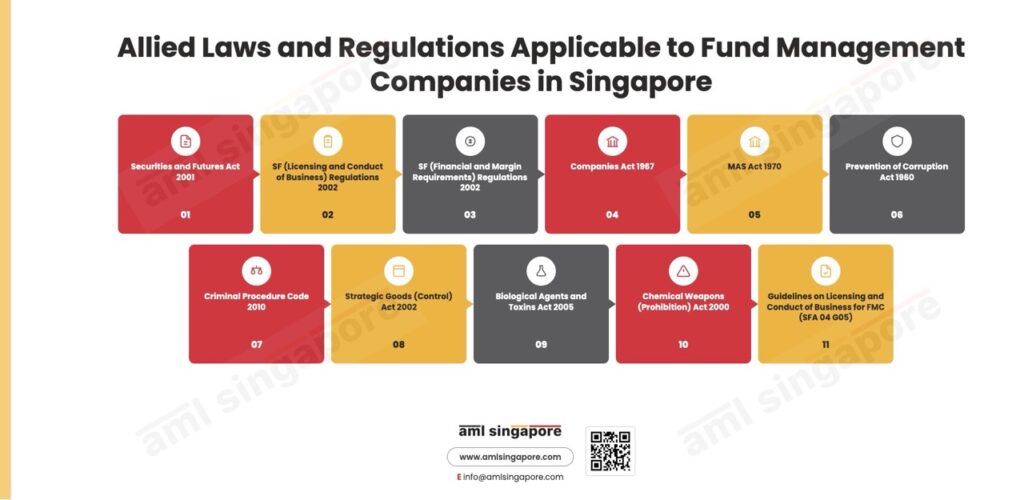
The Securities and Futures Act 2001
The statute that licenses the sector. An FMC carrying on fund management generally requires a capital markets services licence under the SFA, unless an applicable exemption applies. The SFA establishes the statutory framework for regulating fund management, including the licensing requirement and applicable exemptions.
The Securities and Futures (Licensing and Conduct of Business) Regulations 2002
These regulations are subsidiary legislation under the SFA that prescribe requirements relating to licensing and the conduct of business by capital markets intermediaries. They form part of the regulatory framework governing an FMC’s operations and sit alongside the specific AML/CFT requirements imposed by MAS Notice SFA 04 N02.
The Securities and Futures (Financial and Margin Requirements) Regulations 2002
These regulations prescribe financial resource and margin requirements applicable to relevant capital markets intermediaries. They are prudential rather than AML/CFT requirements, but form part of the regulatory framework governing the financial resources and ongoing operations of an FMC.
The Companies Act 1967
The Companies Act 1967 establishes Singapore’s corporate law framework and includes requirements relating to the maintenance of information on registrable controllers. For an FMC, such information can be an important source when identifying and verifying the beneficial owners and controllers of a corporate customer. However, an FMC should apply the customer due diligence requirements under the applicable AML/CFT framework and should not treat information obtained from a corporate register as automatically sufficient without appropriate verification.
The Monetary Authority of Singapore Act 1970
The Monetary Authority of Singapore Act 1970 establishes MAS and sets out its statutory functions and powers as Singapore’s central bank and integrated financial regulator. It forms part of the institutional framework under which MAS supervises financial institutions, including fund management companies. The specific statutory authority for individual regulatory requirements, including AML/CFT notices, should be read from the legislation under which the relevant notice is issued.
The Prevention of Corruption Act 1960
The Prevention of Corruption Act 1960 is Singapore’s principal legislation criminalising corruption. Corruption can generate proceeds that become relevant to money laundering risk. For an FMC, this is relevant where the source of a customer’s wealth or funds may be connected to corruption, particularly when assessing higher risk customers, PEPs and complex ownership structures.
The Criminal Procedure Code 2010
The Criminal Procedure Code 2010 provides the general procedural framework for criminal investigations, including investigative powers relating to the production, search and seizure of evidence. Where an FMC receives a lawful request, order or direction from a competent authority concerning customer or fund records, it may be required to produce the relevant information. Any confidentiality or tipping off considerations should be assessed under the applicable legislation and AML/CFT requirements.
The Strategic Goods (Control) Act 2002
The Strategic Goods (Control) Act 2002 regulates the transfer, brokering and certain other activities involving strategic goods, including goods with potential military or dual use applications. It is relevant to Singapore’s wider proliferation control framework. For an FMC, the Act may provide contextual information when assessing customers or transactions connected with strategic goods or high risk trade, but an FMC’s proliferation financing and targeted financial sanctions obligations arise primarily from the applicable Singapore AML/CFT/CPF and sanctions framework.
The Biological Agents and Toxins Act 2005
The Biological Agents and Toxins Act 2005 regulates specified biological agents and toxins and controls activities involving them. It forms part of Singapore’s broader framework for preventing the misuse of biological materials. For an FMC, the legislation is relevant as contextual background when assessing proliferation financing risks, but it should not be presented as a direct AML/CFT screening requirement applicable to every FMC.
The Chemical Weapons (Prohibition) Act 2000
The Chemical Weapons (Prohibition) Act 2000 implements Singapore’s obligations under the Chemical Weapons Convention and regulates activities involving chemical weapons and related prohibited conduct. It forms part of Singapore’s broader counter proliferation framework. For an FMC, its relevance is primarily contextual to proliferation financing risk and the wider targeted financial sanctions framework rather than as a standalone AML/CFT screening obligation.
Guidelines on Licensing and Conduct of Business for Fund Management Companies (SFA 04 G05)
These guidelines set out requirements for the licensing and conduct of fund management companies, including matters relating to competence, custody, valuation, conflicts of interest and the oversight of outsourced functions. They are not an AML/CFT notice. Instead, they provide the broader licensing and conduct framework within which an FMC operates, alongside the AML/CFT requirements set out in MAS Notice SFA 04 N02 for a FMC.
Miscellaneous Laws and Regulations Applicable to Fund Management Companies in Singapore
These national strategies, risk assessments, committee reports and typology papers provide context for Singapore’s AML/CFT/CPF framework and help financial institutions understand emerging risks and typologies. They are not, by themselves, binding requirements on an FMC, but they may inform risk assessments, supervisory priorities and the design of proportionate controls.
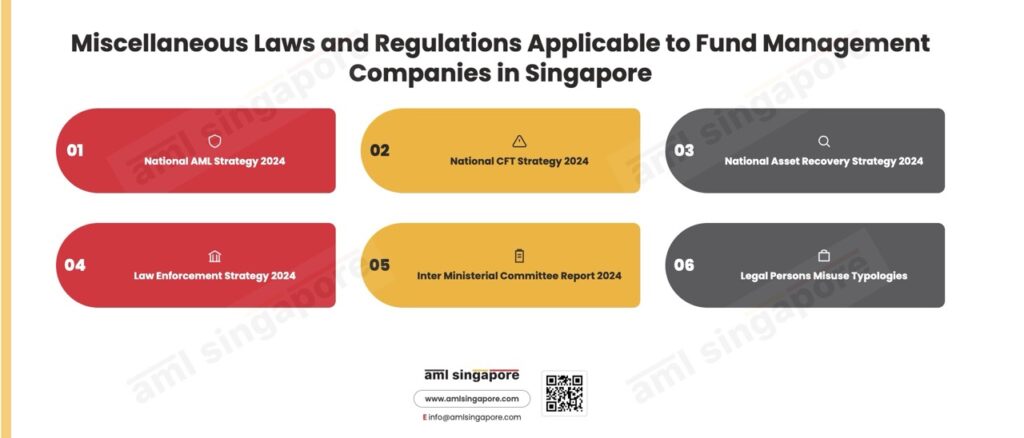
National Anti Money Laundering Strategy 2024
Singapore’s National Anti Money Laundering Strategy sets out the country’s strategic approach to addressing money laundering risks through risk targeted and proportionate measures. For an FMC, the strategy provides national level context for the risk based approach, preventive measures, beneficial ownership transparency and other controls that underpin the wider AML framework.
National Strategy for Countering the Financing of Terrorism 2024
Singapore’s National Strategy for Countering the Financing of Terrorism sets out the country’s strategic approach to identifying, preventing, detecting and disrupting terrorism financing. It provides national level context for the CFT controls and risk based measures that financial institutions, including FMCs, operate within.
National Asset Recovery Strategy 2024
Singapore’s National Asset Recovery Strategy sets out the country’s approach to tracing, freezing, seizing and confiscating criminal assets. For an FMC, it provides context for the broader asset recovery framework and the cooperation that financial institutions may be required to provide to competent authorities in relation to criminal property and investigations.
Singapore Law Enforcement Strategy to Combat Money Laundering (October 2024)
This strategy sets out the law enforcement agencies’ priorities and approach to combating money laundering, including investigation, asset recovery and inter agency cooperation. It provides context for the enforcement environment in which financial institutions operate and highlights the importance of timely information sharing and reporting.
Inter Ministerial Committee on Anti Money Laundering Report (October 2024)
The Inter Ministerial Committee on AML report examines measures to strengthen Singapore’s AML framework following the major money laundering case. Its recommendations include measures concerning the misuse of legal persons, gatekeepers, information sharing and supervisory effectiveness. The report provides useful context for FMCs dealing with complex ownership structures and cross border customers.
Legal Persons: Misuse Typologies and Best Practices (2018)
This typologies paper examines how legal persons can be misused for money laundering and other illicit purposes. It provides useful red flags for an FMC when assessing the ownership and control structures of corporate customers, investment vehicles and other legal persons connected to a customer relationship.
International Standards Applicable to Fund Management Companies in Singapore
Singapore’s AML/CFT/CPF framework is informed by the FATF Recommendations and related guidance. These international standards do not directly impose Singapore law obligations on an FMC. Instead, they provide the international framework against which Singapore develops and evaluates its domestic AML/CFT/CPF regime. They are useful for understanding the policy rationale, risk based approach and typologies underlying Singapore’s requirements.
The FATF Recommendations (updated June 2026)
The FATF Recommendations provide the international standards for combating money laundering, terrorist financing and proliferation financing. They cover areas relevant to an FMC, including customer due diligence, beneficial ownership, politically exposed persons, reliance on third parties, internal controls, suspicious transaction reporting and proliferation financing controls. They are international standards rather than directly applicable Singapore law. The Recommendations were last updated in June 2026.
Mutual Evaluation Report of Singapore (May 2026)
The 2026 FATF/APG Mutual Evaluation Report assesses the effectiveness of Singapore’s AML/CFT/CPF framework and its level of compliance with the FATF Recommendations. It provides an important current assessment of Singapore’s national framework, including supervision, preventive measures, beneficial ownership, financial intelligence, asset recovery and proliferation financing controls. It should be used as contextual material rather than as a source of direct obligations for an FMC.
Methodology for Assessing Technical Compliance and Effectiveness (updated June 2026)
The FATF Methodology provides the framework used by assessors to evaluate countries’ technical compliance with the FATF Recommendations and the effectiveness of their AML/CFT/CPF systems. It is an assessment methodology rather than a set of rules that directly binds an FMC. It helps explain how Singapore’s AML/CFT/CPF framework is assessed at the national level.
FATF Guidance on Politically Exposed Persons (Recommendations 12 and 22, 2013)
This guidance explains the FATF approach to identifying and managing risks associated with politically exposed persons, including measures concerning senior management approval, source of wealth and source of funds and enhanced ongoing monitoring. This guidance explains the FATF approach to PEP risks, particularly Recommendation 12 as it applies to financial institutions. For an FMC, it provides international guidance on identifying PEPs and applying appropriate enhanced measures.
Guidance on Beneficial Ownership of Legal Persons (March 2023)
Guidance issued under the revised Recommendation 24 on how to obtain and verify beneficial ownership information, central to an FMC whose clients invest through companies and holding vehicles.
Best Practices on Beneficial Ownership for Legal Persons (October 2019)
A collection of country best practices for keeping beneficial ownership information adequate, accurate and up to date, backing an FMC’s use of registries and multiple sources when it identifies the controllers of a client’s structure.
Concealment of Beneficial Ownership (July 2018)
A joint FATF and Egmont Group typologies report on how criminals hide beneficial ownership through intermediaries and structures, giving an FMC the red flags to detect concealment behind a wealthy client’s vehicles.
Risk Based Approach: Beneficial Ownership and Transparency of Legal Arrangements (March 2024)
Guidance focused on Recommendation 25 and trusts and similar arrangements, directly relevant to an FMC, since so much private wealth is held through trusts and foundations.
FATF Guidance on Counter Proliferation Financing (February 2018)
This guidance explains the financial measures associated with United Nations Security Council resolutions addressing the proliferation of weapons of mass destruction. For an FMC, it provides international context for understanding proliferation financing risks and targeted financial sanctions. The applicable screening, freezing and reporting obligations arise from Singapore’s domestic laws and regulations implementing the relevant sanctions requirements.
Guidance on Proliferation Financing Risk Assessment and Mitigation (June 2021)
This guidance explains how financial institutions and other relevant private sector entities can assess and mitigate proliferation financing risks using a risk based approach. It is useful supplementary guidance for an FMC when developing its PF risk assessment and controls, but does not itself create Singapore law obligations.
Guidance on Digital Identity (March 2020)
Helps an FMC judge whether a digital identity system is reliable and independent enough for customer due diligence under a risk based approach, a live question where a wealthy client is onboarded remotely across borders.
Artificial Intelligence and Deepfakes: Impacts on ML/TF/PF
A forward looking FATF scan of how artificial intelligence and deepfakes put preventive systems at risk, for example synthetic identities defeating the remote onboarding of an investor, alongside AI’s uses in screening and monitoring.
Money Laundering from Environmental Crime (July 2021)
A FATF study of the ways proceeds of environmental crime pass through the financial system. Its relevance to an FMC arises where a customer’s source of wealth or source of funds may be connected to proceeds of environmental crime such as illegal logging, mining or waste.
Trade Based Money Laundering, Private Sector Handout
A brief FATF reference on the trade based money laundering typologies a private sector firm should know, such as mis invoicing and phantom shipments. It provides useful typological context for an FMC assessing customers whose businesses involve significant cross border trade.
Summary of Key Instruments
The table below distils the instruments a fund management company relies on most, what type each is, whom it binds, and the core obligation it places on the manager. A quick reference to keep by you, not a replacement for the fuller sections above.
Instrument | Type | Binds | Core obligation for an FMC |
CDSA 1992 | Statute | Everyone | Report suspected criminal proceeds; do not tip off |
TSOFA 2002 | Statute | Everyone | Do not deal in terrorist property; screen and report |
FSM sanctions regulations (DPRK, Iran) | Regulations | All FIs | Freeze designated persons’ assets without delay |
MAS Notice SFA 04 N02 | Notice (binding) | CMS licensees | Risk based CDD, source of wealth, records, STR |
Guidelines to Notice SFA 04 N02 | Guidelines | CMS licensees | Primary guidance; how to meet the Notice |
CMG N01, SFA 04 G05 | Notice/Guidelines | FMCs | Fraud reporting; licensing and conduct of an FMC |
Securities and Futures Act 2001 | Statute | FMCs | Licence the FMC; define fund management |
FATF Recommendations | Standard | Countries/FIs | The global standard behind the domestic rules |
Conclusion
For a fund management company in Singapore, the anti money laundering framework is real but proportionate, because the sector serves largely accredited and institutional investors and deals in no physical cash. The criminal statutes make laundering and terrorism financing offences and require suspicions to be reported; the sanctions regulations require designated parties to be screened out; and Notice SFA 04 N02 with its Guidelines turns all of this into a working system of risk based due diligence on investors, enhanced measures for higher risk situations, and suspicious transaction reporting. Because so much money is sourced from abroad and so many controls can be outsourced, an FMC’s framework stands on identifying its investors and overseeing whatever it delegates.
The instruments interlock. An FMC’s enterprise wide risk assessment, an area MAS has flagged, draws on the national risk assessments; its due diligence flows from Notice SFA 04 N02 and its Guidelines; its licence and conduct rules come from the Securities and Futures Act and the licensing guidelines; and its sanctions and proliferation controls draw on the FSM Act sanctions regulations and the FATF standards. Seeing how the pieces connect, and keeping a firm hand on outsourced controls, is what lets an FMC defend its framework to a supervisor watching the sector closely.
A fund management company is licensed under the same capital markets regime, so MAS Notice SFA 04 N02 is its crux too, and our companion guides show how that shared Notice applies to capital markets services licensees and to external asset managers.
Frequently Asked Questions
MAS Notice SFA 04 N02 is the anti money laundering and countering the financing of terrorism notice for capital markets intermediaries, within its scope, including fund management companies carrying on fund management as a regulated activity. It sets out the AML/CFT requirements that FMCs must comply with and is read together with the Guidelines to MAS Notice SFA 04 N02, which guide implementing those requirements.
A fund management company provides advisory and/or discretionary fund management services to its customers. In the case of discretionary management, the FMC may also place trades with relevant brokers or banks to implement the investment strategies of the funds it manages. FMCs typically serve accredited or institutional investors, although funds managed by FMCs may also be made available to retail investors through MAS regulated distributors such as banks, financial advisers and insurance companies.
Singapore’s 2024 Money Laundering National Risk Assessment places fund management companies, excluding external asset managers, in the medium low ML risk category. FMCs typically serve accredited or institutional investors, have relatively low exposure to higher risk customers such as PEPs, do not typically handle physical cash, and generally execute trades through brokers or banks that are subject to AML/CFT requirements and supervision. The sector’s residual vulnerabilities arise mainly from assets and funds sourced from outside Singapore and exposure to customers from other countries, including higher ML risk jurisdictions.
An FMC may outsource certain AML/CFT activities or functions, but outsourcing does not remove the FMC’s responsibility for complying with its AML/CFT obligations. The FMC should maintain appropriate oversight of the outsourced arrangement and ensure that its AML/CFT framework remains effective. MAS has issued guidance specifically addressing capital market intermediaries’ oversight of AML/CFT outsourcing arrangements.
Two things: sound customer due diligence on its investors, including beneficial-ownership work that looks through fund and corporate structures, and firm oversight of any control function it outsources. Because the client base is largely institutional and no cash changes hands, these, rather than cash handling, are where MAS focuses and where it has told the sector there is room to improve.
An FMC must file a suspicious transaction report when the applicable legal requirements for reporting a suspicious transaction are triggered, including where it has reasonable grounds to suspect that property may relate to criminal activity, money laundering or terrorism financing. The report is submitted to the Suspicious Transaction Reporting Office (STRO) within the applicable statutory timeframe. Separate and potentially more immediate obligations may apply where designated or sanctioned persons or property are involved. The FMC must also comply with applicable prohibitions on tipping off. Our guide to STR red flags explains common triggers.
About the Author

Pathik Shah
FCA, CAMS, CISA, CS, DISA (ICAI), FAFP (ICAI)
Pathik is a Chartered Accountant with more than 26 years of experience in governance, risk, and compliance. He helps companies with end-to-end AML compliance services, from conducting Enterprise- Wide Risk Assessments to implementing the robust AML Compliance framework. He has played a pivotal role as a functional expert in developing and implementing RegTech solutions for streamlined compliance.